

Drawings and documents
National Archives restored drawings: drawing
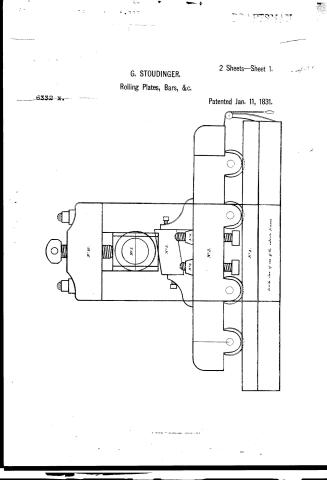
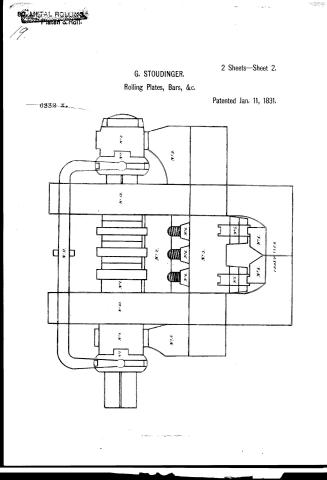
George Stoudinger's Patent Drawing for a Machine for Edging and Drawing Steel Points


National Archives, Restored Patent Drawings (Record Group 241) · Full-size scan at the National Archives · Catalog record
Show the text on the drawing Hide (142 words)
Words on the drawing as machine-read by the National Archives; not checked. Useful mainly for searching.
Sheet 1. CLASSIFICATION / GEORGE STOUDINGER'S / 6332X / 2 Sheets Shut.20 / at / IVISION. / MACHINE FOR EDGING, AND DRAWING STEEL POINTS, / Patented 11ᵗʰ January, 1831. / Scale, one quarter to the inch. / N°10. / Newark, N.J. December 20th.1830. / George Stoudinger. / №1 / №2. / N°6 / N.°.6. / N°3. / №4. / Inside view of one of the outside frumes.
Sheet 2. RK / LING. / Sheets S) / Plants, Bar / of / GEORGE ST / NGER / MATUN / 6332X / MACHINE FOR FROTNG AND WING STEEL POINTS. / DIVISION. / Scale, one quartor to the inch. / Patented 11th January, 1831. / N°.11. / No7. / No. / №10. / N°1. / №10. / No7. / N.°. / N.°2. / 1 Roller, like N.°1. / 1 Die, like N.° 2. / N°..9. / N.°. / 1 Carriage, like N°3. / No. / №6. / №6. / 2 Bearings, like No.. 4. / 8 Rollers, like No.s 5. / N°3. / 6 Screws, like No. 6. / 2 Coupli Nos 7. / 2 Cog. wheels, like N°8. / No5. / No.5. / 2 Racks, like No. I. / 2 Frames, like No... 10. / N.°4. / N.4. / 1 Lever, like N°.11. / FRONT VIEW.
USPTO scan
The patent as scanned by the USPTO
-
 Page 1
-
 Page 2
-
 Page 3
-
 Page 4


U.S. Patent and Trademark Office · Google Patents
Show the transcription Hide (598 words)
Machine transcription (LightOnOCR) of the pages as scanned by the USPTO, most of them the handwritten copies made when the records were restored after the 1836 fire. Not checked; it can misread handwriting, so compare it with the scan.
Page 1.
G. STOUDINGER.
Rolling Plates, Bars, &c.
6332 X.
2 Sheets—Sheet 1.
Patented Jan. 11, 1831.

Page 2.
80 METAL ROLLING
Platen & Roll.
19.
G. STOUDINGER.
Rolling Plates, Bars, &c.
2 Sheets—Sheet 2.
Patented Jan. 11, 1831.
6332 X.

Page 3.
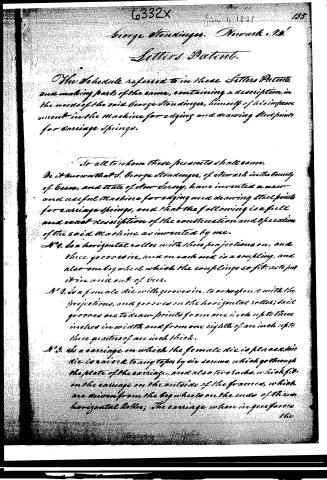
George Stoudinger. Newark, N.J.
Letters Patent.
The Schedule referred to in these Letters Patent, and making part of the same, containing a description, in the words of the said George Stoudinger, himself of his improvement in the machine for edging and drawing steel points for carriage springs.
To all to whom these presents shall come,
Be it known that I, George Stoudinger, of Newark in the county of Essex, and state of New Jersey, have invented a new and useful Machine for edging and drawing steel points for carriage springs, and that the following is a full and exact description of the construction and operation of the said Machine as invented by me.
No. 1. Is a horizontal roller with three projections on, and three grooves in, and on each end is a coupling, and also one big wheel which the couplings so fit as to put it in and out of gear.
No. 2. Is a female die with grooves in, to correspond with the projections, and grooves on the horizontal roller; said grooves are to draw points from one inch up to three inches in width and from one eighth of an inch up to three quarters of an inch thick.
No. 3. Is a carriage on which the female die is placed and die is raised to any taper by six screws, which go through the plate of the carriage, and also two blocks, which fit on the carriage on the outside of the frames, which are driven from the big wheels on the ends of the horizontal roller; The carriage when in position
Page 4.
the point of the plate through, and by putting it out of gear it runs back by weights or a spring attached to the back part of the carriage, said carriage has eight wheels under it with grooves in them, to correspond with the track on which they run.
N. 4. are two bearings on which number three runs.
N. 5. are wheels which fit on under number three.
N. 6. are screws which raise the female die to any taper.
N. 7. are couplings which fit in cog wheels, number eight.
N. 8. are cog wheels which fit in racks to force the carriage forward.
N. 9. are backs which fit on the outside of the carriage.
N. 10. are frames in which the horizontal roller works.
N. 11. is a lever - to put the couplings in and out of gear; said points are drawn by pulling the plate between the horizontal rollers; and the female die, in the first place edge the point down a little, and then put it in the grooves of the female die, and put machine in gear which moves the carriage along, and forces the plate to a point.
The drawings on a scale of one quarter to the inch, accompany this specification, and are hereby referred to. Said machine is all cast iron, except the screws.
To which specification, I have hereunto subscribed my name, in the presence of two witnesses, the twentieth day of December in the year of our Lord, one thousand eight hundred and thirty.
Witnesses
Wm. Bunnington
Mrs. Worts
George Stenninger
Published accounts: journal notice
Notice in the monthly list of patents, with remarks
Journal of the Franklin Institute, new ser., vol. 7 (1831), p. 304 · View the page
15. For a Machine for edging and drawing Steel Points for Carriage Springs; George Stoudinger, Newark, Essex county, New Jersey, January 11.
Remarks. A female die is to be formed, consisting of a steel roller, running as a flatting mill roller, and hollowed out in such a way as to suit the point to be drawn. Below this roller is a bed, which advances upon a carriage, as the roller turns. The platform of this bed has an inclination given to it, which is regulated by means of screws, in order to adjust it to the degree of taper to be given to the point. There is no claim; but as we believe the mode of drawing the points by means of the inclined plane, to be new, the machine itself may, in that case, be considered as altogether so, this being its essential American Patents for January, with Remarks. feature. The plan proposed appears to be not only more easy of execution, but much preferable in practice to the use of eccentric rollers.
About this record
- Patentee
- DATAMP
- Date
- the Name and Date index of patents, DATAMP, USPTO records
- Invention
- DATAMP
- Listed in
- the Name and Date index of patents, DATAMP, USPTO records, Jim Shaw's X-patent list, the Journal of the Franklin Institute, Burke's List of Patents (1847)
- Burke's 1847 Patent Office list gives the same patent.