

Drawings and documents
National Archives restored drawings: drawing
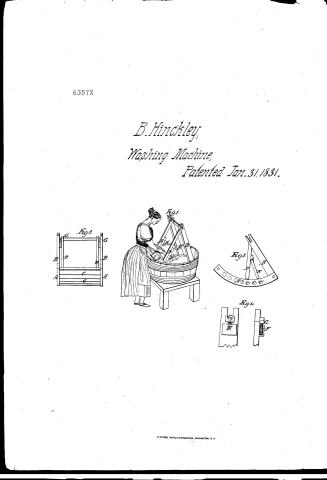
Benjamin Hinckley's Patent Drawing for a Washing Machine

National Archives, Restored Patent Drawings (Record Group 241) · Full-size scan at the National Archives · Catalog record
Show the text on the drawing Hide (89 words)
Words on the drawing as machine-read by the National Archives; not checked. Useful mainly for searching.
Benjamin Hinckley / CLASSIFICATION / Washing Machine Jan 3/, 1831 / 6357.X / Patented 3 / DIVISION. / Fight, / Fir.3. / 3. / Fifl / $ C C) (C') / Pig.4. / References, / Fift. machine in operation. / Fid 2. side view. Fig. 3. endview, / Fid. 4. Sections of uprichts, showing spring fo. / A.curved pieces. B. uprights. C, rollers. D. rubber. / E. hinged piece. Espring. G.pin. / Patent office Deeg. 1841 / Made under the direction of the Commipinium of / Patents in conformity with Act of bougrep 3 Mare h 1937 / HL Ellmoth / Commisione of Patents,
USPTO scan
The patent as scanned by the USPTO
-
 Page 1
-
 Page 2
-
 Page 3
-
 Page 4


U.S. Patent and Trademark Office · Google Patents
Show the transcription Hide (1,247 words)
Machine transcription (LightOnOCR) of the pages as scanned by the USPTO, most of them the handwritten copies made when the records were restored after the 1836 fire. Not checked; it can misread handwriting, so compare it with the scan.
Page 1.
6357X
B. Hinckley,
Washing Machine,
Patented Jan. 31, 1831.
Fig 1
Fig 3
Fig 2
Fig 4
Page 2.
Jan 31 1831
0357x Benjamin Winchley.
Letters Patent
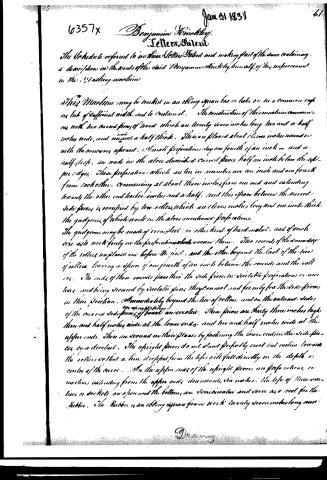
The Schedule referred to in these Letters Patent and making part of the same containing a description in the words of the said Benjamin Winchley himself of his improvement in the Washing machine
This Machine may be worked in an oblong square box or tub, or in a common cistern or tub of sufficient width and to contain it. The construction of this machine commences with two curved pieces of wood which are twenty seven inches long two and a half inches wide, and one inch and a half thick. These are placed about eleven inches around each with the curves upward. Small perforations say one fourth of an inch — and one half inch, are made in the above described curved pieces half an inch below the upper edges. These perforations which are ten in number are ten inch and one fourth from each other, commencing at about three inches from one end and extending towards the other end twelve inches and a half. And this space between the curved side pieces is occupied by ten rollers which are eleven inches long and one inch thick. The gutters of which work in the above mentioned perforations.
The gutters may be made of iron sheet or other kind of hard metal, and of such size as to work freely in the perforations which receive them. Two rounds of the same size of the rollers are placed one before the first, and the other beyond the last of the ten rollers, leaving a space of one fourth of an inch between the rounds and the rollers. The ends of these rounds pass into the side pieces in suitable perforations or notches, and being secured by suitable pins they cannot and firmly fix the side pieces in their position. Immediately beyond the lines of rollers, and on the outward sides of the curved side pieces of board are erected. These pieces are thirty three inches high three and half inches wide at the lower ends, and two and half inches wide at the upper ends. These are secured in their places by fastening the lower ends in the side pieces by a screw. The upright pieces do not stand perfectly erect but incline towards the rollers so that a line drawn from the tops will fall directly in the depth or centre of the curve. In the upper ends of the upright pieces are perforations or notches extending from the upper ends downwards six inches. The tops of these notches or sockets are open and the bottoms are semi-circular and serve as a rest for the Rubber. The Rubber is an oblong square frame twelve twenty seven inches long and
Page 3.
about eleven inches wide. This consists of two side pieces which are two inches wide and three fourths of an inch thick, connected at top and bottom by cross pieces that are one and a half inches and the ends of the upper cross piece which extend outwards two inches and a half from the side pieces are fitted to work in the above described sockets in the manner of gutters. The construction of the rubber is completed by the addition of another piece of frame work. The side pieces of which are only sixteen inches long, out of the same width and thickness of the others, and the lower ends are connected by a cross piece of the same construction of that which connects the lower ends of the other side pieces. These two pieces are connected into one by placing them together so that the two bottom pieces shall exactly correspond with each other, and they are secured in this position by screwing or nailing the upper ends of the latter side pieces firmly to the others. This piece of the machine is fitted to operate as a sort of hand to grasp and hold the linen or other clothes designed to be washed, by cutting off the side pieces of the last described part of the rubber at about three inches from the upper ends, and attaching suitable hinges at the same places, so as to form joints. The two bottom pieces are made to be open by means of light steel springs which are placed between the side pieces of the two parts of the rubber. By dropping the gutters of the upper end pieces of the rubber into the sockets of the upper ends of the upright pieces the rubber has its proper place in the machine. To facilitate the operation of the rubber it is raised from the rollers by two spiral springs which are secured in their proper places by blocks that are three inches long, two inches wide and one inch and a fourth thick. These blocks are perforated three from top to bottom within half inch range of the bottom and are bolted on the outside of each of the upright pieces about three inches below the lower part of the sockets, and pins are fitted to work in the perforations made in the blocks. These pins are about twelve inches long, the heads of the pins are three inches long, two inches wide and one inch thick. On the top of the pins is a cover fitted to secure the gutters which extend outwards from the upright pieces sufficiently to rest on the curved ends of the pins. The aforementioned spiral springs enclose the lower part of the pins and occupy a space of two inches between the upper ends of the perforated blocks, and the upper shoulders at the lower part of the head of the pins. A piece of lining is inserted under the aforementioned two rollers, commencing at the end of the side pieces where the rubber commences, and extends about nine inches. The lining must be one inch
Page 4.
6357x Jan 31, 1831 64
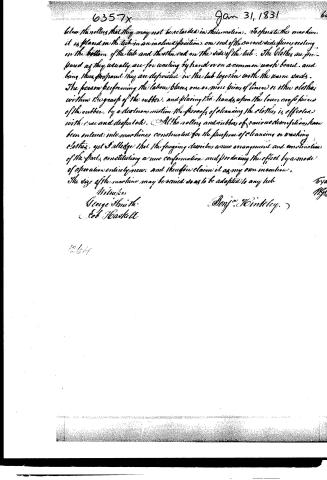
below the rollers that they may not be startled in their motion. To operate this machine it is placed in the tub in an inclined position, one end of the curved side piece resting on the bottom of the tub and the other end on the side of the tub. The clothes are prepared as they usually are for washing by hand or on a common wash board, and being thus prepared they are deposited in the tub together with the warm water. The person performing the labour places one or more pieces of linen or other clothes within the grasp of the rubber, and placing the hands upon the lower end of pieces of the rubber, by a declinatory motion the process of cleaning the clothes is effected with ease and despatch. Although rollers and rubbers of various descriptions have been introduced into machines constructed for the purpose of cleaning or washing clothes, yet I allege that the foregoing describes a new arrangement and construction of the parts, constituting a new combination, and producing the effect by a mode of operation entirely new, and therefore claim it as my own invention.
The size of the machine may be varied so as to be adapted to any tub
Witness
George Smith
Eck Haskell
Benj. H. Wintley.
Toya
1864
Published accounts: journal notice
Notice in the monthly list of patents
Journal of the Franklin Institute, new ser., vol. 7 (1831), p. 315 · View the page
44. For a Washing Machine; James Hinkley, Fayette, Kennebeck county, Maine, January 31.
About this record
- Patentee
- DATAMP
- Date
- the Name and Date index of patents, DATAMP, USPTO records
- Invention
- DATAMP
- Listed in
- the Name and Date index of patents, DATAMP, USPTO records, Jim Shaw's X-patent list, the Journal of the Franklin Institute, Burke's List of Patents (1847)
- Burke's 1847 Patent Office list gives the same patent.