

Drawings and documents
National Archives restored drawings: drawing
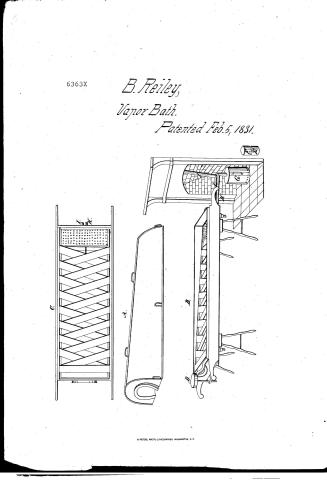
Boyd Reiley's Patent Drawing for a Medicated Steam Bath

National Archives, Restored Patent Drawings (Record Group 241) · Full-size scan at the National Archives · Catalog record
Show the text on the drawing Hide (38 words)
Words on the drawing as machine-read by the National Archives; not checked. Useful mainly for searching.
Boyd Reiley's medicated Steam Bath / BATHS & CLOSETS. / Patented Feby 5. 1831. / [8] Vapor Baths. / CLASSIFICATION / 6363-4 / DIV ISION. / NONE NO III Я / ool / E'
USPTO scan
The patent as scanned by the USPTO
-
 Page 1
-
 Page 2
-
 Page 3
-
 Page 4
-
 Page 5
-
 Page 6
-
 Page 7
-
 Page 8
-
 Page 9
-
 Page 10
-
 Page 11
-
 Page 12
-
 Page 13


U.S. Patent and Trademark Office · Google Patents
Show the transcription Hide (3,791 words)
Machine transcription (LightOnOCR) of the pages as scanned by the USPTO, most of them the handwritten copies made when the records were restored after the 1836 fire. Not checked; it can misread handwriting, so compare it with the scan.
Page 1.
6363X
B. Reiley,
Vapor Bath.
Patented Feb. 5, 1831.
Page 2.
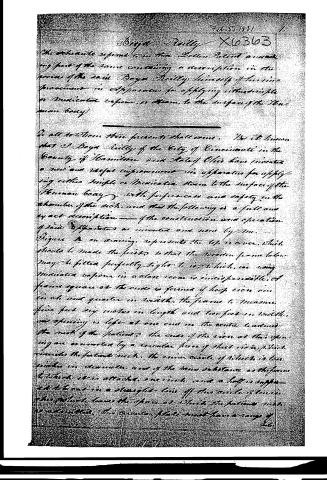
7th-37-1831
Bryant Reilly X6363
The schedule refers to the above Patent as well as part of the same containing a description in the words of the said Bryant Reilly himself of his invention in apparatus for applying either simple or medicated vapors, or steam, to the surface of the human body.
To all to whom these presents shall come. We it known that A Bryant Reilly of the City of Cincinnati in the County of Hamilton and State of Ohio have invented a new and useful improvement in apparatus for applying either simple or medicated steam to the surface of the human body, with preference and safety in the chamber of the sick, and that the following is a full and exact description of the construction and operation of said apparatus as invented and used by me.
Figure A on drawing represents the top or cover, which should be made the joints so that the wooden frame below may be fitted perfectly tight to it, which, in using medicated vapors in a close room is indispensable. A frame square at the ends is formed of half inch iron in oh and quarter in width, the frame to measure five feet six inches in length and two feet in width, one opening is left at one end on the centre to admit the neck of the patient, the ends of the iron at this opening are connected by a circular piece of sheet iron, which surrounds the patient's neck, the inner circle of which is one inch in diameter and of the same substance as the frame to which it is attached, one inch and a half is supposed to bear in a straight line off this circle of iron, this plate leaves the space at which the patient's neck is admitted, this circular plate must have a range of
Page 3.
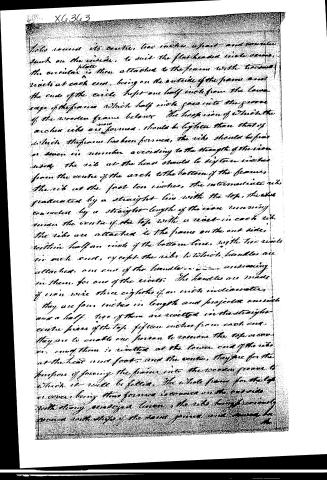
Holes around its centre, two inches apart and somewhat sunk on the inside, to suit the flat-headed iron screws. The circular plate is then attached to the frame with two screws at each end, being on the outside of the frame and the ends of the circle kept one half inch from the lower edge of the frame which half inch goes into the groove of the wooden frame below. The keepers of which the arched ribs are formed, should be lighter than that of which the frame has been formed. The ribs should be fixed in number according to the strength of the iron used. The ribs at the head should be eighteen inches from the centre of the arch to the bottom of the frame, the ribs at the foot ten inches, the intermediate ribs graduated by a straight line with the top, the ribs connected by a straight length of the iron running under the centre of the top with a rivet in each rib. The ribs are attached to the frame on the outside, within half an inch of the bottom line, with two rivets in each end, except the ribs to which handles are attached, one end of the handles being screwed in them for one of the rivets. The handles are made of iron wire three eighths of an inch in diameter, they are four inches in length and project one inch and a half. Two of them are rivetted in the straight centre piece of the top, fifteen inches from each end. They are to enable one person to remove the top or cover, and there is rivetted at the lower end of the ribs at the head and foot, and the centre, they are for the purpose of forcing the frame into the wooden groove to which it will be fitted. The whole frame for the top or cover being thus formed is covered on the outside with strong staved linen, the ribs being previously covered with strips of the same piece and covered by
Page 4.
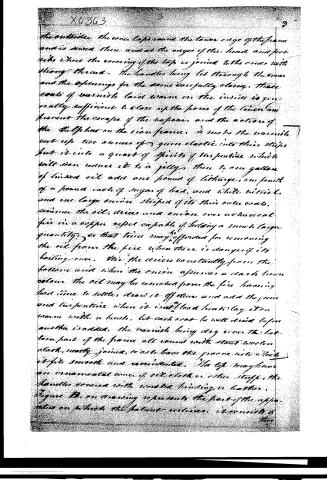
the outside, the cover laps around the lower edge of the frame and is sewn there and at the edges of the head and foot sides where the covering of the top is joined to the sides with strong thread. The handles being let through the cover and the openings for the same are carefully closed. Three coats of varnish laid warm on the inside is generally sufficient to close up the pores of the linen and prevent the escape of the vapors, and the action of the sulphur on the iron frame. To make the varnish put up two ounces of gum elastic into three strips, put it into a quart of spirits of turpentine which will soon reduce it to a jelly, then to one gallon of linseed oil add one pound of litharge, one fourth of a pound each of sugar of lead, and white vitriol, and one large onion stripped of its thin outer coats. Simmer the oil, dried and onion over a charcoal fire in a copper vessel capable of holding a much larger quantity, so that time may be afforded for removing the oil from the fire when there is danger of its boiling over. Stir the onions constantly from the bottom and when the onion assumes a dark brown colour the oil may be removed from the fire having had time to settle, drain it off clear and add the gum and turpentine when it is still hot. Heat lay it on warm with a brush, let each coat be well dried before another is added, the varnish being dry over the bottom part of the frame all round with stout woollen cloth, neatly joined, so as to leave the groove into which it fits smooth and varnished. The top may have an ornamental cover of silk cloth or other stuff, the handles covered with wadded binding or leather. Figure B, on drawing represents the part of the apparatus on which the patent resides. It consists of
Page 5.
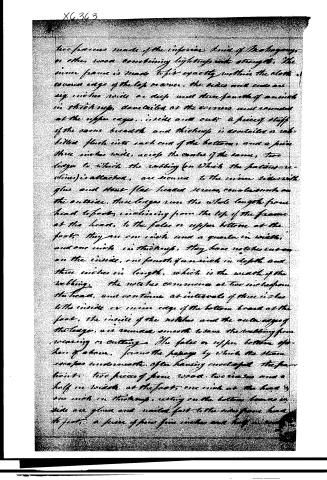
two frames made of the inferior kind of Mahogany or other wood combining lightness with strength. The inner frame is made to fit exactly within the cloth-covered edge of the top cover. The sides and ends are six inches wide or deep and three-fourths of an inch in thickness, dovetailed at the corners and rounded at the upper edges. Inside and out, a piece of stuff of the same breadth and thickness is dovetailed or rabbitted flush into each end of the bottom, and a piece three inches wide, except the centre of the same, two inches to which the rubbing (on which the patient reclines) is attached, are secured to the inner sides with glue and stout flat-headed screws, countersunk on the outside. These lugs run the whole length from head to foot, inclining from the top of the frame at the head, to the false or upper bottom at the foot. They are one inch and a quarter in width, and one inch in thickness. They have notches cut on the inside, one-fourth of an inch in depth and three inches in length, which is the width of the rubbing. The notches commence at two inches from the head, and continue at intervals of three inches to the inside or inner edge of the bottom board at the foot. The inside of the notches and the outer edges of the lugs, are rounded smooth to save the rubbing from wearing or cutting. The false or upper bottom, open at the top, forms the passage by which the steam escapes underneath, after having enveloped the patient. Two pieces of fine wood, two inches and a half in width at the foot, one inch at the head, and one inch in thickness, resting on the bottom boards inside are glued and nailed fast to the inner frame from the foot. A piece of fine fine iron and half an inch
Page 6.
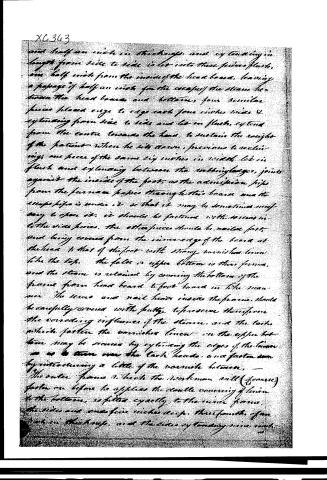
and half an inch in thickness, and extending in length from side to side is let into these pieces flush, one half inch from the inside of the head board, leaving a passage of half an inch for the escape of the steam between the head board and bottom, four similar pieces placed edge to edge each four inches wide & extending from side to side and let in flush, extend from the centre towards the head, to sustain the weight of the patient. When he sits down, previous to reclining, one piece of the same six inches in width let in flush and extending between the reclining longer, joints against the inside of the foot, as the admission pipe from the furnace pipes through this board and the escape pipe is under it so that it may be sometimes necessary to open it, it should be fastened with screws into the side pieces. The other piece should be nailed fast, and being covered from the inner edge of the board at the head to that of the foot with strong varnished linen like the top. The false or upper bottom is thus formed, and the steam is retained by covering the bottom of the frame from head board to foot board in like manner. The screws and nail heads inside the frame should be carefully covered with putty to preserve them from the corroding influence of the steam, and the tacks which fasten the varnished linen on the upper bottom may be secured by extending the edges of the linen so as to turn over the tack heads, and fasten down by interposing a little of the varnish between.
The outer frame which the workman will (of course) fasten on before he applies the double covering of linen to the bottom, is fitted exactly to the inner frame, the sides are one and a half inches deep, three fourths of an inch in thickness, and the sides extending nine inches
Page 7.
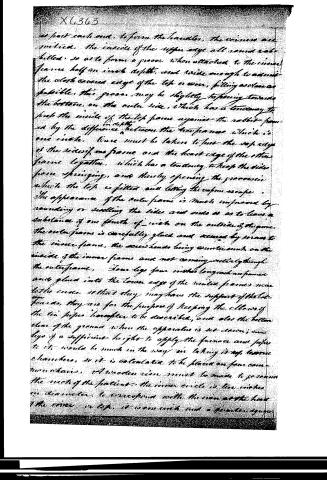
at least each end, to form the handles, the corners are mitred. The inside of the upper cage all round is bolted, so as to form a groove when attached to the inner frame half an inch deep, and wide enough to admit the cloth covered edge of the top cover, fitting as close as possible. This groove may be slightly tapering towards the bottom, on the outer side, which has a tendency to keep the inside of the top frame against the rabbit frame by the difference in depth between the two frames which is one inch. Care must be taken to just the top edge of the sides of one frame and the heart edge of the other frame together, which has a tendency to keep the side frame springing, and thereby opening the grooves in which the top is fitted and letting the vapors escape. The appearance of the outer frame is much improved by rounding or swelling the sides and ends so as to leave a substance of one fourth of inch on the outside of the groove. The outer frame is carefully glued and secured by screws to the inner frame, the screw heads being countersunk on the inside of the inner frame and not coming entirely through the outer frame. Four legs four inches long and an frame are glued into the lower edge of the united frames near to the ends, so that they may have the support of the table upon which they are for the purpose of keeping the elbows of the top pipes hereafter to be described, and also the bottom clear of the ground when the apparatus is set down; and legs of a sufficient height to apply the furnace and pipes to it, would be much in the way in taking it up, become cumbersome, so it is calculated to be placed on four common chairs. A wooden rim must be made to surround the neck of the patient. The inner circle is two inches in diameter, to correspond with the rim at the base of the cover or top; it is one inch and a quarter square.
Page 8.
and should be made of two thick pieces glued together, the grain of one crossing the other, the edge is deeply indented with a gouge all round, the inner edge is rounded off so as to be easy to the patient. This piece is attached to the iron rim at the head, after the cover is put on, by screws from the inside, the screw heads covered with the oil cloth, the rim cut off to suit the view will extend to the top of the glass and be eight inches and a half from the top of the inner circle to the edge of the glass. When the top is in its place, the piece of the rim cut off being one inch and a half inside, is let into the head of the outer wooden frame, so as to join the upper part of the rim, and then glued fast, it will be necessary to reduce the thickness of this piece to bring it even with the upper parts, a piece of wooden cloth should be glued to the ends of the upper part to make the joint better, if the outer frame is rounded it will be necessary to hollow out the end of the frame under the circle to the depth of the round or swell.
Figure C on drawing represents the top of the wooden frame with the way in which the robbing is applied entering both ends at the two upper notches, and after crossing them continue to enter them on the upper side all the way to the ends, where they are secured by eyelet holes and that end lacing, a piece of hard wood should be run into a loop or sheath formed by lapping the ends of the robbing below the holes. The little adust admits the steam at the bottom may be covered by a movable piece of thin board perforated, it is however of little consequence, as none but the feet of very tall persons can reach the aperture. Figure D on drawing represents a circular
Page 9.
X6363
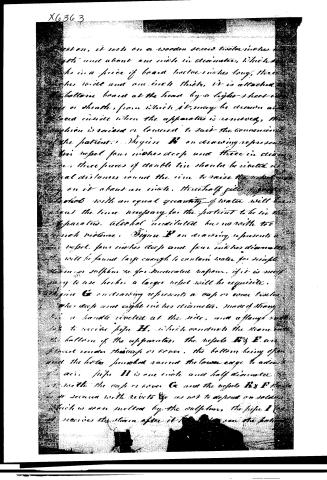
When in use, it rests on a wooden board twelve inches in length and about one inch in diameter, which has a block in a piece of board twelve inches long; there is a piece of wood one inch thick, it is attached to the bottom board at the head by a light sheet iron band or sheath, from which it may be drawn and placed inside when the apparatus is removed, the cushion is raised or lowered to suit the convenience of the patient. Figure B on drawing represents a box vessel four inches deep and three in diameter; three pieces of double tin should be riveted at equal distances round the rim to raise the sides, and they are about an inch, three half gills of spirit of alcohol with an equal quantity of water will burn about the time necessary for the patient to be in the apparatus. Alcohol undiluted burns with too much violence. Figure P on drawing represents a larger vessel, four inches deep and four inches diameter; they will be found large enough to contain water for simple steam or sulphuric gas for medicinal vapors, if it is necessary to use herbs, a larger vessel will be requisite. Figure C on drawing represents a cup or cover twelve inches deep and eight inches diameter, made of strong tin; a handle riveted at the side, and a flange outside to receive pipe H, which conducts the steam into the bottom of the apparatus, the vessels B and P are placed under this cup or cover, the bottom being open and the holes punched around the lower edge to admit the air. Pipe H is one inch and half diameter and connects the cup or cover C and the vessels B and P; they are secured with rivets so as not to depend on solder, which is soon melted by the sulphur. The pipe I (not shown) receives the steam after it has passed over the patient.
Page 10.
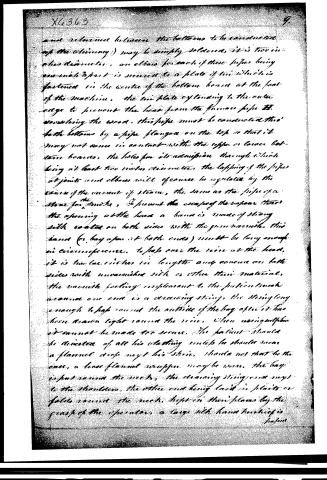
and reference between the bottoms to be conducted up the chimney) may be simply soldered, it is two inches diameter, an elbow for each of these pipes being one inch apart is secured to a plate of tin which is fastened in the centre of the bottom beam at the foot of the machine, the tin plate extending to the outer edge to prevent the heat from the furnace pipe burning the wood, this pipe must be conducted through both bottoms by a pipe flange on the top so that it may not come in contact with the upper or lower bottom beams, the holes for its admission through which being at least two inches diameter, the lapping of the pipes at joints and elbows will of course be regulated by the course of the current of steam, the same as the pipes of a stove for smoke, to prevent the escape of the vapour through the opening at the head a band is made of strong silk coated on both sides with the gum varnish, this band (or bag open at both ends) must be long enough in circumference, to lap over the wire at the head, it is two or three inches in length and covered on both sides with unvarnished silk or other thin material, the varnish feeling unpleasant to the patient, such around one end is a drawing string, the string long enough to lap round the outside of the bag after it has been drawn tight round the wire, when using sulphur it cannot be made too secure, the patient should be dressed of all his clothing except he should wear a flannel dress next his skin, should not that be the case, a loose flannel wrapper may be worn, the bag is put round the neck, the drawing string end next to the shoulder, the other end being laid in folds or folds round the neck, kept in their places by the grasp of the operator, a large silk handkerchief is passed
Page 11.
X6363
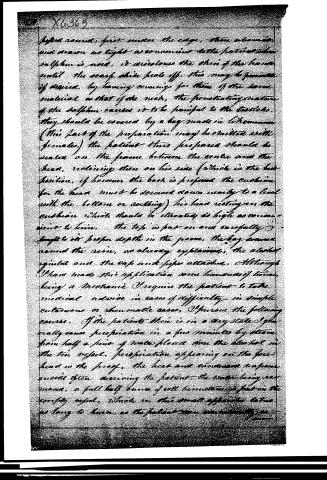
folded round, first under the edge, then above it, and drawn as tight as convenient to the patient when sulphur is used, it discolors the skin of the head until the scarf skin peels off. This may be prevented if desired, by having covering for them of the same material as that of the neck, the penetrating nature of the sulphur causes it to be painful to the tactile. They should be covered by a bag made in like manner (this part of the preparation may be omitted with females) the patient thus prepared should be seated on the frame between the centre and the head, reclining there on his side (which is the best position, if however the back is preferred the cushion for the head must be screwed down nearly to a level with the bottom or rocking) his head resting on the cushion which should be elevated as high as convenient to him. The top is put on and carefully brought to its proper depth in the groove, the bag drawn round the neck, as already explained, the alcohol ignited and the cap and pipe attached. Although I have made this application some hundreds of times, being a mechanic I require the patient to take medical advice in cases of difficulty in simple cutaneous or rheumatic cases, I pursue the following course. If the patient's skin is in a dry state I generally cause perspiration in a few minutes by steam from half a pint of water placed over the alcohol in the tin vessel, perspiration appearing on the forehead is the proof, the heat and steam vapors speedily open, desiring the patient the water being removed, a full half ounce of roll bismuthine is put in the tinety vessel, which in this small apparatus burns as long to burn, as the patient can conveniently bear.
Page 12.
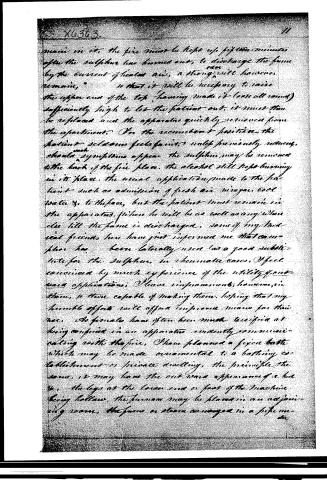
remain in it, the fire must be kept up, fifteen minutes after the sulphur has burned out, to discharge the fume by the current of heated air, a strong smell however remains, so that it will be necessary to raise the upper end of the top (having made it loose all round) sufficiently high to let the patient out, it must then be replaced and the apparatus quickly removed from the apartment. In the recumbent position, the patient seldom feels faint, unless previously nauseous, should such symptoms appear the sulphur may be removed to the back of the fire place, the alcohol still kept burning in its place, the usual application made to the patient such as admission of fresh air, vinegar, cold water &c to the face, but the patient must remain in the apparatus, where he will be as well as any where else till the fume is discharged, some of my medical friends here have just informed me that camphor has been lately used as a good substitute for the sulphur, in rheumatic cases, I feel convinced by much experience of the utility of our own applications; I have improvements, however, in them, or those capable of making them, hoping that my humble efforts will afford improved means for their use. So female have often been much terrified at being confined in an apparatus evidently communicating with the fire, I have planned a fixed bath which may be made ornamental to a bathing establishment or private dwelling, the principle the same, it may have the out ward appearance of a bed &c, the legs at the lower end or foot of the machine being hollow, the furnace may be placed in an adjoining room, the fume or steam conveyed in a pipe under
Page 13.
X6363
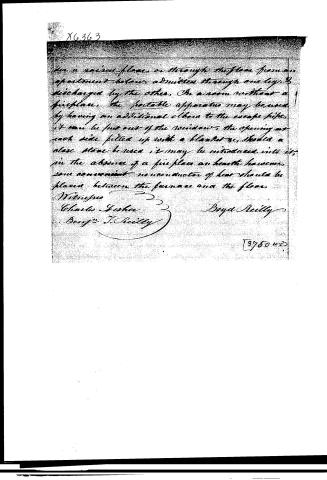
air a certain floor, or through the floor from an apartment below, admitted through one key & discharged by the other. In a room without a fireplace, the portable apparatus may be used by having an additional elbow to the escape pipe, it can be put out of the window; the opening on each side filled up with a blanket &c, should a close stove be used it may be introduced into it; in the absence of a fireplace an hearth hammer, some convenient non-conductor of heat should be placed between the furnace and the floor.
Witnesses
Charles Foster
Benj'n T. Reilly
Boyd Reilly
[375040]
Published accounts: journal notice
Notice in the monthly list of patents, with remarks
Journal of the Franklin Institute, new ser., vol. 7 (1831), p. 367 · View the page
6. For an improvement in the apparatus for Applying either simple or medicated Steam to the human body; Boyd Reilly, Cincinnati, Hamilton county, Ohio, February 5.
Remarks. This, as will be seen by the title, is a steam doctor's apparatus. The culprit--patient we mean--is to be laid upon a couch made for the purpose, and is to be covered over with a frame made of hoop iron, covered with cloth, &c. so as to have the form of a wagon top. The cloth is to be varnished, to render it steam tight, and is fitted perfectly to the frame of the couch. An opening is left at one end for the head of the subject, and the opening closed around his neck by means described in the specification. A tube from a metallic apparatus for heating the materials to be converted into vapour, opens into the cavity of the apparatus. The vapour of water, either simple or medicated, is sometimes to be used, but the favourite application appears to be sulphur. The familiar tells us that "when sulphur is used it discolours the skin of the hands, until the scarf skin peels off. This may be prevented, if desired, by having coverings for them of the same material as that for the neck, the penetrating nature of the sulphur causes it to be painful to [parts of great delicacy, they should be covered by a bag in like manner." "Although I have made this application some hundreds of times, being a mechanic, I require the patient to take medical advice in cases of difficulty. In simple cutaneous or rheumatic cases, I pursue the following course. If the patient's skin is in a dry state, I generally cause perspiration in a few minutes by steam from half a pint of water;" "the water being removed, a full half ounce of roll brimstone is put into the empty vessel, which in this small apparatus takes as long to burn as the patient can conveniently remain in it." "In this recumbent position the patient seldom feels faint unless previously reduced. Should such symptoms appear, the sulphur may be removed to the back of the fire place, the usual applications being made to the patient, such as admission of fresh air, vinegar, cold water," &c. It is useless to waste reasoning upon those who appear by their acts, to consider ignorance and temerity as the best diploma which can be exhibited of the skill of a professor of the healing art; and whilst this class of patients is numerous, freebooters will be found in abundance, who, taking advantage of popular ignorance, are ready to sally forth, to "burn, sink and destroy."
About this record
- Patentee
- DATAMP
- Date
- the Name and Date index of patents, DATAMP, USPTO records
- Invention
- DATAMP
- Listed in
- the Name and Date index of patents, DATAMP, USPTO records, Jim Shaw's X-patent list, the Journal of the Franklin Institute, Burke's List of Patents (1847)
- The Franklin Institute's journal spells the name differently.
- Burke's 1847 Patent Office list gives the same patent.