

Drawings and documents
National Archives restored drawings: drawing
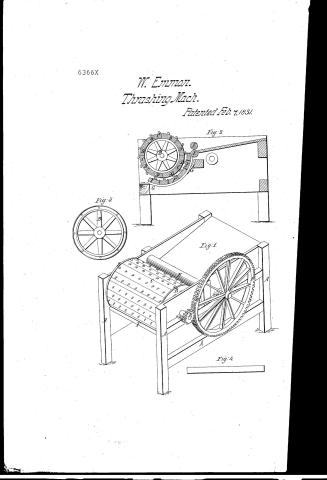
William Emmon's Patent Drawing for a Threshing Machine

National Archives, Restored Patent Drawings (Record Group 241) · Full-size scan at the National Archives · Catalog record
Show the text on the drawing Hide (116 words)
Words on the drawing as machine-read by the National Archives; not checked. Useful mainly for searching.
Eintered / 130. THRASHING. / yeo / William Emmon's / VOL.13.p,145. / Thrashing Machines. / A. Cylinder Machines. / Threshing Machine / Patented 7, Feb, 7, 1831, / $2,50- / CLASSIFICATION / 63667 / DIV ISION. / Fight. / Fig.2, / DO / DD / Ret / DO / OP / MANADA / FA / Fig.3. / Die / IIIIIIIIIRA / Fif.1. Perspective References. of Machine / Patent Office Mar 17th 184 say. / Fid.2. vertical Section. / Fig. 4. / Made under the direction of the Patents / Fig.3. cast crow wheel / Fish. iron strips forthe concave, / in conformity with act of Congrefs 30 March 1837, / A. Frame. B. Biron wheels. C. cylinder, / D. rodspafing through the where, / E.Feeding rollers.F. concave G springs / H.pinian on eylinder shaft. / I. driving wheel, / Commipioner of Patents,
USPTO scan
The patent as scanned by the USPTO
-
 Page 1
-
 Page 2
-
 Page 3


U.S. Patent and Trademark Office · Google Patents
Show the transcription Hide (679 words)
Machine transcription (LightOnOCR) of the pages as scanned by the USPTO, most of them the handwritten copies made when the records were restored after the 1836 fire. Not checked; it can misread handwriting, so compare it with the scan.
Page 1.
6366X
W. Emmon.
Thrashing Mach.
Patented Feb. 7, 1831.
Fig. 2.
Fig. 3.
Fig. 1.
Fig. 4.
Page 2.
6366X William Commons a Citizen of Letters Patent.
The schedule referred to in these Letters Patent and making part of the same, containing a description in the words of the said William Commons, himself of his improvement in the threshing Machine.
To all to whom these presents shall come. Be it known that I William Commons, of the city of New York, the county and state of New York, have invented a new and useful improvement in threshing grain, and the following is a full and exact description of the construction and operation of the said Machine, as invented or improved by me; called the Cylinder Threshing Machine; specified in the words following, viz. This improvement consists, 1st of a frame of suitable size and dimensions to contain the operating parts 2nd A cylinder of from 18 to 22 inches diameter and from 18 to 30 inches in length and constructed in the following manner, viz. Two cast iron wheels with arms have 3/4", with a groove in one side of each of their arms. These wheels are placed on a shaft at such distance apart as to be the length of the cylinder. In these grooves are inserted the ends of the staves, which compose the cylinder, rods or bolts passing through the arms or arms of said wheels, from one to the other, with a screw and nut, to draw the cylinder together, which is in the shell of the cylinder in their place. 3rd In the periphery of the cylinder is inserted 10 to 16 rows of teeth, of from 1 to 1 1/2 inch projection, usually made of 1 inch iron rods, and bearded to prevent their getting loose. The teeth are bent a semicircle, the points standing back from the grain. 4th The circular bed is formed of staves, about one third the circumference of the
Page 3.
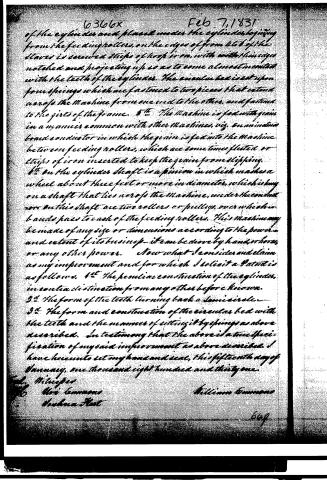
6366x Feb. 7, 1831
of the cylinder and placed under the cylinder, joining from the feeding rollers, on the edges of from 2 to 6 of the blades is secured strips of hoop iron, with with their edges notched and projecting up so as to come almost in contact with the teeth of the cylinder. The circular bed is set upon four springs which are fastened to two pieces that extend across the Machine from one end to the other, and fastened to the girts of the frame. 5th The Machine is fed with grain in a manner common with other Machines, viz. on an inclined board conductor in which the grain is fed into the Machine between feeding rollers, which are sometimes fluted or strips of iron inserted to keep the grain from slipping. 6th On the cylinder shaft is a pinion in which meshes a wheel about three feet or more in diameter, which is hung on a shaft that lies across the Machine, under the conductor on this shaft are two rollers or pulleys, over which two bands pass to each of the feeding rollers. This Machine may be made of any size or dimensions according to the power and extent of its business—it can be driven by hand, or horse, or any other power. Now what I consider and claim as my improvement and for which I solicit a Patent is as follows. 1st The peculiar construction of the cylinder, in certain distinction from any other before known. 2nd The form of the teeth turning back a semicircle— 3rd The form and construction of the circular bed with the teeth and the manner of setting it by springs as above described. In testimony that the above is a true specification of my said improvement as above described, I have hereunto set my hand and seal, this fifteenth day of January, one thousand eight hundred and thirty one.
Filed, Wilmipes
Wm. Emmons
Ursula Hart
William Emmons
609
Published accounts: journal notice
Notice in the monthly list of patents, with remarks
Journal of the Franklin Institute, new ser., vol. 7 (1831), p. 369 · View the page
9. For a Thrashing Machine; William Emmons, city of New York, February 7.
Remarks. This contains all the usual appendages of thrashing machines. The teeth upon the cylinder are to be in rows, and from 1 to 1½ inches long. They are to be bent back so as to form a semicircle, declining from the grain. The hollow segment is to be borne up by spiral springs. The claims are to "the peculiar construction of the cylinder, in contradistinction from any other before known. The form of the teeth turning back in a semicircle. The form and construction of the circular bed, with the teeth, and the manner of setting it on springs."
About this record
- Patentee
- DATAMP
- Date
- the Name and Date index of patents, DATAMP, USPTO records
- Invention
- DATAMP
- Listed in
- the Name and Date index of patents, DATAMP, USPTO records, Jim Shaw's X-patent list, the Journal of the Franklin Institute, Burke's List of Patents (1847)
- Burke's 1847 Patent Office list gives the same patent.