

Drawings and documents
National Archives restored drawings: drawing
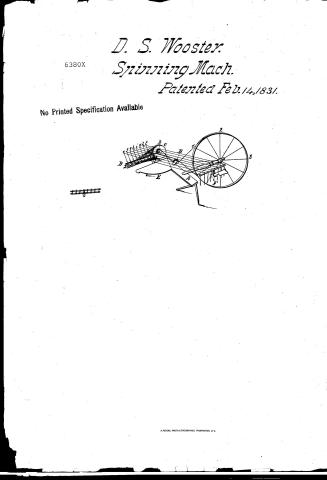
D.S. Wooster's Patent Drawing for a Machine for Spinning Wool

National Archives, Restored Patent Drawings (Record Group 241) · Full-size scan at the National Archives · Catalog record
Show the text on the drawing Hide (39 words)
Words on the drawing as machine-read by the National Archives; not checked. Useful mainly for searching.
11 118. SPINNING. Tex / Spinning [142] Domestic. / Restored Palit / D S WOOSTER'S O / Voz 12.19.195 / Machine for Spinning Wool. / CLASSIFICATION / Patented 14. Feb. / 1831. / 6380- X / DIV ISION. / ####111#
USPTO scan
The patent as scanned by the USPTO
-
 Page 1
-
 Page 2
-
 Page 3


U.S. Patent and Trademark Office · Google Patents
Show the transcription Hide (804 words)
Machine transcription (LightOnOCR) of the pages as scanned by the USPTO, most of them the handwritten copies made when the records were restored after the 1836 fire. Not checked; it can misread handwriting, so compare it with the scan.
Page 1.
D. S. Wooster.
6380X
Spinning Mach.
Patented Feb. 14, 1831.
No Printed Specification Available

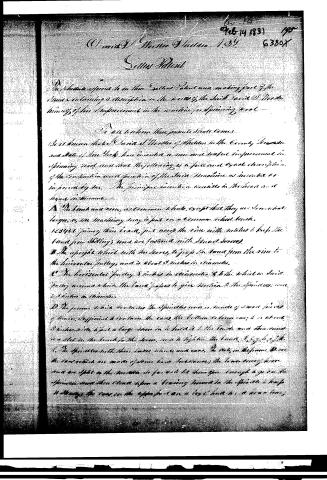
Page 2.
Maria W. Master of Shelton 1.34
Feb 14 1831
6380X
Letters Patent
A
The subscriber refers to her Letters Patent now making part of the same, containing a description in the words of the said Maria W. Master, himself, of her improvement in the machine for spinning wool.
We all believe this patent shall come.
Be it known that Maria W. Master of Shelton in the County of Essex and State of New York has invented a new and useful improvement in spinning wool and that the following is a full and exact description of the construction and operation of the said machine as invented or improved by her. The principal invention consists in the head and frame mechanism.
A The head and arm, as common wheel, except that they are somewhat larger, or the machine may be put on a common wheel bench. 123456 joining this head, put across the side with notches to keep the head from shifting, and are fastened with steel screws.
B The upright wheel with the lever, to pass the band from the side to the horizontal pulley, and is about 3 inches in diameter.
C The horizontal pulley 3 inches in diameter & to the wheel on said pulley around which the band passes to give motion to the spindles, and 2 1/2 inches in diameter.
D The frame to which are to be the spindles and is made of small pieces of iron, sufficient to contain the cars, the bottom to have one; it is about 3 inches wide, to put a large stone in to hold it if the bands were thin round and set in the bench to the floor, and to tighten the bands, by pulling it.
E The spindles with their cases, wheels, and cars, the rods in the frame. All the cars which are made of stone have brasses; the brasses being loose and are split in the middle so far as to let them open enough to go on the spindles, and then close upon a sliding hammer in the spindle to keep it during the cars in the opposite end a long bolt, and a cross bar.
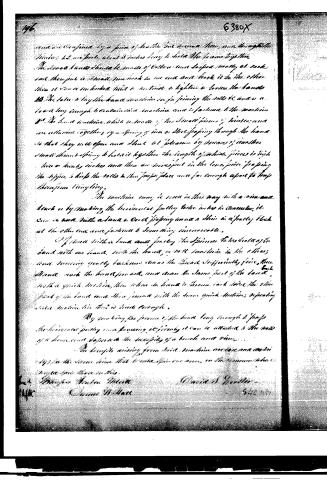
Page 3.
146. 6380X
and are confined by a piece of leather just a seam thin, and through the
Hindley 12. we spoke about 8 inches long to hold the frame together.
The Small hand should be made of copper one to pass easily at each
end, then put a small hook in one end and hook it in the other
then it can be unhooked, twist a machine a tighten a loose the hands
13. The tube to lay the hand machine in for joining the rolls to make a
to a long enough to contain the machine and is fastened to the machine
14. The hand machine which is made of two small pieces of iron, and
are attached together by a spring of iron or stick passing through the hand
so that they will open and shut at pleasure by means of another
small thumb spring to hold it together. The length of these pieces is eight
two or twenty inches and there are two put in the long piece passing
the upper, to keep the rolls in their proper place one far enough apart to keep
them from tangling.
The machine may be used in this way with a rim and
block or by making the horizontal pulley twice inches in diameter, it
can be used with a hand or cord passing round a thin in a pulley block
at the other end and fastened to something immovable.
If used with a hand and pulley the spinner takes hold of the
band with one hand, with the hand, or roll machine in the other,
and moving gently backwards draws the thread sufficiently fine, then
draws back the hand forward, and again the same part of the band,
with a quick motion, then when the hand is drawn back leave the other
part of the band and draw forward with the same quick motion, repeating
this motion till there is none enough.
By making the frame of the hand long enough to pass
the horizontal pulley and passing it firmly, it can be attached to the wall
of a room and depends on the capacity of a bench and room.
No benefits arising from this machine are lost and working
by the same time that to take spin one over, in the common wheel
you can spin there on this.
Thomas Hunter Smith
James H. Hall
David J. Goudie
340 5/11
Published accounts: journal notice
Notice in the monthly list of patents, with remarks
Journal of the Franklin Institute, new ser., vol. 7 (1831), p. 373 · View the page
21. For an improved Machine for Spinning Wool; David Wooster, Sheldon, Genessee county, New York, February 14.
Remarks. The common wheel for spinning wool is to be made to turn a number of spindles, -eight are shown in the drawing. The rolls of wool are to be fixed in an apparatus to be held in the hand: this contrivance consists of two strips of wood, 18 or 20 inches long, hinged together, and capable of being opened and closed readily, and in this the rolls are to be secured. There is nothing in the arrangement to recommend it to particular notice, nor is there any claim made.
About this record
- Patentee
- DATAMP
- Date
- the Name and Date index of patents, DATAMP, USPTO records
- Invention
- DATAMP
- Listed in
- the Name and Date index of patents, DATAMP, USPTO records, Jim Shaw's X-patent list, the Journal of the Franklin Institute, Burke's List of Patents (1847)
- Burke's 1847 Patent Office list gives the same patent.