

Drawings and documents
National Archives restored drawings: drawing
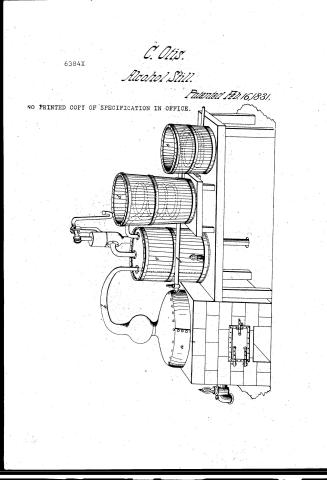
Charles Otis' Patent Drawing for an Apparatus for Distilling

National Archives, Restored Patent Drawings (Record Group 241) · Full-size scan at the National Archives · Catalog record
Show the text on the drawing Hide (97 words)
Words on the drawing as machine-read by the National Archives; not checked. Useful mainly for searching.
195. ALCOHOL. / Distilled Spirits. / C1 / Apparatus. / Stills. / Doublers and Worms / $259 / CHARLES OTIS / Apparatus for Distilling. / caassification / 6384-+ / Patented 16th February 1831. / DIVISION. / Preferences. a. the still. b. the tube c tub for low wines d the tube with / a still worm callathe heater. e the cooler with a worm. / Patent affice the 20th November 1839. / f. pipe for conveying the been from the heater to the still. / made under the direction of the Commipioner of Patents in / Conformity with act of 3d. 1837 / of Patents.
USPTO scan
The patent as scanned by the USPTO
-
 Page 1
-
 Page 2
-
 Page 3


U.S. Patent and Trademark Office · Google Patents
Show the transcription Hide (508 words)
Machine transcription (LightOnOCR) of the pages as scanned by the USPTO, most of them the handwritten copies made when the records were restored after the 1836 fire. Not checked; it can misread handwriting, so compare it with the scan.
Page 1.
6384X
C. Otis.
Alcohol Still.
Patented Feb. 16, 1831.
NO PRINTED COPY OF SPECIFICATION IN OFFICE.

Page 2.
Charles Otis
Letters patent.
The Schedule referred to in these Letters Patent, and making part of the same, containing a description in the words of the said Charles Otis himself, of his Improvement in the apparatus for Distilling.
To all whom it may concern; be it known that I, Charles Otis, have made an improvement in the apparatus used for Distilling, and that the following is a full and exact description of the same.
The still may be constructed in the ordinary manner. A tube is to lead from the heat of the still into a tub or vessel which contains low wines. The top of the tub is made to fit steam tight, and the before mentioned tube passes through it, being also so closely fitted as to prevent the escape of any vapour around it, and extending nearly to the bottom of the vessel. The vapour from the beer which is contained in the still, will thus pass into the vessel containing the low wines and cause the liquid to boil.
A tube leads from the upper part of the vessel of low wines, into a second tub containing a still worm, and called the heater. This heater is to be filled with the beer with which the still is to be charged. This beer becomes heated in consequence of the partial condensation of the vapour in its passage through the worm. This heater is to be elevated, so that a tube inserted near the bottom of it may convey the heated beer into the still, when it is ready for a charge.
From the worm in the heater the spirit is condensed through a cooler in the usual way.
By this arrangement of the distilling apparatus, the low wines are converted into high wines by the operation of the vapour.
Page 3.
of the beer contained in the still.
I usually insert the still in a second vessel so as to distil by a water-bath; in this case I economise heat by conducting the steam from this second or outer vessel by means of tubes, so as to heat a second still, or to aid in performing other operations in the still house, to which it may be applicable. Sometimes I convey the steam through a tube, provided with a cock, from the outer vessel into the still. This, however, I do not claim as making any part of my invention. What I claim as new, and for which I ask a patent, is the conducting the vapour from the first distillation of the beer into a vessel containing low wines, in the manner and for the purposes hereinbefore described.
Witnesses
Chas. O. Jones
Joe Eastman
Patented (Feb. 16, 1891) (470 words)
Published accounts: specification
Specification printed in the Journal of the Franklin Institute
Journal of the Franklin Institute, new ser., vol. 7 (1831), p. 388 · View the page
Text of the specification as printed in the Journal, from OCR; not proofread.
Specification of a patent for an improvement in the apparatus for Distilling. Granted to CHARLES OTIS, Tunkhannock, Luzerne county, Pennsylvania, February 16, 1831. To all whom it may concern, be it known, that I, Charles Otis, have made an improvement in the apparatus used for distilling, and that the following is a full and exact description of the same. The still may be constructed in the ordinary manner. A tube is to lead from the beak of the still into a tub, or vessel, which contains low wines. The top of the tub is made to fit steam tight, and the before mentioned tube passes through it, being also so closely fitted as to prevent the escape of any vapour around it, and extending nearly to the bottom of the vessel. The vapour from the beer which is contained in the still, will thus pass into the vessel containing the low wines, and cause the liquid to boil. A tube leads from the upper part of the vessel of low wines, into a second tub containing a still worm, and called the heater. This heater is to be filled with the beer with which the still is to be charged. This beer becomes heated in consequence of the partial condensation of the vapour, in its passage through the worm. This heater is to be elevated, so that a tube inserted near the bottom of it may convey the heated beer into the still, when it is ready for a charge. From the worm in the heater the spirit is conducted through a cooler, in the usual way. By this arrangement of the distilling apparatus, the low are converted into high wines, by the operation of the vapour of the beer contained in the still. I usually insert the still in a second vessel, so as to distil by a water bath; in this case I economize heat by conducting the steam from the second, or outer vessel, by means of tubes, so as to heat a second still, or to aid in performing other operations in the stillhouse, to which it may be applicable. Sometimes I convey the steam through a tube, provided with a cock, from the outer vessel into the still. This, however, I do not claim as making any part of my invention. What I claim as new, and for which I ask a patent, is the conducting the vapour from the first distillation of the beer, into a vessel containing low wines, in the manner, and for the purposes hereinbefore described. CHAS. OTIS. Note by the Editor. - We do not perceive the difference between the plan here specified, and that of William Cook, which will be found in Vol. 5, p. 157. That patent was issued in December, 1829.
Published accounts: journal notice
Notice in the monthly list of patents, with remarks
Journal of the Franklin Institute, new ser., vol. 7 (1831), p. 374 · View the page
27. For an improvement in the apparatus for Distilling; Charles Otis, Tunkhannock, Luzerne county, Pennsylvania, February 16.
Remarks. (See the specification.)
Published accounts: journal notice
Notice in the monthly list of patents, with remarks
Journal of the Franklin Institute, new ser., vol. 7 (1831), p. 388 · View the page
The said Levi Disbrow claims as his invention the advantageous application of heat to the boilers of steam engines, by means of two, or more, furnaces for anthracite, or other coal, erected within the boiler itself; and as parts of the same invention, he claims the mode of supplying such furnaces with feeders passing into them from the surface of the boiler, and also the mode of discharging the gas or smoke of the coal by a cylindrical pipe, or pipes, extending from the top of each furnace to the outer surface of the boiler. LEVI DISBROW. Disbrow's Steam Boilers. B E E A, boiler. B, B, furnaces. C, C, pipes for smoke. D, D, feeders. E, E, grates. Specification of a patent for an improvement in the apparatus for Distilling. Granted to CHARLES OTIS, Tunkhannock, Luzerne county, Pennsylvania, February 16, 1831.
Remarks. To all whom it may concern, be it known, that I, Charles Otis, have made an improvement in the apparatus used for distilling, and that the following is a full and exact description of the same. The still may be constructed in the ordinary manner. A tube is to lead from the beak of the still into a tub, or vessel, which contains low wines. The top of the tub is made to fit steam tight, and the before mentioned tube passes through it, being also so closely fitted as to prevent the escape of any vapour around it, and extending nearly to the bottom of the vessel. The vapour from the beer which is contained in the still, will thus pass into the vessel containing the low wines, and cause the liquid to boil. A tube leads from the upper part of the vessel of low wines, into a second tub containing a still worm, and called the heater. This heater is to be filled with the beer with which the still is to be charged. This beer becomes heated in consequence of the partial condensation of the vapour, in its passage through the worm. This heater is to be elevated, so that a tube inserted near the bottom of it may convey the heated beer into the still, when it is ready for a charge. From the worm in the heater the spirit is conducted through a cooler, in the usual way. By this arrangement of the distilling apparatus, the low are converted into high wines, by the operation of the vapour of the beer contained in the still.
Published accounts: journal notice
Notice in the monthly list of patents, with remarks
Journal of the Franklin Institute, new ser., vol. 7 (1831), p. 389 · View the page
I usually insert the still in a second vessel, so as to distil by a water bath; in this case I economize heat by conducting the steam from the second, or outer vessel, by means of tubes, so as to heat a second still, or to aid in performing other operations in the stillhouse, to which it may be applicable. Sometimes I convey the steam through a tube, provided with a cock, from the outer vessel into the still. This, however, I do not claim as making any part of my invention. What I claim as new, and for which I ask a patent, is the conducting the vapour from the first distillation of the beer, into a vessel containing low wines, in the manner, and for the purposes hereinbefore described. CHAS. OTIS. Note by the Editor. - We do not perceive the difference between the plan here specified, and that of William Cook, which will be found in Vol. 5, p. 157. That patent was issued in December, 1829. Specification of a patent for an improvement in the Manufacture of Gas for illuminating purposes. Granted to JOSEPH BARTON, city of New York, an alien, but a resident in the United States for two years, February 11, 1831.
Remarks. BE it known, that I, Joseph Barton, have discovered a new and useful improvement in the manufacturing of gas, for illuminating purposes, and of a portable nature, and that the following articles are used as a combination to produce said gas without smell, viz. Tallow, spirits of turpentine and rosin fused together, and decomposed through red hot tubes. Turpentine and alcohol, Coal tar and rosin, Coal tar and tallow, do. do. do. do. do. do. do. Coal tar, tallow, and rosin, do. Seneca oil, coal tar, tallow, and rosin, do. do. India rubber and Hydro carbons, do. do. Oil of turpentine and rosin, do. do. The foregoing substances contain gaseous matter, which when mingled with the pure illuminating principle, diminish its intensity, and increase its bulk. The application of the combinations heretofore enumerated, is to unite two or more of these hydro-carbons, and decompose the mixture so as to form a compound on which chemical agents will act so as to separate the deteriorating from the beneficial, viz. spirits of turpentine by its decomposition furnishes the pure illuminating principle, (Carburetted Hydrogen,) mingled with free hydrogen, and carbonic oxide gases, both destitute of illuminating principle or properties, but with the addition of a small portion of rosin previous to decomposition, the carbonic oxide is converted into carbonic acid, which may be entirely removed by washing with an alkaline or earthy lixivium, and if to this a small portion of tallow, or oil, be added, it will have the effect of converting the free hydrogen which the mixture still contains, into pure carburetted hydrogen, which will be perfectly free from smell or smoke. If alcohol be added to turpentine, and the gaseous mixture resulting from its decomposition be passed through an alkaline lixivium, and thus purified from carbonic acid and other deteriorating gases, the gas thus produced will be the pure illuminating principle, which when compressed by a peculiar process into copper recipients with valves, may be made portable and applied to all uses where light is essential. The method of making illuminating gases by a union of two or more vegetable, animal, or mineral hydro-carbons has never before been suggested or acted upon. JOSEPH BARTON. Remarks by the Editor. We were placed upon tiptoe, some months since, by the announcement in the New York papers, that a chemist of that city, Mr. Barton, had made some important discoveries in the making and using of gas, for illumination, and if we had not learned from experience to chasten our anticipations, the result would have been sore disappointment. There is not a single fact, or principle, noticed in the foregoing specification, with which every chemist was not perfectly familiar, and therefore there is not a point in it which can lay the slightest claim to discovery. We are first told that the gas is " of a portable nature." What does this mean? How much more portable is it than the gas from oil, or from rosin, made at the New York gas works? If the patentee supposes, as he evidently does, for he makes it the very foundation of his claim, that two or more oleaginous, bituminous, or resinous substances have never been mixed together for the manufacturing of gas, he has but little knowledge of the history of that art. The name of hydro-carbons with which he labels these different articles, has not been enlisted into the ranks of the chemical nomenclature, and, we apprehend, will not be received as a volunteer. The last article upon the list of compounds to be used is scarcely made with a view to economy. The chemist would not wish to convert turpentine into rosin and spirits, for the sake of combining them together again, for the manufacture of gas. It appears, however, according to the chemistry of this specification, that rosin is to be added to HOWARD'S Rail-road Carriages. spirits of turpentine in order to convert oxide of carbon into carbonic acid. We wish ve very much to see the rationale of this process, as, according to our philosophy, carbonic acid would be more likely to become oxide of carbon, by heating it in company with rosin, than the oxide of carbon to undergo the change above designated.
About this record
- Patentee
- DATAMP
- Date
- the Name and Date index of patents, DATAMP, USPTO records
- Invention
- DATAMP
- Listed in
- the Name and Date index of patents, DATAMP, USPTO records, Jim Shaw's X-patent list, the Journal of the Franklin Institute, Burke's List of Patents (1847)
- Burke's 1847 Patent Office list gives the same patent.