

Drawings and documents
National Archives restored drawings: drawing
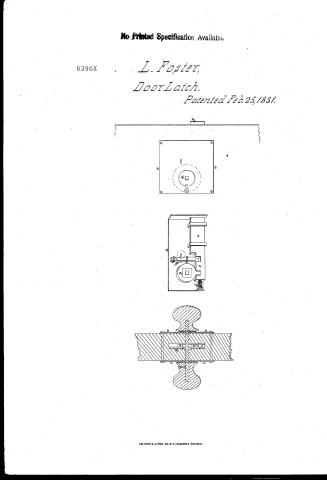
L. Foster's Patent Drawing for Mortice and Fastenings

National Archives, Restored Patent Drawings (Record Group 241) · Full-size scan at the National Archives · Catalog record
Show the text on the drawing Hide (89 words)
Words on the drawing as machine-read by the National Archives; not checked. Useful mainly for searching.
LOCKS & LATOHES S, / Dol. 12 hage 399 / #1- / 70. Latohes / Combined. / atches / Patented 25ᵗʰFeb" 183/- / CLASSIFICATION 6396.4 / L. FOSTER / Leonard Josher / DIVISION. / mortice door Tastenings / A. Lock plate / B. Tumbler / C. Catchboll / d. Stering / e. E'scutcheons / f. Key bolls / I. Catch onDoorframe / h. i. Small E Sliding Knob scutcheon gorlocking The spindle / Patent Office Nov 3D 1841 / Strickland Delh / Made under the direction of the commymism / of Patent in conformety with achof 3 Manch 1837 / 112 Ellmoth / Commussionar
USPTO scan
The patent as scanned by the USPTO
-
 Page 1
-
 Page 2
-
 Page 3
-
 Page 4
-
 Page 5


U.S. Patent and Trademark Office · Google Patents
Show the transcription Hide (1,269 words)
Machine transcription (LightOnOCR) of the pages as scanned by the USPTO, most of them the handwritten copies made when the records were restored after the 1836 fire. Not checked; it can misread handwriting, so compare it with the scan.
Page 1.
No Printed Specification Available
6396X
L. Foster,
Door Latch.
Patented Feb. 25, 1831.

AM. PHOTO-LITHO. CO. N.Y. (OSBORNE'S PROCESS.)
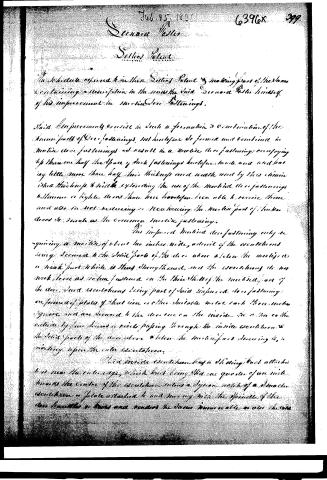
Page 2.
Feb. 25, 1851
Secunda Vester
Sellers Patent
The Schedule referred to in this Sellers Patent & making part of the same containing a description in the same the said Secunda Vester himself of his improvement in mortise door fastenings.
Vaid Improvement consists in such a formation & combination of the known parts of door fastenings, not heretofore so formed and combined in mortise door fastenings as result in a mortise door fastening occupying by three one half the space of such fastenings heretofore made and not having little more than half their thickness and width used by this claim that thickness & width extending the use of the mortise door fastenings to thinner or lighter doors than have heretofore been able to receive them and also in not restricting or restricting the mortise part of the door doors to such as the common mortise fastenings.
This improved mortise door fastening only requiring a mortise of about two inches wide, admit of the escutcheon being secured to the solid part of the door above & below the mortise or a weak part while is thus strengthened, and the escutcheon do not work loose as when fastened on the thin shell of the weakened part of the door, said escutcheon being part of said improved door fastening composed of plates of that iron or other suitable metal, each three inches square and are secured to the door one on the inside & one on the outside by four screws or rivets passing through the inside escutcheon & the solid parts of the door above & below the mortise part securing to, & working upon the outer escutcheon.
Their inside escutcheon has a sliding bolt attached to it near the outer edge, which bolt being three one quarter of an inch towards the centre of the escutcheon enters a syphon notch of a smooth escutcheon or plate attached to and moving with the spindle of the door handle or knob and renders the same inoperable as one the one
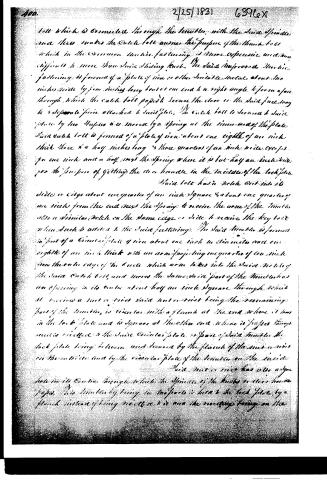
Page 3.
400. 2/25/1831 63960X
bolt which is connected through the trundle with the said spindle, and this makes the catch bolt answer the purpose of the thumb bolt which in the common manner fastening is more expensive and more difficult to move than said sliding bolt. The said improved thumb fastening is formed of a plate of iron or other suitable metals about two inches wide by four inches long but at one end at a right angle to form a face through which the catch bolt passes to secure the door to the said face may be a separate piece attached to said plate. The catch bolt is secured to said plate by two staples & is moved by a spring at the inner end of the plate. Said catch bolt is formed of a plate of iron about one eighth of an inch thick three & a half inches long & three quarters of an inch wide except for one inch and a half near the spring where it is but half an inch wide for the purpose of getting the door handle in the middle of the lock plate.
Said bolt has a notch cut into its sides or edge about one quarter of an inch square & about one quarter of an inch from the end near the spring to receive the cone of the thumb also a similar notch on the same edge or side to receive the key bolt when such is added to the said fastening. The said thumb is formed in part of a circular plate of iron about one inch in diameter with one eighth of an inch thick with an arm projecting one quarter of an inch from the outer edge of the circle which arm takes into the said notch of the said catch bolt, and moves the same. Said part of the thumb has an opening in its center about half an inch square through which it receives a nut or piece said nut or nut being the remaining part of the thumb, is circular with a flange at the end where it has in the lock plate and is square at the other end where it passes through said nut or nut has also a hole in its center through which the spindle of the knob or door handle passes. This thumb by being in the plate is held to the lock plate by a flange instead of being riveted to it and the nut being on the
Page 4.
2/25/1831 6396X 401
mutter & bolt moving is not liable to wear loose and separate from the lock plate as the common mortice does from its being in one piece and useless to the stationary lock plate. The key hole when such is opposed to the short door fastening is very small and is secured to the lock plate at right angles with the catch bolt & when moved by the key thrusts into the before mentioned notch of said catch bolt which is then immovable and serves the purpose of the common key bolt.
The Catch on the door frame which is usually straight has the angle or inclined plane requisite to force the catch bolt back and renders it unnecessary that said bolt should be any thicker than thought requires though the usual thickness of the catch bolt in door fastenings is nearly half an inch. A thin strip thought necessary to get an inclined plane of length and angle sufficient to force said bolt back on closing the door.
The above improvements are applicable to mortice door fastenings moved either by sliding or turning door bolts.
Said mortice door fastening may also be made with a top plate or cover which with the nails or screws to secure it to the bottom or main plate would render the staples which secure the catch bolt to the main plate unnecessary. The turnbuckle in the latter case might be in one piece & both ends round to turn to the top & bottom plates in the common way.
That I Claim as my improvements in said mortice lock or door fastening may be whole lock or what is such a portion or combination of the before described parts of said door fastening if not hereinafter formed and combined in mortice door fastenings as result in a mortice door fastening to flat or three as not to weaken the the morticed part of the door like the common mortice fastening, nor so narrow as to be embraced & strengthened by the counterbores nor by the sliding back on said mortice, it being less expensive and more easily and safely moved than the thumb bolt of the common mortice fastening.
And by these improvements said mortice door fastening is made applicable to common doors and door fastenings.
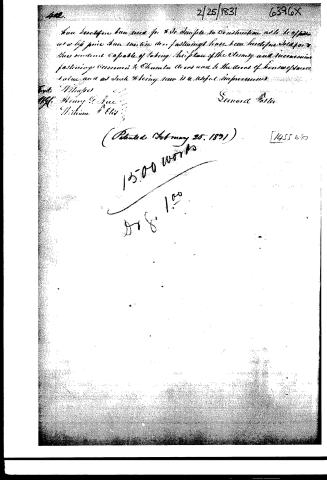
Page 5.
2/25/1831
have heretofore been used for the purpose in construction and to be applied at a less price than the iron door fastenings have been heretofore used for, has rendered capable of taking the place of the clumsy and inconvenient fastening common to Chamber doors and to the doors of houses of more value, and as such being new is a useful improvement.
Signed:
Steward Foster
( Patented February 25, 1831 )
15.00 WTP
1.00
Published accounts: journal notice
Notice in the monthly list of patents, with remarks
Journal of the Franklin Institute, new ser., vol. 7 (1831), p. 379 · View the page
40. For an improvement in Mortise Door Fastenings; Leonard Foster, Boston, Massachusetts, February 25.
Remarks. This is to be a substitute for the common mortise lock; but it is to be so constructed as not to occupy more than half the width, or thickness, usually required for such locks; adapting it, therefore, to thinner doors, and weakening the door much less than ordinary. The bolt is to be shot forward either by a turning or sliding knob, which projects through the escutcheons. The escutcheons are to be made of metal plates, three inches square, and as the body of the lock is but two inches, the screws by which these are fastened enter the solid parts of the door, above and below the lock. On the inside of the door there is a small bolt which enters the main bolt, and secures it in its place. When it is desired to have the door to lock on the outside, a small lock, like those used for drawers, is fixed under the bolt of the mortise lock, which has a notch in it to receive the bolt of the small lock. The advantage, thus obtained, is the carrying of a small key instead of a large one. To enable the bolt to spring back as the door closes, the plate on the door post is made to slope, the thickness of the bolt itself not being sufficient for that purpose. The claims are to the construction and arrangement of the various parts of the door fastening.
About this record
- Patentee
- DATAMP
- Date
- the Name and Date index of patents, DATAMP, USPTO records
- Invention
- DATAMP
- Listed in
- the Name and Date index of patents, DATAMP, USPTO records, Jim Shaw's X-patent list, the Journal of the Franklin Institute, Burke's List of Patents (1847)
- Burke's 1847 Patent Office list gives the same patent.