

Drawings and documents
National Archives restored drawings: drawing
John Woolley's Patent Drawing for a Machine for Turning Edges of Sheet Metals

National Archives, Restored Patent Drawings (Record Group 241) · Full-size scan at the National Archives · Catalog record
Show the text on the drawing Hide (117 words)
Words on the drawing as machine-read by the National Archives; not checked. Useful mainly for searching.
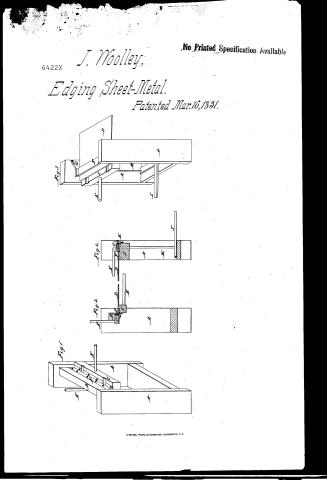
ARTAL WARE, MAKING, / WARE, / Edging Sheets. / Edging Sheets / $150 / MAKING John Wedley. / CLASSI NCATION / 6422-+ / Turning Edges of theet metals / DIVISION. / Patented 16 March 1831, / Moushine / Fig 3 / Fig.). / Fig.2. / Figh. / E's / C'VE / madel burned / Part / References. / Fif1. edgang machine, Fif.2. section of 1. / Patent OfficeDed'9 16 / Fid 4 section of is / Fir. 3.modifica tion of edgeing machine, / Made under the direction of the Commision of Paten / A. frame. B. horizontal bar. C.C.' moovable bars. / Steel blades / D. coppersheet. Ehandles F. former. aspring Hrest. I.becl. / in conformity with Act of Cougrep 3 March 1841, / K.board. I.treadle. M. connecting rod. / NL Month / Commipioner of Paters
USPTO scan
The patent as scanned by the USPTO
-
 Page 1
-
 Page 2
-
 Page 3
-
 Page 4


U.S. Patent and Trademark Office · Google Patents
Show the transcription Hide (1,113 words)
Machine transcription (LightOnOCR) of the pages as scanned by the USPTO, most of them the handwritten copies made when the records were restored after the 1836 fire. Not checked; it can misread handwriting, so compare it with the scan.
Page 1.
6422X
J. Woolley.
Edging Sheet-Metal.
Patented Mar. 16, 1831.
No Printed Specification Available

Page 2.
Mar 16, 1831
John Woolley of New York City.
Letters Patent.
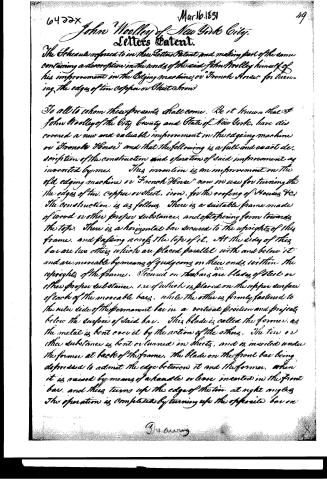
The Schedule referred to in the Letters Patent and making part of the same containing a description in the words of the said John Woolley himself of his improvement in the Edging machine, or "French Horse" for turning the edges of tin, copper or sheet iron.
To all to whom these presents shall come. Be it known that I John Woolley of the City, County and State of New York, have discovered a new and valuable improvement in the edging machine or "French Horse" and that the following is a full and exact description of the construction and operation of said improvement as invented by me. This invention is an improvement on the old edging machine or "French Horse" now in use for turning the edges of tin, copper or sheet iron, for the roofing of Houses, etc. The construction is as follows. There is a suitable frame made of wood or other proper substance, and of tapering form towards the top. There is a horizontal bar secured to the uprights of this frame, and passing across the top of it. At the sides of this bar are two others which are placed parallel with and below it and are movable by means of guide bars on their ends within the uprights of the frame. Secured on the bars are blades of steel or other proper substance, one of which is placed on the upper surface of each of the movable bars, while the other is firmly fastened to the under side of the permanent bar in a vertical position and projects below the surface of said bar. This blade is called the former, as the metal is bent over it by the action of the other. The tin or other substance is bent or turned in sheets, and is inserted under the former at back of the frame, the blade on the front bar being depressed to admit the edge between it and the former. When it is raised by means of a handle or lever inserted in the front bar, and thus turns up the edge of the tin at right angles. The operation is completed by turning up the opposite bar on
Page 3.
6422x
Mar 16, 1831
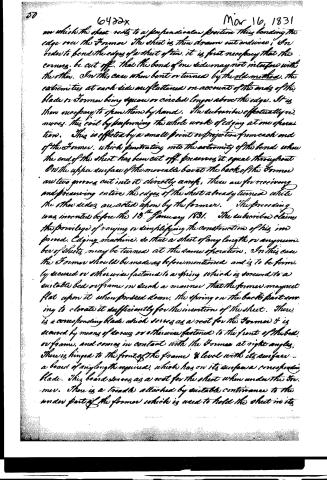
on which the sheet rests to a perpendicular position thus bending the edge over the former. The sheet is then drawn out andwise. In order to bend the edges of a sheet of tin, it is first necessary that the corners be cut off, that the bend of one side may not interfere with the other. In this case when bent or turned by the old method, the extremities at each side are flattened on account of the ends of the blade or former being square or circular longer above the edge. It is then necessary to open them by hand. The subscriber effectually removes this evil by performing the whole work of edging at one operation. This is effected by a small point or projection from each end of the former, which penetrating into the extremity of the bend, when the end of the sheet has been cut off, preserves it equal throughout. On the upper surface of the movable bar (at the back of the former) are two grooves cut into it directly across. These are for receiving and forming entire the edges of the sheet already turned while the other sides are acted upon by the former. The preceding was invented before the 13th January 1831. The subscriber claims the privilege of varying or simplifying the construction of his improved edging machine, so that a sheet of any length or any number of sheets may be turned at the same operation. In this case the former should be made as before mentioned and is to be firmly secured or otherwise fastened to a spring which is screwed to a suitable bed or frame in such a manner that the former may not flat upon it when pressed down. The spring on the back part serving to elevate it sufficiently for the insertion of the sheet. There is a corresponding blade which serves as a rest for the former & is secured by means of screws or otherwise fastened to the front of the bed or frame, and comes in contact with the former at right angles. There is hinged to the front of the frame & level with its surface a board of any length required, which has on its surface a corresponding blade. This board serves as a rest for the sheet when under the former. There is a treadle attached by suitable contrivances to the under part of the former which is used to hold the sheet in its
Page 4.
6422x
Mar. 16, 1831
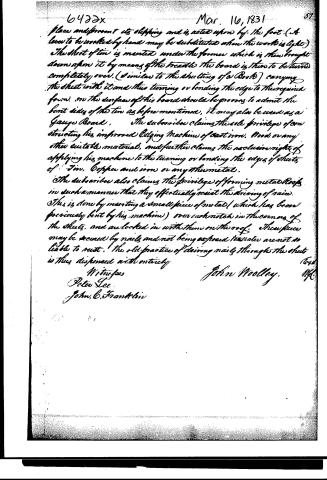
place and prevent its slipping and is acted upon by the foot. (A lever to be worked by hand may be substituted when the work is light.) The sheet of tin is inserted under the former which is then brought down upon it by means of the treadle; the board is then to be turned completely over. (Similar to the shutting of a Book) carrying the sheet with it and thus turning or bending the edge to the required form. On the surface of this board should be grooves to admit the bent sides of the tin as before mentioned, it may also be used as a Gauge Board. The subscriber claims the sole privilege of constructing his improved Bending Machine of cast iron, Wood or any other suitable material, and further claims the exclusive right of applying his machine to the turning or bending the edges of sheets of Tin, Copper and iron or any other metal.
The subscriber also claims the privilege of forming metal Roofs in such a manner that they effectively resist the driving of rain. This is done by inserting a small piece of metal (which has been previously bent by his machine) over each notch in the corners of the sheets, and are locked in with them on the roof. These pieces may be secured by nails and not being exposed to water are not so liable to rust. The old practice of driving nails through the sheet is thus dispensed with entirely.
Witnesses
Peter Lee
John C. Franklin
John Woolley.
Ford
N.H.
Published accounts: journal notice
Notice in the monthly list of patents, with remarks
Journal of the Franklin Institute, new ser., vol. 8 (1831), p. 15 · View the page
21. For an Edging Machine, or "French horse," for turning the Edges of Tin, copper, or sheet iron, for roofing; John Woolley, city of New York, March 16.
Remarks. The improvements made upon this machine do not stand sufficiently alone in the specification to enable us to distinguish them clearly. One, however, is stated to be the preventing of the closing or flattening of the ends of the bend first formed, by the subsequent bending of the other sides. This is effected by providing grooves in the machine into which these first formed edges pass. The claims made are rather vague in their character, such as the privilege of varying the machine, and constructing it of different materials. But there is one claim which certainly belongs to another subject, as it makes no part of the edging machine. It is as follows. "The subscriber claims the privilege of forming metal roofs in such a manner that they effectually resist the driving of rain. This is done by inserting a small piece of metal, (which has been previously bent by his machine,) over each notch in the corners of the sheets; these are to be locked in with them on the roof. These pieces may be secured by nails, and not being exposed to the water, are not so liable to rust. The old practice of driving nails through the sheets is thus dispensed with entirely."
About this record
- Patentee
- DATAMP
- Date
- the Name and Date index of patents, DATAMP, USPTO records
- Invention
- DATAMP
- Listed in
- the Name and Date index of patents, DATAMP, USPTO records, Jim Shaw's X-patent list, the Journal of the Franklin Institute, Burke's List of Patents (1847)
- Burke's 1847 Patent Office list gives the same patent.