

Drawings and documents
National Archives restored drawings: drawing
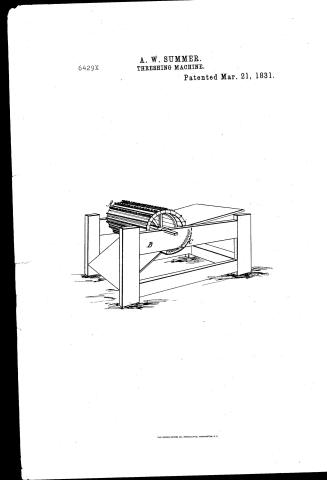
A. W. Summer's Patent Drawing for a Float and Tooth Threshing Machine

National Archives, Restored Patent Drawings (Record Group 241) · Full-size scan at the National Archives · Catalog record
Show the text on the drawing Hide (143 words)
Words on the drawing as machine-read by the National Archives; not checked. Useful mainly for searching.
Entered. / $150 / 130. THRASHING. / Thrashing Machines. / A. Cylinder Machines. / A.W.Summer- / CLASSIFICATION / 6429+ / A.H.Summers. / DIVISION. / Hoat Thrashing machine / Patented 21st March 1831. / References. / A. Represents the Cylinder fourten Inches diameter with teeth and floats. 14 float and 14 rows of teeth, the floats are made of fband iron projecting five eighths / from the surface, The rows of reeth are placed one inch from centre to centre, and one rom of teeth follows the spaces in the other. mn / B. Represents the frame.m C. Shervs the manner of placing the bars in,the concave; These,lars are made dimoning and the acute angle. / direct to the centre, and the obtuse angle comes so near as to prevent wheat caps from passing th rough the acute within 1/8th of the teeth.
USPTO scan
The patent as scanned by the USPTO
-
 Page 1
-
 Page 2
-
 Page 3


U.S. Patent and Trademark Office · Google Patents
Show the transcription Hide (607 words)
Machine transcription (LightOnOCR) of the pages as scanned by the USPTO, most of them the handwritten copies made when the records were restored after the 1836 fire. Not checked; it can misread handwriting, so compare it with the scan.
Page 1.
6429X
A. W. SUMMER.
THRESHING MACHINE.
Patented Mar. 21, 1831.

THE NORRIS PETERS CO., PHOTO-LITHO., WASHINGTON, D. C.
Page 2.
6429X
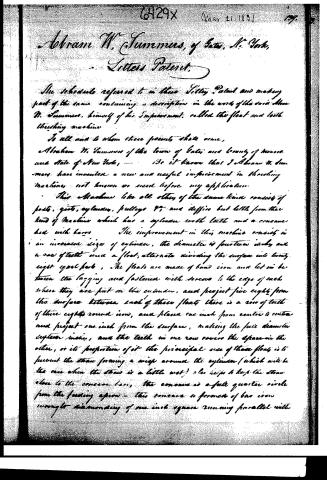
Abraham W. Summers, of Sats. N. York,
Letters Patent.
The schedule referred to in these Letters Patent and making part of the same containing a description in the work of the said Abraham W. Summers, himself of his Improvement, called the float and tooth threshing machine.
To all and to whom these presents shall come,
Abraham W. Summers of the town of Sats. and county of Monroe and state of New York, — Be it known that I Abraham W. Summers have invented a new and useful improvement in threshing machines, not known or used before my application.
This Machine like all others of the same kind consists of posts, girts, cylinders, pulleys &c, and differs but little from that kind of Machine which has a cylinder with teeth and a concave bed with bars. The improvement in this machine consists in an increased size of cylinder, the diameter is fourteen inches and a row of teeth and a float, alternate dividing the surface into twenty-eight equal parts. The floats are made of band iron and let in between the laggings and fastened with screws to the edge of each where they are put on the cylinder, and project five eighths from the surface between each of these floats there is a row of teeth of three eighths round iron, and placed one inch from center to center and project one inch from the surface, making the full diameter eighteen inches, and the teeth in one row covers the space in the other, or its proportion of it. The principal use of these floats is to prevent the straw forming a wrap around the cylinder (which will be the case when the straw is a little wet) also helps to keep the straw close to the concave bars, the concave is a full quarter circle from the feeding apron — this concave is formed of bar iron wrought diamonding of one inch square running parallel with
Page 3.
3/21/1831 6429x
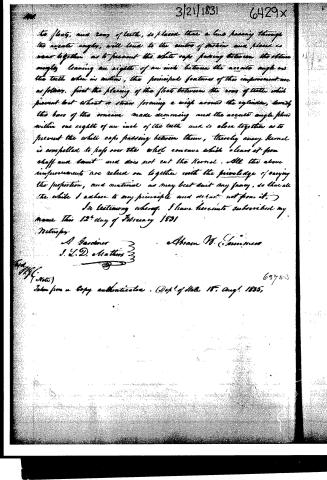
the flutes, and rows of teeth, is placed that a line passing through the acute angle, will lead to the center of motion and placed as near together as to prevent the white caps passing between the obtuse angles, leaving an eighth of an inch between the acute angle and the teeth when in motion, the principal features of this improvement are as follows. First the placing of the flutes between the rows of teeth which prevent but what a straw forming a wrap around the cylinder, binds the bars of the cone made descending and the acute angle placed within one eighth of an inch of the teeth and is close together as to prevent the white caps passing between them, thereby every kernel is compelled to pass over the whole cone which cleans it from chaff and dust and does not cut the kernel. All the above improvements are relied on together with the privilege of varying the proportion, and material as may best suit any fancy, so that all the while I adhere to my principle and depart not from it.)
In testimony whereof, I have hereunto subscribed my name this 12th day of February 1831
Witnesses:
A. Gardiner
J. L. D. Mathews
A. W. Simmons
637 (Note)
Taken from a copy authenticated. Dep't of State 18th Augt. 1835,
Published accounts: journal notice
Notice in the monthly list of patents, with remarks
Journal of the Franklin Institute, new ser., vol. 8 (1831), p. 17 · View the page
28. For a Thrashing Machine; Abraham W. Summers, Gates, Monroe county, New York, March 21.
Remarks. The cylinder of this machine has rows of teeth set along it, from end to end, and between each of these rows there is what the patentee calls a float, which is a piece of hoop iron set edgewise, and projecting about five-eighths of an inch from the cylinder. The hollow segment is formed of straight bars, set side by side, and presenting an acute angle to the cylinder. The patentee says"The principal features of this improvement are as follows. The placing of the floats between the rows of teeth, which prevent wet wheat or straw forming a wisp round the cylinder. The bars of the VOL. VIII.-No. 1.-JULY, 1831. 3 concave made diamonting, and the acute angle placed within an eighth of an inch of the teeth, and so close together as to prevent the white caps passing between them. Thereby every kernel is compelled to pass over the whole concave, which clears it from chaff, and smut, and does not cut the kernel."
About this record
- Patentee
- DATAMP
- Date
- the Name and Date index of patents, DATAMP, USPTO records
- Invention
- DATAMP
- Listed in
- the Name and Date index of patents, DATAMP, USPTO records, Jim Shaw's X-patent list, the Journal of the Franklin Institute, Burke's List of Patents (1847)
- Burke's 1847 Patent Office list gives the same patent.