

Drawings and documents
National Archives restored drawings: drawing
William Lawrence's Patent Drawing for a Hanging Lamp

National Archives, Restored Patent Drawings (Record Group 241) · Full-size scan at the National Archives · Catalog record
Show the text on the drawing Hide (115 words)
Words on the drawing as machine-read by the National Archives; not checked. Useful mainly for searching.
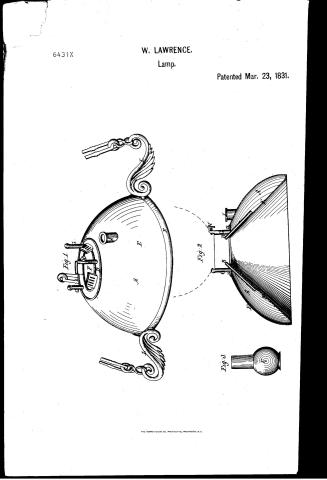
67. LAMPS & GAS FITTINGS, / Wm Lawrna, / Vol.13,7421, 70,21, / Harps and Hangers. / Hanging Lamp / Patented 23, March 1831, / ASSIFICATION / 6431.+ / Fifl / DIVISION. / ШТ / Fif.2, / III / Fifes. / References. / Fif.1.I amp. / Fid.2. Virtical section. / Fig.3. Lamp glass, / Patent Office 90 Sept 1841 / A body of la mp. / Made under the derection of the Commission A Patents / B. wiek tubes. b. slits in tubes. / C.glass tube, D.f lat top surface, / in conformity with act of bougrep 3 March 1837, / Ol / E.outer shell. Einner shell. / G. slandards for holding glass. / Mengh Sumorth / H. screw / I. feeder. R. band to hold lamp. / Nonmiprom of Patents, / I. scrolls for r suspending.
USPTO scan
The patent as scanned by the USPTO
-
 Page 1
-
 Page 2
-
 Page 3
-
 Page 4


U.S. Patent and Trademark Office · Google Patents
Show the transcription Hide (1,273 words)
Machine transcription (LightOnOCR) of the pages as scanned by the USPTO, most of them the handwritten copies made when the records were restored after the 1836 fire. Not checked; it can misread handwriting, so compare it with the scan.
Page 1.
6431X
W. LAWRENCE.
Lamp.
Patented Mar. 23, 1831.

THE NORRIS PETERS CO., PHOTO-LITHO., WASHINGTON, D. C.
Page 2.
Mar 23, 1831
William Lawrence - New Haven, Connecticut
Letters Patent
(Patented March 23, 1831. Reissued March 10, 1834.)
The Schedule referred to in these Letters Patent and making part of the same, containing a description in the words of the said William Lawrence himself of his improvement in the Chandelier or hanging Lamp, for which Letters Patent, duly noted, dated the 23 day of March 1831, which Letters Patent being hereby cancelled in account of a defective Specification.
To all to whom these presents shall come. Be it known that I William Lawrence of New Haven in the County of New Haven and State of Connecticut have invented a new and useful improvement in the Chandelier or hanging lamp that on the twenty-third day of March in the year of one thousand eight hundred and thirty-one, and of the Independence of the United States of America the fifty-fifth I obtained Letters Patent of the said United States in due form for said invention or improvement, signed by Andrew Jackson President of the United States, and with the seal of the United States thereunto affixed. And finding the specification of the said invention or improvement, made by me and annexed to said Letters Patent to be defective and inaccurate, I have amended the said Letters Patent and caused the same to be recorded in the department of State of the United States, and now for the purpose of obtaining Letters Patent for said invention or improvement for the unexpired part of the fourteen years since obtaining the first patent, I hereby declare that the following is a full and exact description of the said Chandelier or hanging Lamp as invented or improved by me — The principal object of my improvement is to secure a more perfect and equal diffusion of clear and vivid light as well under as above and around the lamp. This effected by an opening through the body of the Lamp or vessel containing the oil of such form and situation to the location of the wicks as not materially to intercept the radiation of light and by a requisite number of wicks placed in tubes inserted in the upper part of the lamp and by a glass tube placed at a proper height above the upper extremity of the body of the lamp. By this combination
Page 3.
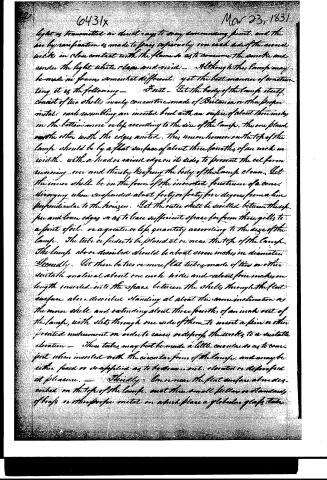
light is transmitted in direct rays to any commanding point, and the air by rarefaction is made to pass especially over each side of the smoke wicks in close contact with the flame so as to consume the smoke and render the light white clear and vivid. Although this lamp may be made in forms somewhat different, yet the best manner of constructing it is the following—
First—Let the body of this lamp itself consist of two shells nearly concentric made of Britannia or other proper metal, each resembling an inverted bowl with an orifice of about three inches in the bottom more or less, according to the size of the lamp, the one placed over the other with the edges united. This union however on the top of the lamp should be by a flat surface of about three fourths of an inch in width, with a head or raised edge on its sides to prevent the oil from running over and thereby keeping the body of the lamp clean. Let the inner shell be in the form of the inverted fourteenths of a cone, diverging when suspended about forty or forty-five degrees from a line perpendicular to the horizon. Let the outer shell be worked between the upper and lower edges so as to leave sufficient space for from three grills to a pint of oil, or a greater or less quantity according to the size of the lamp. The tube or feeder to be placed at or near the top of the lamp. The lamp above described should be about seven inches in diameter.
Secondly—Let there be two or more flat tubes made of tin or other suitable material about one inch wide and about four inches in length inserted into the space between the shells through the flat surface above described standing at about the same inclination as the inner shell and extending about three fourths of an inch out of the lamp, with slits through one side of them to insert a fine or other pointed instrument in order to raise or depress the wicks to a suitable elevation—These tubes may best be made a little crescent so as to correspond when inserted with the circular form of the lamp, and may be either fixed or so applied as to be drawn out, elevated or depressed at pleasure.
Thirdly—On or near the flat surface above described on the top of the lamp, insert three small pillars or standards of brass or other proper metal on which place a globular glass tube
Page 4.
6431x
Mar. 23, 1831
20
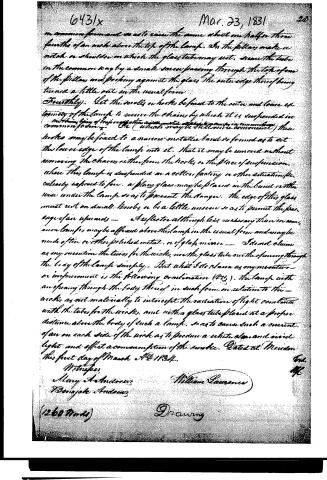
in common form and so as to raise the same about one half or three fourths of an inch above the top of the lamp. On the pillars make a notch or shoulder on which the glass tube may rest. Secure the tube in the common way by a small screw passing through the top of one of the pillars and pressing against the glass the outer edge thereof being turned a little out in the usual form.
Fourthly. Let the scrolls or hooks be fixed to the outer and lower extremity of the lamp to receive the chains by which it is suspended in common form. (which may be either more convenient) these hooks may be fixed to a narrow metallic band so formed as to set the lower edge of the lamp into it. That it may be removed without removing the chains either from the hooks or the place of suspension.
Where this lamp is suspended in a cotton factory or other situation peculiarly exposed to fire, a plane glass may be placed in the band or other wire under the lamp so as to prevent the danger. The edge of this glass must rest on small knobs or be a little uneven so as to permit the passage of air upwards — a reflector although less necessary than in some common lamps, may be affixed above the lamp in the usual form and may be made of tin or other polished metal, or of glass mirror — I do not claim as my invention the tubes for the wicks, nor the glass tube or the opening through the body of the lamp simply. But what I do claim as my invention or improvement is the following combination (Fig.). The lamp with an opening through the body thereof in such form in relation to the wicks as not materially to intercept the radiation of light contained with the tubes for the wicks, and with a glass tube placed at a proper distance above the body of such a lamp, so as to cause such a current of air on each side of the wick as to produce a white clear and vivid light and effect a consumption of the smoke. Dated at Maiden this first day of March A.D. 1831.
Witnesses
Mary A. Andrews
Benajah Andrews
William Lawrence
(1260 Words)
Drawing
Pat. 14
Published accounts: journal notice
Notice in the monthly list of patents, with remarks
Journal of the Franklin Institute, new ser., vol. 8 (1831), p. 18 · View the page
30. For an improvement in the Chandelier, or Hanging Lamps; William Lawrence, Meriden, New Haven county, Connecticut, March 23.
Remarks. This hanging lamp has a reservoir, or chamber, in a form somewhat This reserresembling that of the astral lamp now in such general use. voir is composed of two shells soldered at their lower edges, and allowing a space between their upper edges for flat tubes with wicks to pass out. It is proposed, sometimes, to cover the funnel shaped opening at the lower edge with a pane of glass, cараble of being removed for cleaning; the glass is represented in the drawing by the straight line at bottom. "By this improvement much of the light of the lamp will be reflected and concentrated from the inner surface of the globe glasses, and pass diverging by means of the opening through the body of the lamp, and thus prevent the shadow of that, and cause an equal diffusion of light; they are peculiarly adapted to work shops, binacles, &c. and may be made of all sizes." " I do not claim as my invention, the suspended lamp, the glass globed tubes, and the reflector in common use; nor the opening simply through the body of the lamp. But I do claim as my invention the means of making them altogether more useful than heretofore, viz. by the bell shaped opening of the well; the tubes for the wicks; the feeders; the bottom glass; and the mode of construction and suspension, as above described, and thereby its adaptation to produce the results specified above."
Published accounts: journal notice
Notice in the monthly list of patents
Journal of the Franklin Institute, new ser., vol. 14 (1834), p. 238 · View the page
23. For a Chandelier, or Hanging Lamp; William Lawrence, Meriden, New Haven county, Connecticut. First patented March 23, 1831.
About this record
- Patentee
- DATAMP
- Date
- the Name and Date index of patents, DATAMP, USPTO records
- Invention
- DATAMP
- Listed in
- the Name and Date index of patents, DATAMP, USPTO records, Jim Shaw's X-patent list, the Journal of the Franklin Institute, Burke's List of Patents (1847)
- Burke's 1847 Patent Office list gives the same patent.