

Drawings and documents
USPTO scan
The patent as scanned by the USPTO
-
 Page 1
-
 Page 2
-
 Page 3
-
 Page 4


U.S. Patent and Trademark Office · Google Patents
Show the transcription Hide (768 words)
Machine transcription (LightOnOCR) of the pages as scanned by the USPTO, most of them the handwritten copies made when the records were restored after the 1836 fire. Not checked; it can misread handwriting, so compare it with the scan.
Page 2.
United States Patent
Patent No.: X6448
John Ames
Letters Patent Dated April 6, 1836.
The Schedule referred to in these Letters Patent and making part of the same, containing a description in the words of the said John Ames himself of his improvement in the method of "washing rags for the manufacture of Paper"
Know all men by these presents, that I John Ames of Springfield in the County of Hampden and Commonwealth of Massachusetts, Gentleman, have invented, constructed, made and applied to use, a new and useful improvement in the mode or method of washing rags and in the manufacture of paper, by machinery set forth and specified in the words following my. The improvement consists in dispensing with the washers or screens now in use and substituting in their stead, a wire cloth cylinder for carrying off the dirt and filth which may be held in the rags or held in solution by the water, without the wash and delay of the old mode. The cylinder used by me is about twenty two inches in length and twenty two inches in diameter, hollow, closed at one end, open at the other, surrounded by two coats or coverings of wire cloth, and revolves upon an axis. I construct the cylinder as follows. The frame consists of metallic rods of suitable length, and sufficient in number to give strength and form to the cylinder, running parallel with the axis and supported by arms of the same metal. Over these rods is first stretched a coarse wire cloth and then over
Page 3.
United States Patent
Patent No.: X6448
that is stretched under a wire cloth of finer texture; any reticulated material however will do for the inner covering as its principal object and use is to support the outer one without opposing any considerable obstacle to the free passage of the water into the cylinder. The cylinder is left open at one end but is entirely closed by a metal disk at the other.
Thus constructed it is fixed in the washing vats or engine, resting on rollers with the open end adjusted to the side of the engine or vat so closely as to prevent a waste of the stock, and placed at a convenient height to allow a free passage of the rags around the engine.
Within the circle described by the periphery of the open end of the cylinder in front the side of the engine, an orifice is made to let off the water which penetrates into the cylinder. A band or gearing connected with other parts of the machinery communicates a rotary motion upon its axis, to the cylinder corresponding with the current, or roll of the stuff around in the engine.
The benefit and utility of this improvement consists, 1st in the saving of time in preparing the rags for manufacture. 2nd in dispensing with the washer now in use; and 3rd in preventing a waste of stock, which in the ordinary mode of cleaning is very considerable. By my improved mode the dirty water is made to pass off more rapidly, and of course the clean water can be admitted more freely, than when washers are used through the apertures of which, the pulp is driven by the force of the roll or motion of the water and so wasted, or clogs the washers by filling up the apertures and prevents the passing of the dirty water. By the rotary motion
Page 4.
United States Patent
Patent No.: X6448
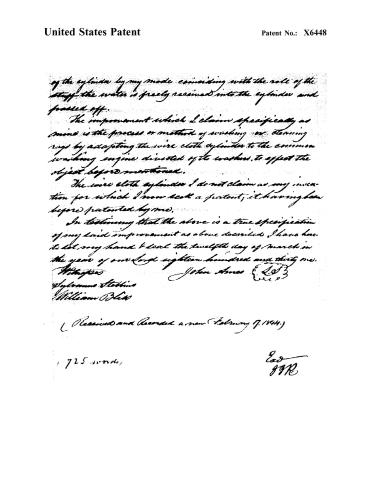
of the cylinder by my mode coinciding with the roll of the
stuff the water is freely received into the cylinder and
pressed off.
The improvement which I claim specifically as
mine is the process or method of washing or cleaning
rags by adapting the wire cloth cylinder to the common
washing engine directed of the washer, to effect the
object before mentioned.
The wire cloth cylinder I do not claim as any invention
for which I now seek a patent, it having been
before patented by me.
In testifying that the above is a true specification
of my said improvement as above described, I have here
to set my hand & seal the twelfth day of March in
the year of our Lord eighteen hundred and thirty one.
Witnesses
Sylvanus Stobbins
William Black
John Stone
(Received and Recorded a new February 7, 1844.)
725 words
Ead
JPR
Published accounts: specification
Specification printed in the Journal of the Franklin Institute
Journal of the Franklin Institute, new ser., vol. 8 (1831), p. 127 · View the page
Text of the specification as printed in the Journal, from OCR; not proofread.
Specification of a patent for an improvement in the method of Washing Rags for the manufacture of Paper. Granted to JOHN AMES, Springfield, Hampden county, Massachusetts, April 6, 1831. THE improvement consists in dispensing with the washers, or screens now in use, and substituting in their stead a wire cloth cylinder, for carrying off the dirt and filth which may be beaten from the rags, or held in solution in the water, without the waste and delay of the old mode. The cylinder used by me is about twenty-two inches in length, and twenty-two inches in diameter, hollow, closed at one end, open at the other, surrounded by two coats, or coverings of wire cloth, and revolves upon an axis. I construct the cylinder as follows: the frame consists of metallic rods of suitable length, and sufficient in number to give strength and form to the cylinder, running parallel with the axis, and supported by arms of the same metal. Over these rods is first stretched a coarse wire cloth, and then over that is stretched another wire cloth of finer texture; any reticulated material, however, will do for the inner covering, as its principal object and use is to support the outer one without opposing any considerable obstacle to the free passage of the water into the cylinder. The cylinder is left open at one end, but is entirely closed by a metal disk at the other. Thus constructed, it is fixed in the washing vat, or engine, resting on arbours, with the open end adjusted to the side of the engine or vat, so closely as to prevent a waste of the stock, and placed at a convenient height to allow a free passage of the rags around in the engine. Within the circle described by the periphery of the open end of the cylinder upon the side of the engine, an orifice is made to let off the water which percolates into the cylinder. A band or gearing connected with other parts of the machinery communicates a rotary motion upon its axis to the cylinder, corresponding with the current, or roll of the stuff in the engine. The benefit and utility of this improvement consist, 1st, in the saving of time in the preparing the rags for manufacture; 2nd, in dispensing with the washers now in use; 3d, in preventing a waste of stock, which in the ordinary mode of cleaning is very considerable. By my improved mode the dirty water is made to pass off more rapidly, and of course the clean water can be admitted more freely than when washers are used, through the apertures of which the pulp is driven by the force of the roll, or motion of the beaters, and so wasted, or clogs the washers by filling up the apertures, and prevents the passing off of the dirty water. By the rotary motion of the cylinder, by my mode, coinciding with the roll of the stuff, the water is freely received into the cylinder, and passes off. The improvement which I claim especially as mine, is the process, or method, of washing, or cleaning, rags, by adapting the wire cloth cylinder to the common washing engine divested of its washers, to effect the objects before mentioned. The wire cloth cylinder I do not claim as my invention for which I now seek a patent; it having been before patented by me. Ames' Rag Washing Machine. D B A A, the vat. JOHN AMES. B, the wire gauze covering to the cylinder. C, the open end of the cylinder running close to the vat. D, the opening through which water escapes.
Published accounts: specification
Specification printed in the Journal of the Franklin Institute
Journal of the Franklin Institute, new ser., vol. 8 (1831), p. 348 · View the page
Text of the specification as printed in the Journal, from OCR; not proofread.
Specification of a patent for a new method of Washing Rags in the manufacturing of Paper. Granted to DAVID AMES, Jr. and JOHN AMES, Springfield, Hampden county, Massachusetts. Assignees of Samuel Eckstein, Philadelphia, June 13, 1831. INSTEAD of the washer, or screw, now in use, I employ a circular disk or plate, which is covered with wove wire, and is made to revolve within the cistern, or vat, of the paper engine, against the side opposite to that on which the cylinder, or roll, is placed. The revolution of the circular disk is effected by means of a pinion upon the shaft of the engine, which pinion mashes into a cog wheel placed upon the same shaft upon which the disk, or plate, is fixed, and with which it revolves. A brass ring, which may be one foot in diameter, and one inch in thickness, is fastened by bolts, or screwed, on the inside of the cistern, concentric with the shaft upon which the disk, or plate, revolves. This shaft carries, upon its inner end, a brass wheel, which may be twenty-two inches in diameter, more or less. The face of this wheel, towards the inside of the engine, receives the covering of wove wire. It has on the back of it a secondary or smaller rim, of such a size as to fit against the fixed ring, first mentioned, and forming a joint with it. A rim of wood is screwed on to the face of the larger brass wheel, to which to attach the facing of wove wire through which the water is to run from the vat. Below the fixed ring, a space six inches wide, and an inch deep, is cut out of the side of the engine, and through to the bottom; this space, when covered with a sheet of copper, forms a vent for the water which passes from the engine through the wove wire into the space formed by the projection of the fixed ring. Through this wire disk, and these openings, the water finds a free exit, without obstructing the motion of, or wasting, the pulp. A larger quantity of water, therefore, may be admitted into the vat, than is ordinarily done; and the washing is more rapidly, effectually, and economically performed, than by any other means now in use. What I claim as my invention, is the revolving disk, or plate, covered with wove wire, and so placed within the vat of a paper engine as to allow the water to pass freely through it, upon the principle, and for the purposes herein described. SAMUEL ECKSTEIN. It will be seen that the effect produced by the invention of Mr. Eckstein is similar to that of Mr. Ames, the specification of which Down's Improvements in Gas for Illumination. may be found at page 127. To prevent all interference the Messrs. Ames became the purchasers of the improvement above described.
Published accounts: specification
Specification printed in the Journal of the Franklin Institute
Journal of the Franklin Institute, new ser., vol. 11 (1833), p. 178 · View the page
Text of the specification as printed in the Journal, from OCR; not proofread.
Specification of a patent for an improvement in the method of sizing paper by machinery. Granted to JOHN AMES, Springfield, Massachusetts, Septemper 1, 1832. To all persons to whom these presents shall come, John Ames, of Springfield, in the county of Hampden and commonwealth of Massachusetts, gentleman, sends greeting: AMES' Mode of Sizing Paper. Be it known that I, the said John Ames, have invented, made, and applied to use, a new and useful invention and improvement in the method and process of sizing paper by machinery, as is herein set forth and specified, viz. Upon a frame of proper strength and materials, I place, near and parallel to each other, three cylinders of wood, or metal, of about fifteen or twenty inches in diameter, and in length conforming to the width of the paper to be sized, to revolve in a horizontal position upon their respective axes. The boxes, or bearings, upon which the axis of one of said cylinders rests, are fixed; those of the other two are moveable, and governed by screws, so as to regulate the distances of the cylinders from each other. Above the line between the middle cylinder and one of the outer ones, and parallel to them, I suspend a pipe, or trough, pierced with small holes, in such a position that the sizing matter, with which said trough, or pipe, is to be filled, may drop between said two cylinders. Below said cylinders, three parallel rollers, corresponding in length with said cylinders, are arranged so that the middle roller shall be elevated a little above the line of the other two. Above the middle roller, I suspend another pipe, or trough, as above described, to be also filled with sizing matter. An endless web of felt is made to pass over one of the outer cylinders, and between it and the middle one, thence down under the middle roller; thence up between the middle cylinder and the other outer one; thence over the latter, and down under the two lowest rollers; and thence up to the place of beginning. The cylinders are to be brought in close contact by means of the screws applied to the said moveable boxes, or bearings. The paper to be sized is brought over the outer cylinder, and introduced between it and the middle one, immediately under the sizing trough, or pipe, from which the sizing matter drops, and sufficiently wets one side; it then passes under the middle cylinder to which it adheres: the felt passes down under the middle roller, and is wetted by the sizing matter oozing from the lower sizing trough, or pipe; and again ascending, it passes between the other outer cylinder and the middle one, pressing the paper against the latter, and thus sufficiently sizing the other side of the paper. The sized paper is to be then disengaged from the middle cylinder, (to which it adheres as aforesaid,) and taken off by a cylindrical or other suitable reel. The moving power is applied to the middle cylinder, which communicates motion, by friction, to the other parts of the machine connected by the endless felt. The same result may be produced by a different position and arrangement of parts. I do not claim the cylinders, endless felt web, or other parts of the machine, separately, as my invention; all that I claim specifically as mine, is the several parts of said machine in combination, with the use of the endless felt web, for the purpose of sizing paper. JOHN AMES.
Published accounts: journal notice
Notice in the monthly list of patents, with remarks
Journal of the Franklin Institute, new ser., vol. 8 (1831), p. 111 · View the page
12. For an improvement in the method of Washing Rags in the manufacture of Paper; John Ames, Springfield, Hampden county, Massachusetts, April 6.
Remarks. (See the specification.)
Published accounts: journal notice
Notice in the monthly list of patents, with remarks
Journal of the Franklin Institute, new ser., vol. 8 (1831), p. 127 · View the page
Instead of a cylinder with teeth, there is to be a wheel like a wagon wheel, one side, or face, of which is to be covered with teeth, or beaters, to a considerable distance from its periphery, towards the centre. This wheel is to run against a corresponding piece furnished with teeth. The construction and arrangement are not clearly described, or distinctly represented in the drawing, nor is there any claim made. [TO BE CONTINUED.] SPECIFICATIONS OF AMERICAN PATENTS. Specification of a patent for an improvement in the method of Washing Rags for the manufacture of Paper. Granted to JOHN AMES, Springfield, Hampden county, Massachusetts, April 6, 1831.
Remarks. THE improvement consists in dispensing with the washers, or screens now in use, and substituting in their stead a wire cloth cylinder, for carrying off the dirt and filth which may be beaten from the rags, or held in solution in the water, without the waste and delay of the old mode. The cylinder used by me is about twenty-two inches in length, and twenty-two inches in diameter, hollow, closed at one end, open at the other, surrounded by two coats, or coverings of wire cloth, and revolves upon an axis. I construct the cylinder as follows: the frame consists of metallic rods of suitable length, and sufficient in number to give strength and form to the cylinder, running parallel with the axis, and supported by arms of the same metal. Over these rods is first stretched a coarse wire cloth, and then over that is stretched another wire cloth of finer texture; any reticulated material, however, will do for the inner covering, as its principal object and use is to support the outer one without opposing any considerable obstacle to the free passage of the water into the cylinder. The cylinder is left open at one end, but is entirely closed by a metal disk at the other. Thus constructed, it is fixed in the washing vat, or engine, resting on arbours, with the open end adjusted to the side of the engine or vat, so closely as to prevent a waste of the stock, and placed at a convenient height to allow a free passage of the rags around in the engine. Within the circle described by the periphery of the open end of the cylinder upon the side of the engine, an orifice is made to let off the water which percolates into the cylinder. A band or gearing connected with other parts of the machinery communicates a rotary motion upon its axis to the cylinder, corresponding with the current, or roll of the stuff in the engine. The benefit and utility of this improvement consist, 1st, in the saving of time in the preparing the rags for manufacture; 2nd, in dispensing with the washers now in use; 3d, in preventing a waste of stock, which in the ordinary mode of cleaning is very considerable. By my improved mode the dirty water is made to pass off more rapidly, and of course the clean water can be admitted more freely than when washers are used, through the apertures of which the pulp is driven by the force of the roll, or motion of the beaters, and so wasted, or clogs the washers by filling up the apertures, and prevents the passing off of the dirty water. By the rotary motion of the cylinder, by my mode, coinciding with the roll of the stuff, the water is freely received into the cylinder, and passes off. The improvement which I claim especially as mine, is the process, or method, of washing, or cleaning, rags, by adapting the wire cloth cylinder to the common washing engine divested of its washers, to effect the objects before mentioned.
Published accounts: journal notice
Notice in the monthly list of patents, with remarks
Journal of the Franklin Institute, new ser., vol. 8 (1831), p. 128 · View the page
The wire cloth cylinder I do not claim as my invention for which I now seek a patent; it having been before patented by me. Ames' Rag Washing Machine. D B A A, the vat. JOHN AMES. B, the wire gauze covering to the cylinder. C, the open end of the cylinder running close to the vat. D, the opening through which water escapes. Specification of a patent for an improved mode of manufacturing Spades and Shovels, by means of Machinery.-Granted to CHARLES RICHMOND and SAMUEL CASWELL, JR., Taunton, Bristol county, Massachusetts, April 7, 1831.
Remarks. To all whom it may concern, be it known that we, Charles Richmond and Saml. Caswell, Jr. have invented an improved mode of CARMAN'S Inclined Plane Friction Roller Press. manufacturing spades and shovels by machinery; whereby much labour is saved, and the articles manufactured are made with greater truth and uniformity than by the modes hitherto pursued, and that the following is a full and exact description of our said invention. The principal machinery which we employ is such as is well known to machinists; and to this, therefore, we make no claim, as we have merely so modified it, in size and form, as to adapt it to the purpose to which we apply it. That our mode of procedure may be perfectly understood, we have deposited in the Patent Office of the United States, drawings of the machinery, as modified and applied by us, and also a model of the same, corresponding with the drawings. This machinery consists, first, of a cutting press, by which the plate prepared for making a spade, or a shovel, is cut out at one operation; and by another operation is punched, to receive the rivets necessary to attach the back strap and coffer, to the plates.
About this record
- Patentee
- DATAMP
- Date
- the Name and Date index of patents, DATAMP, USPTO records
- Invention
- DATAMP
- Listed in
- the Name and Date index of patents, DATAMP, USPTO records, Jim Shaw's X-patent list, the Journal of the Franklin Institute, Burke's List of Patents (1847)
- Burke's 1847 Patent Office list gives the same patent.