

Drawings and documents
National Archives restored drawings: drawing
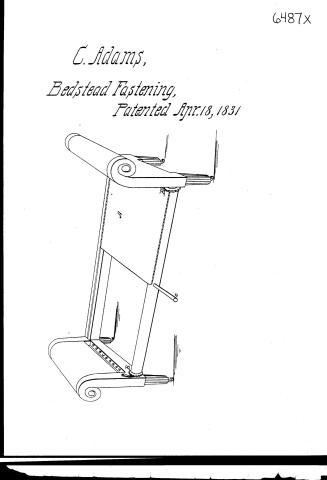
C. Adams' Patent Drawing for Couches, Sofas, Settees, and Chairs

National Archives, Restored Patent Drawings (Record Group 241) · Full-size scan at the National Archives · Catalog record
Show the text on the drawing Hide (80 words)
Words on the drawing as machine-read by the National Archives; not checked. Useful mainly for searching.
5. BEDS, / Bed Bottoms, / Fabric. / 5. BEDS / Sofa Budstiads / Vol 12. nage. 211. / [62] Cording & Fastenings / C.ADAMS / CLASSIFICATION / 6487.4 / Couches, Sofas setteese chairs / DIVISION. / Patented 15" an 183/- / A.Partoj Suching / B. Ratchet wheels click / C. Lever / 8 88 B, & 8 / did / Patent Office aug 31 1841 / Ma de under the direction of the commissioner / of Patents in conformity with act of 3° March 153y / Strickland Del" / Mennya elmorth / Commisioner of Patents
USPTO scan
The patent as scanned by the USPTO
-
 Page 1
-
 Page 2
-
 Page 3


U.S. Patent and Trademark Office · Google Patents
Show the transcription Hide (599 words)
Machine transcription (LightOnOCR) of the pages as scanned by the USPTO, most of them the handwritten copies made when the records were restored after the 1836 fire. Not checked; it can misread handwriting, so compare it with the scan.
Page 1.
C. Adams,
Bedstead Fastening,
Patented Apr. 18, 1831
6487X
Page 2.
X0006487
Apr. 18, 1831
211.
Charles Adams
Sofas Patent
The Schedule referred to in these Letters Patent and making part of this same containing a description in the words of the said Charles Adams himself of his improvement in the art of constructing and manufacturing couches, sofas, settees and chairs.
To all persons to whom these presents shall come, Charles Adams of the City of Boston County of Suffolk and Commonwealth of Massachusetts, cabinet maker, does greet: Be it known that I the said Charles Adams have invented, constituted, made and applied to use a new and useful improvement in the art of constructing and manufacturing couches, sofas, settees and chairs which I call the swivel top couch, sofa, settee, or chair. What I claim as my improvement in the manufacture of the above mentioned articles consists in the application of the swivel top principle in binding and holding together the parts and tightening the lashing or other material upon which the cushion lies which offers advantages before unknown. To give a clear illustration of this it is necessary to describe the several parts in the construction which are as follows: The several beams or rails (the front, back and end beams or rails) are formed with round turns at each end so that they may turn on the posts by a small lever, each beam or rail having at one or both ends a notched wheel or segment of one onto the tooth of which a small click falls to hold fast what the lever gains; this click is swivelled on the side of the post just above the notches. On the upper side of the end rails are three or four short pins with button heads around which a strong cord passes and alternately through eyelet holes made in the ends of the lashing, each end of the cord made fast, so that by turning the rails the lashing is tightened lengthwise. The front and back edges of the lashing may be nailed fast to the front and back beam or rails or it may be held fast on button headed pins inserted into the rails and then be tightened widthwise by turning said beams or rails. It is proper to observe that the front rail or beam may be formed firmly into the post so as to not turn and the lashing tightened by turning the back rail only. By this application
Page 3.
212.
application of the wind to the frames of the above mentioned articles may be kept tight and firm at all times. The seats are rendered more firm, elastic and comfortable with less expense of material and labor in the stiffening than if made in the common way. The frames can be taken apart at any time and rendered capable of easy removal from place to place and through small and narrow passages. They are rendered more portable and much expense of freight may be saved when shipped in consequence of close packing and the whole article may be manufactured at less expense.
In testimony that the above is a true specification of my said improvement I have hereunto set my hand and seal this first day of January in the year of our Lord one thousand eight hundred and thirty one.
Witnesses
Hannah Smister
John Johnson
Charles Adams
588 n-25
Published accounts: journal notice
Notice in the monthly list of patents, with remarks
Journal of the Franklin Institute, new ser., vol. 8 (1831), p. 125 · View the page
49. For an improvement in Couches, Sofas, Settees and Chairs, called the "Windlass couch, sofa," &c.; Charles Adams, Boston, Suffolk county, Massachusetts, April 18.
Remarks. The claim is to "applying the windlass principle in binding and holding together the parts, and tightening the sacking or other material upon which the cushion lies." The plan resembles that adopted in bedsteads, and for which a patent was obtained by the same gentleman. The rails are made round, and have round tenons, with a ratchet wheel and click at one or both ends of them. By means of these, sacking bottoms, cords, or similar appendages may be tightened. The advantages stated to accrue, are the facility with which the before mentioned articles may be kept tight; the rendering the seats always firm and elastic, with less expense of material than when stuffed in the common way. The facility of taking apart and stowing for transportation; and greater economy in construction.
About this record
- Patentee
- DATAMP
- Date
- the Name and Date index of patents, DATAMP, USPTO records
- Invention
- DATAMP
- Listed in
- the Name and Date index of patents, DATAMP, USPTO records, Jim Shaw's X-patent list, the Journal of the Franklin Institute, Burke's List of Patents (1847)
- Burke's 1847 Patent Office list gives the same patent.