

Drawings and documents
USPTO scan
The patent as scanned by the USPTO
-
 Page 1
-
 Page 2
-
 Page 3
-
 Page 4


U.S. Patent and Trademark Office · Google Patents
Show the transcription Hide (1,085 words)
Machine transcription (LightOnOCR) of the pages as scanned by the USPTO, most of them the handwritten copies made when the records were restored after the 1836 fire. Not checked; it can misread handwriting, so compare it with the scan.
Page 2.
United States Patent
Patent No.: X6504
Robert Mc Cormick of Augusta Co. Virginia
Letters Patent
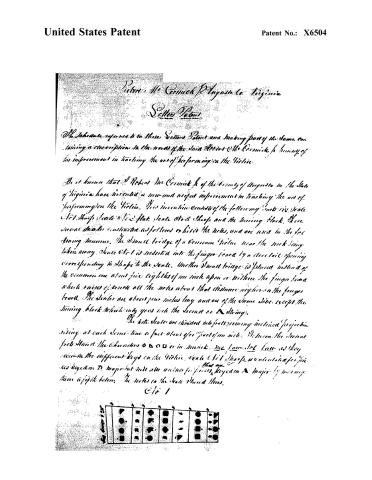
The Inventor referred to in these Letters Patent and making part of the same containing a description in the words of the said Robert Mc Cormick of his improvement in teaching the art of performing on the Violin.
It is known that Robert Mc Cormick of the County of Augusta in the State of Virginia have invented a new and useful improvement in teaching the art of performing on the Violin. This invention consists of the following parts viz. Scale & 1st Sharp Scale & 2nd flat Scale & 3rd Sharp and the tuning block. These several scales constructed as follows exhibit the notes, and are used in the following manner. The small bridge of a common Violin near the neck being taken away, Scale & 1st is inserted into the finger board by a close tail opening corresponding in shape to the scale. Another small bridge is placed instead of the common one about five eighths of an inch upon or within the finger board which raises or lowers all the notes about that distance higher on the finger board. The scales are about four inches long and are of the same size except the tuning block which only goes into the second or A string.
The note scales are divided into parts running inclined projecting rising at each some time a foot about four parts of an inch. Between the several feet stand the characters O D O U or in music the four 1st tone as they occur in the different keys on the Violin. Scale & 1st Sharp is calculated for the keys in D major but will also answer for the keys in A major by moving them a fifth below. The notes in the scale stand thus.
Fig 1

Page 3.
United States Patent
Patent No.: X6504
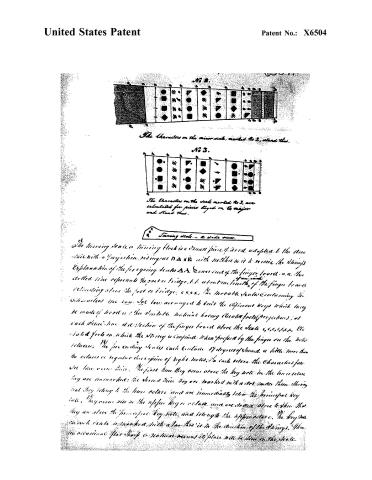
No 2.
The characters on the minor scale, marked No 2, stand thus.
No 3.
The characters on the scale marked No 3, are calculated for pieces keyed on C major and stand thus.
Tuning scale — a side view.
The tuning scale or tuning block is a small piece of wood adapted to the tune with a projection rising at DA & B with notches in it to receive the strings.
Explanation of the foregoing scales AA. Downward of the finger board, a.a. the dotted line represents the position bridge, b.b. about the fourth of the finger board extending above the fret or bridge, c.c.c.c. The movable scales containing the characters are two. Let law arranged to suit the different keys which may be made of wood or other suitable material having elevated frets/projections; at each semi-tone a section of the finger board above the scale c.c.c.c.c.c. etc. solid frets on which the string is confined when pressed by the finger on the notes returns. The preceding scales each contain 17 degrees of sound, a little more than the octaves or regular three-pair of eight notes. In each octave the characters for the law occur twice. The first time they occur above the key note in the lower octave they are minor keys; the second time they are marked with a dot under them showing that they belong to the lower octave and are immediately below the principal key note. They occur also in the upper key or octave and are dotted above to show that they are above the principal key note and belong to the upper octave. The key note on each scale is marked with a bar there in to the thickness of the strings. The occasional flat sharp or natural occurs its place with a line on the scale.
Page 4.
United States Patent
Patent No.: X6504
The letters which are represented as sharp at the beginning of a tune, have the notes placed on them and their place supplied by natural &c.
Mode of Operation During the Violin. The Violin is tuned by the tuning screw which is driven into the decant, but the note becomes much the second or A string. The treble or B string is raised to any height that may be desired. The second A string is then placed in the notch at B and the screw is then driven the same screw with the treble. The tuning scale is then shoved back in order to let the second string vibrate by the side of it. The third or G string is then placed in the notch A and drawn so nearer with the second. The tuning scale or block is shoved in the second placed in the notch B as before which will allow the third string to vibrate between A and D the fourth string is placed in the notch D and managed in like manner. This being done the tuning scale or block is removed.
Manner of Playing by These Scales. The scale is shoved into the decant which is cut out of the finger board. The fingers are placed firmly on the notes between the frets or projections as they stand on the scale which confines the string on them projecting frets from which it vibrates consequently the line will not be cut—though the fingers should move up or down a short distance. Or the characters may be placed as in the preceding drawings in a book or otherwise and committed to memory by the learner, or they may be marked on paper and placed on the finger board of the Violin; or the characters may be cut on the finger board of the violin. The first lesson I consider the best mode which is to have small thin movable scales all of one size adapted to a decant which is cut out of the finger board to receive them with elevated frets at such some time which have already been described.
I claim as my invention and for which I desire a Patent are the 3 movable scales C, D, E, F, G, A, B, and their combination together with the tuning scale or tuning block and the manner of applying the same to common Violins.
Witnesses
Wm. P. Elliot 2
Henry Bishop 3
[Signature]
Wm. Mc Cormick Jr
642
1850
Published accounts: journal notice
Notice in the monthly list of patents, with remarks
Journal of the Franklin Institute, new ser., vol. 8 (1831), p. 166 · View the page
64. For an improvement in Teaching the Art of Performing on the Violin; Robert M.Cormick, Augusta county, Virginia, April 21.
Remarks. Not being adepts in music, we will not attempt a particular analysis of the merits of the plan before us. The specification refers to three musical scales, which are delineated in it, and which we do not think it necessary to give. These scales are to be let into the finger board, by dovetails. They have frets across them at each semitone, so that when the string is pressed by the finger, it is stopped by the fret, as in some guitars, a little variation of the finger not affecting the note. These scales may be changed. One of them is for pieces keyed on D major. One on the minor scale, and the other for pieces on C major. Besides these scales, there is what is called a tuning scale, or block, which is to be slipped into the place prepared for the scales. It has projections rising on it with notches to receive the strings alternately. The object, if we understand the description, is to stop the string at such a part as shall enable the performer to tune it, by making it sound the same note with the preceding string. Thus, when the treble, or E string, is raised to the desired height, the second, or A string, is placed in the notch intended for it, and strained till it produces the same sound with the treble, and so on. The claim is to the three main scales, and the tuning scale, or block.
About this record
- Patentee
- DATAMP
- Date
- the Name and Date index of patents, DATAMP, USPTO records
- Invention
- DATAMP
- Listed in
- the Name and Date index of patents, DATAMP, USPTO records, Jim Shaw's X-patent list, the Journal of the Franklin Institute, Burke's List of Patents (1847)
- Burke's 1847 Patent Office list gives the same patent.