

Drawings and documents
National Archives restored drawings: drawing
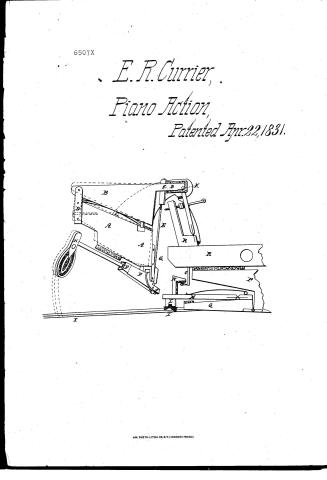
E. R Currier's Patent Drawing for an Improvement in the Piano Forte


National Archives, Restored Patent Drawings (Record Group 241) · Full-size scan at the National Archives · Catalog record
Show the text on the drawing Hide (58 words)
Words on the drawing as machine-read by the National Archives; not checked. Useful mainly for searching.
Sheet 1. 84. MUSIC. Arli Aflims / [112] Piano Actions. / Aso / E R Currier's / CLASSIFICATION / 6507-+ / PATENTED 22° Apl 1831 / DIVISION. / IMPROVEMENT IN THE PIANO FORTE. / : B / FAI / I,
Sheet 2. LVL / 76, / E.R. Currier, / 6502X / esons / necess / Piano Action, / Patented Apr.22,1831. / II / should / OH / GREAT / hg / ГИЗТАН HHT 10 10
USPTO scan
The patent as scanned by the USPTO
-
 Page 1
-
 Page 2
-
 Page 3
-
 Page 4


U.S. Patent and Trademark Office · Google Patents
Show the transcription Hide (1,015 words)
Machine transcription (LightOnOCR) of the pages as scanned by the USPTO, most of them the handwritten copies made when the records were restored after the 1836 fire. Not checked; it can misread handwriting, so compare it with the scan.
Page 1.
6507X
E. R. Currier
Piano Action
Patented Apr. 22, 1831.

AM. PHOTO-LITHO. CO. N.Y. (OSBORNE'S PROCESS)
Page 2.
Obenozge R. Carrier
Letters Patent.
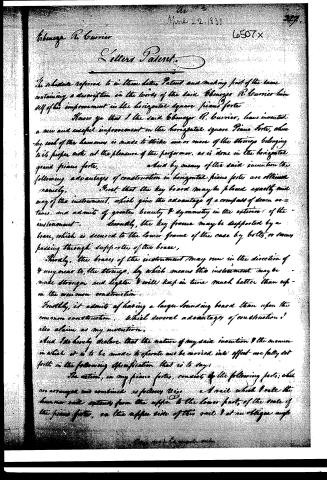
The schedule referred to in these letters Patent and making part of the same containing a description in the words of the said Obenozge R. Carrier him self of his improvement in the horizontal square piano forte.
Know ye that I the said Obenozge R. Carrier, have invented a new and useful improvement in the horizontal square Piano Forte, where by each of the hammers is made to strike one or more of the strings belonging to its proper note at the pleasure of the performer, as is done in the horizontal grand piano forte. And by means of the said invention the following advantages of construction in horizontal piano forte are obtained namely.
First, that the key board may be placed exactly midway of the instrument, which give the advantage of a compass of seven octaves, and admits of greater beauty & symmetry in the exterior of the instrument.
Secondly, the key frame may be supported by a brace, which is secured to the lower frame of the case by bolts, or screws passing through supports of the brace.
Thirdly, the braces of the instrument may run in the direction of & very near to, the strings, by which means the instrument may be made stronger and lighter & will keep in tune much better than upon the common construction.
Fourthly, it admits of having a larger sounding board than upon the common construction, which several advantages of construction I also claim as my invention.
And I do hereby declare that the nature of my said invention & the manner in which it is to be made to operate and be carried into effect are fully set forth in the following specification that is to say:
The action, in my piano forte, consists of the following parts: which are arranged and combined as follows viz. a rail which I call the hammer rail extends from the upper to the lower part, of the case of the piano forte, on the upper side of this rail I at an oblique angle
Page 3.
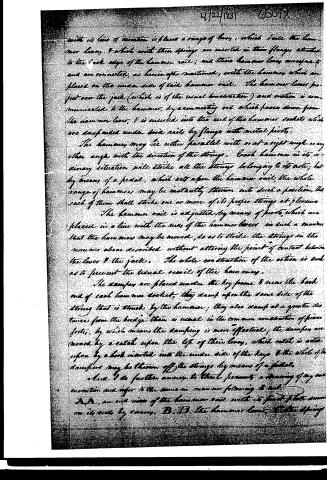
with its line of motion is placed a range of hammers, which shall the hammer levers, & which with their springs are inserted in their flanges attached to the back edge of the hammer rail; and these hammer levers correspond, and are connected, as herein after mentioned, with the hammers which are placed on the under side of said hammer rail. The hammer levers project over the jack (which is of the usual construction) and motion is communicated to the hammer, by a connecting rod which passes down from the hammer lever, & is inserted into the end of the hammer socket which are secured under said rails by flanges with metal pivots.
The hammers may lie either parallel with or at a right angle or any other angle with the direction of the strings. Each hammer in its ordinary situation while strikes all the strings belonging to its note; but by means of a pedal, which acts upon the hammer rail, the whole range of hammers may be instantly thrown into such a position, that each of them shall strike one or more of its proper strings at pleasure.
The hammer rail is adjusted by means of pivots, which are placed in a line with the ends of the hammer levers, so such a manner that the hammers may be moved, so as to strike the strings in the manner above described without altering the point of contact between the levers & the jacks. The whole construction of the action is such as to prevent the usual recoil of the hammers.
The dampers are placed under the key frame & near the back end of each hammer socket; they damp upon the same side of the string that is struck by the hammer; they also damp at a greater distance from the bridge than is usual in the common construction of pianofortes, by which means the damping is more effectual; the dampers are moved by a catch upon the top of their lever, which catch is acted upon by a hook inserted into the under side of the keys & the whole of the dampers may be thrown off the strings by means of a pedal.
And I do further annex to these presents a drawing of my said invention and refer to the same in manner following to suit.
Fig. A, an end view of the hammer rail with its fixed plate secured on its sides by screws. B, B, the hammer levers. C, the springs
Page 4.
4/22/1831 6507X
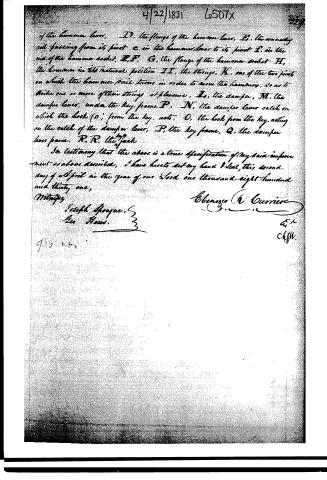
of the hammer lever, D, the flange of the hammer lever, E, the armating rod passing from its pivot C in the hammer lever to its pivot F in the end of the hammer socket, F, G, the flange of the hammer socket, H, the hammer in its natural position, II, the strings, K, one of the two pivots on which the hammer pivot turns in order to move the hammers, so as to strike one or more of their strings at pleasure, L, the damper, M, the damper lever, under the key frame P, N, the damper lever catch on which the hook O, from the key, acts, O, the hook from the key, acting on the catch of the damper lever, P, the key frame, Q, the damper lever frame, R, R, the jack.
In testimony that the above is a true specification of my said improvement as above described, I have hereunto set my hand and seal, this second day of April in the year of our Lord one thousand eight hundred and thirty one,
Witness,
Joseph Sproule.
Geo. Hens.
Ebenezer A. Gurrier
A. R.
Chf.
Published accounts: journal notice
Notice in the monthly list of patents, with remarks
Journal of the Franklin Institute, new ser., vol. 8 (1831), p. 167 · View the page
67. For an improvement in the Horizontal Square Piano Forte; Ebenezer R. Curcier, Boston, Massachusetts, April 22.
Remarks. The objects claimed to have been accomplished by this improvement are the following: The making each hammer strike one or more strings, as in the grand piano forte; for which purpose the hammer rail is made to shift by means of a pedal. The placing the key board exactly midway of the instrument, giving a compass of seven octaves, and preserving greater symmetry and beauty than by the ordinary arrangement. The running of the braces very near to the strings, thus attaining great strength and lightness, with the property of keeping in tune. As these advantages depend principally upon the arrangement of the action, a drawing would be necessary to their explanation.
About this record
- Patentee
- DATAMP
- Date
- the Name and Date index of patents, DATAMP, USPTO records
- Invention
- DATAMP
- Listed in
- the Name and Date index of patents, DATAMP, USPTO records, Jim Shaw's X-patent list, the Journal of the Franklin Institute, Burke's List of Patents (1847)
- The Franklin Institute's journal spells the name differently.
- Burke's 1847 Patent Office list gives the same patent.