

Drawings and documents
National Archives restored drawings: drawing
D. Harrington's Patent Drawing for a Health Vehicle

National Archives, Restored Patent Drawings (Record Group 241) · Full-size scan at the National Archives · Catalog record
Show the text on the drawing Hide (68 words)
Words on the drawing as machine-read by the National Archives; not checked. Useful mainly for searching.
45. FURNITURE. / [62] Rocking Chairs. / Vol. / D .HARRINGTON / 6514-4 / 6514 / Health Vehicle / Patented 23 23"an'1831"V / DIVISION. / A. Rockers / B. Eliptic springs / C. Peice connecting Rockers / D. Seat / dio / Patent Office June 30 1841 / Made under the dinction of the Commynour / Strichland Del / of Patents m conformity with act of 3 Marchtgry / M LSumorth / Communious of Patents
USPTO scan
The patent as scanned by the USPTO
-
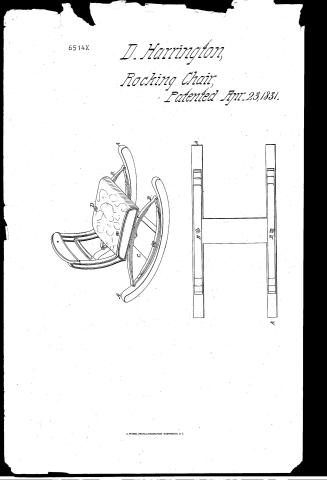 Page 1
-
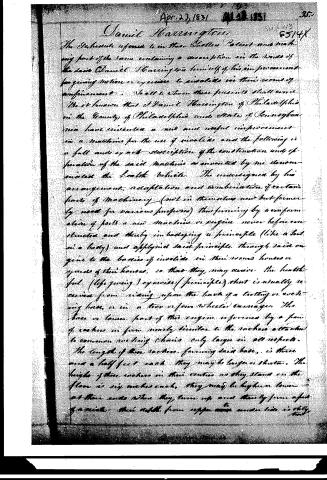 Page 2
-
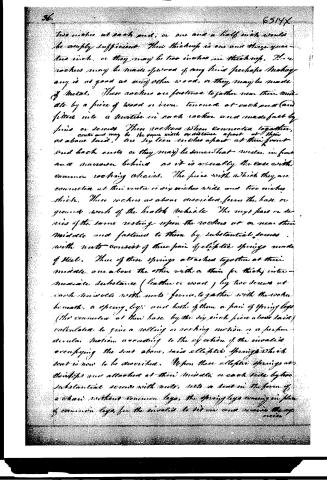 Page 3
-
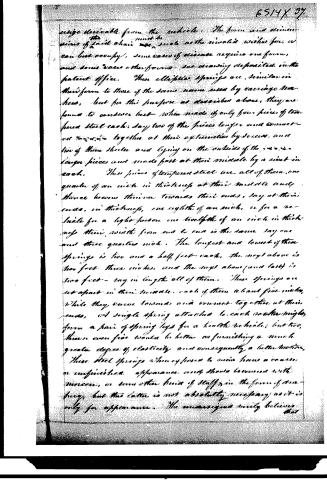 Page 4
-
 Page 5
-
 Page 6


U.S. Patent and Trademark Office · Google Patents
Show the transcription Hide (1,725 words)
Machine transcription (LightOnOCR) of the pages as scanned by the USPTO, most of them the handwritten copies made when the records were restored after the 1836 fire. Not checked; it can misread handwriting, so compare it with the scan.
Page 1.
6514X
D. Harrington,
Rocking Chair,
Patented Apr. 23, 1831.
Page 2.
Apr. 23, 1831
Daniel Harrington
The Schenectady referred to in these Letters Patent and making part of the same containing a description in the hands of the said Daniel Harrington himself of his improvement for giving motion or exercise to invalids in their rooms of confinement. To all to whom these presents shall come:
Be it known that I Daniel Harrington of Philadelphia in the County of Philadelphia and State of Pennsylvania have invented a new and useful improvement in a machine for the use of invalids and the following is a full and exact description of the construction and operation of the said machine as invented by me denominated the Health Vehicle. The invention by his arrangement, adaptation and combination of certain parts of machinery (not in themselves new but formerly used for various purposes) thus forming by a combination of parts a new machine or engine never before constructed and thereby embodying a principle (like a bolt in a body) and applied said principle through said engine to the bodies of invalids in their rooms houses or yards of their houses, so that they may derive the healthful (life giving) exercise (principle) that is usually received from riding upon the back of a trotting or walking horse, or in a two or four wheeled carriage. The base or lower part of this engine is formed by a pair of rockers in form nearly similar to the rockers attached to common rocking chairs only larger in all respects. The length of these rockers forming said base, is three and a half feet each. They may be longer or shorter. The height of these rockers in their centres as they stand on the floor is six inches each, they may be higher or lower at their ends when they turn up and thereby form a part of a cradle. Their depth from upper side under side is only
Page 3.
two inches at each end, or one and a half inch would be amply sufficient. Their thickness is one and three-quarters inch, or they may be two inches in thickness. These rockers may be made of wood of any kind perhaps Mahogany is as good as any other wood, or they may be made of metal. These rockers are fastened together near their middle by a piece of wood or iron, tenoned at each end (and fitted into a mortise in each rocker and made fast by pins or screws. These rockers when connected together, center and may be the same width or distance apart at their as above said, one to ten inches apart at their front and back ends or they may be somewhat wider in front and narrower behind as it is usually the case with common rocking chairs. The piece with which they are connected at their center is six inches wide and two inches thick. These rockers as above described form the base or ground work of the health vehicle. The next part or series of the same resting upon the rockers at or near their middle and fastened to them by substantial joints. With nuts consist of three pair of elliptic springs made of steel. Three of these springs attached together at their middle one above the other with a thin (or thick) intermediate substance (leather or wood) by two screws at each middle with nuts formed together with the rocker beneath, a spring leg; and both of them a pair of spring legs (the connected at their base by the six inch piece above said) calculated to give a rolling or rocking motion or a perpendicular motion according to the opinion of the invalid occupying the seat above, said elliptic springs which seat is now to be described. Upon these elliptic springs at their tops are attached at their middle, or each side by two substantial screws with nuts, sits a seat in the form of a chair without common legs, the spring legs coming in place of common legs for the invalid to sit on and receive the age made.
Page 4.
carriage derivable from the vehicle. The form and dimensions of said chair must be such as the invalid wishes for, or can best occupy; some cases of disease require one form, and some cases other forms, are now being deposited in the patent office. These elliptical springs are similar in their form to those of the same name used by carriage makers, but for this purpose as described above, they are found to answer best when made of only four pieces of tempered steel each; say two of the pieces longer and connected together at their extremities by screws, and two of them shorter and lying on the outside of the two longer pieces and made fast at their middle by a rivet in each. These pieces of tempered steel are, all of them, one quarter of an inch in thickness at their middle and hence become thinner towards their ends, say at their ends, in thickness, one eighth of an inch, or for a vehicle for a light person one twelfth of an inch in thickness; their width from end to end is the same, say one and three quarters inch. The longest and lowest of these springs is two and a half feet each, the next above is two feet three inches, and the next above (and last) is two feet—say in length all of them. These springs are set apart in their middle, each of them about five inches, while they come towards and connect together at their ends, a single spring attached to each seat, might serve a pair of spring legs for a health vehicle; but two, three or even five would be better as furnishing a much greater degree of elasticity and consequently a better motion. These steel springs when exposed to rain have a coarse or unfinished appearance and should be covered with mucus, or some other kind of stuff, in the form of a drapery, but this latter is not absolutely necessary as it is only for appearance. The undersigned merely believes that
Page 5.
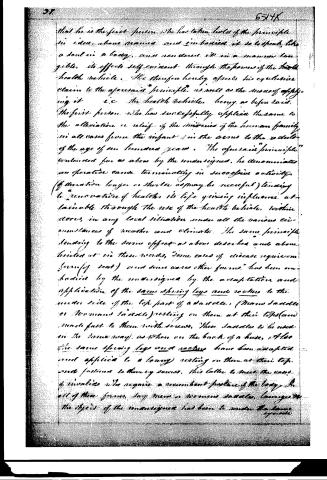
that he is the first person who has taken hold of the principle in idea, about manna and I imbibed it so to speak, like a soul in a body, and man does it in a manner tangible, its effects self-evident through the powers of the health vehicle. He therefore hereby affirms his exclusive claim to the aforesaid "principle," as well as the means of applying it, i.e., the health vehicle, being, as before said, the first person who has successfully applied the same to the alleviation or relief of the miseries of the human family in all cases from the infant to the adult of the age of one hundred years. The aforesaid "principle" contained for as above by the undersigned, he denominates an operative cause terminating in successive activity (if duration longer or shorter as may be successful) tending to "renovation of health," its life-giving influence attainable through the use of the health vehicle, within doors, in any local situation under all the various circumstances of weather and climate. The same principle tending to the same effect as above described and above limited at in these words, "Some cases of disease require one form (of seat) and some cases other forms," has been understood by the undersigned by the adaptation and application of the same spring legs and rosters to the under side of the top part of a saddle. (Man's saddle or Woman's saddle) resting on them at their tops (and made fast to them with screws. These saddles to be used in the same way), as when on the back of a horse. Also the same spring legs and rosters have been adopted and applied to a lorry (resting on them at their tops and fastened to them by screws. This latter to meet the case of invalids who acquire a recumbent posture of the body. In all of these forms, say man's or woman's saddles, language to the effect if the undersigned had been to under the same
Page 6.
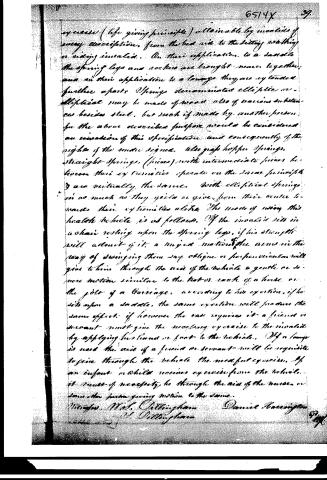
exercise (life giving principle) obtainable by invalids of every description, from the bed side to the sitting or walking invalids. On their application to a saddle the spring legs and rockers are brought nearer together, and on their application to a lounge they are extended further apart. Springs denominated elliptical or elliptical may be made of wood also of various substances besides steel, but such if made by another person for the above described purpose would be considered an invasion of this specification and consequently of the rights of the under signed. Also gas hopper springs, straight springs, (pieces) with intermediate pieces between their extremities operate on the same principle and are virtually the same. With elliptical springs in as much as they yield or give, from their centre towards their extremities alike. The mode of using this health vehicle is as follows. If the invalid sits in a chair resting upon the spring legs, if his strength will admit of it, a slight motion of the arms in the way of swinging them say oblique or perpendicular will give to him through the axis of the vehicle a gentle or severe motion similar to the trot or such of a horse or the gait of a carriage, according to his exertion, if he sits upon a saddle, the same exertion will produce the same effect; if however the case requires it a friend or servant must give the necessary exercise to the invalid by applying his hand or foot to the vehicle. If a lounge is used the aid of a friend or servant will be requisite to give through the vehicle the needed exercise. If an infant or child receives exercise from the vehicle it must of necessity be through the aid of the nurse or some other person giving motion to the same.
Witnesses: Wm. C. Dillingham Daniel Harrington
…
Published accounts: journal notice
Notice in the monthly list of patents, with remarks
Journal of the Franklin Institute, new ser., vol. 8 (1831), p. 168 · View the page
71. For a Machine for giving Motion or Exercise to Invalids, in their own Rooms; Daniel Harrington, city of Philadelphia, April 23.
Remarks. The general form of this instrument, or machine, may be that of a sofa, arm chair, or other kind of seat, or lounge. These may be placed upon rockers, similar to those of rocking chairs. The seat of the chair, or other vehicle, instead of being supported, and connected to the rockers by legs, are sustained upon springs; which are usually of an elliptical form, or that of a double bow; there is a series of these springs, one above the other, and properly connected by their middles. They may be hidden by drapery, and the whole apparatus assume an elegant appearance. The number of pairs of springs may vary, but from three to five on each side will operate most agreeably. The invention claimed is to the application of springs to a health vehicle, for the purposes described; these springs may be varied in form; grass-hopper springs, straight springs, connected in a proper manner, and others may be employed for the same purpose. The vehicle may be moved by the invalid; or when necessary, the motion may be given by an attendant, and the force of it may be regulated according to circumstances, so as to imitate the exercises of walking, trotting, or galloping.
About this record
- Patentee
- DATAMP
- Date
- the Name and Date index of patents, DATAMP, USPTO records
- Invention
- DATAMP
- Listed in
- the Name and Date index of patents, DATAMP, USPTO records, Jim Shaw's X-patent list, the Journal of the Franklin Institute, Burke's List of Patents (1847)
- Burke's 1847 Patent Office list gives the same patent.