

Drawings and documents
National Archives restored drawings: drawing
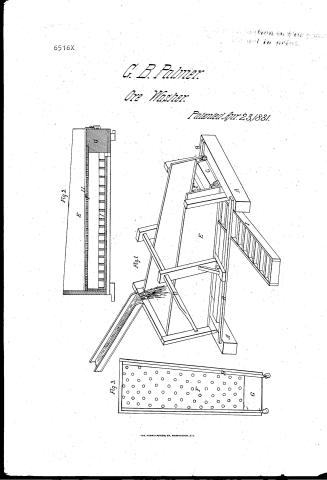
Green B. Palmer's Patent Drawing for a Machine for Separating Gold

National Archives, Restored Patent Drawings (Record Group 241) · Full-size scan at the National Archives · Catalog record
Show the text on the drawing Hide (83 words)
Words on the drawing as machine-read by the National Archives; not checked. Useful mainly for searching.
90. ORE. / [3] / Washers / Gran B. Palmer! / Tol.13.7.250 / 1250 / CLASSIFICATION 6516-+ DIVISION. / Lperating Gold, / 23 April 1831 / Fife. / Fig.2. / Fight / References, / Fich 3. top view. / Fid.1. rocker, Fig.2. longitudinal section, / S.A. blocks, B. sprinds. Ct"jar", D. Handle. / E. the plates rocker. Evonplates? I riffler. ct.foot dlock Hbars for fastening / Patent Office Dee.g. 1841 / Made under the Commifrieur of Patents / in confonmity with act of leangrefs 3March 1837, / Cominiproning Patients,
USPTO scan
The patent as scanned by the USPTO
-
 Page 1
-
 Page 2
-
 Page 3
-
 Page 4


U.S. Patent and Trademark Office · Google Patents
Show the transcription Hide (1,761 words)
Machine transcription (LightOnOCR) of the pages as scanned by the USPTO, most of them the handwritten copies made when the records were restored after the 1836 fire. Not checked; it can misread handwriting, so compare it with the scan.
Page 1.
6516X
G. B. Palmer.
Ore Washer.
Patented Apr. 23, 1831.
Fig. 1
Fig. 2
Fig. 3
THE NORRIS PETERS CO., WASHINGTON, D.C.
Page 2.
6516X April 23, 1831
Green B. Palmer, Brindletown, North Carolina.
Letters Patent
Dated April 23rd, 1831.
The Schedule referred to in these Letters Patent and making part of the same, containing a description in the words of the said Green B. Palmer himself of his improvement in the machine for separating gold from earth and other substances.
To all whom these presents shall come: Be it known that Green B. Palmer of Brindletown, County of Burke and State of North Carolina, has invented a new and useful improvement in the Raker and inclined plane for washing out gold from the sand, gravel, earth and other mineral and earthy substances, called the Panning Raker, and that the following is a full and exact description of the construction and operation of the same.
Page 3.
machine as convenient and improved by you (to wit):
There is a trough called a rocker made of strong plank, open at one end and closed at the other, eight feet long and fourteen inches wide at the plates, sloped ten inches to the foot on each side so as to be wider at top; with the perforated iron plates or bars on it seven feet long and fourteen inches wide, lying in a horizontal position, but depressed toward the front of the rocker. Below the perforated iron plates in the rocker the sides thereof are extended down eight or ten inches to a plank bottom with a strong block of solid wood the full width, depth and length of one foot, to come up even with the perforated iron plates, over which the rock, gear, &c. is to pass off at the open end.
The perforated iron plates are fixed in a frame of wood or metal four inches wide and seven feet long, and all so constructed as to be moved in or out at pleasure, to fit nicely to the sides and ends, and particularly to fit down on a shoulder or abutment on the solid block at the lower end so that the upper surface of the frame of perforated iron plates and solid block is even, and to rest on the edges on the inclined plane below it. The bottom of the extended part of the rocker below the perforated iron plates to have a hole thrown in by four inches on the centre, or a panel of angle holes on lines of it, at the junction of the bottom with the solid block (the said holes or holes being intended to carry off the water and be seven feet from the back.
The inclined plane or riffle is also a trough fourteen inches wide at the ends seven feet long, six inches deep at the upper end and four and a half inches at the lower end, with sides sloping from the top to the bottom, so that the bars across it circular at top and to depress in the middle one and one half inch from the ends at the ends, said stops to be four inches apart, in the clear and five inches high as to prevent water or any other thing passing over them. The riffle is then to be placed even with the perforated iron plates in the rocker with the deep part under them and the head of the rocker, so that below the lower end of the riffle corresponding with the one with the bottom of the rocker or ends. These could be placed under each other's riffle with one each having guide bars in them above the bars of the gold should be fine, proper inclination being given and sufficient depth to the face of the rocker or the length of the which is extended. There must be three frames of these, one at each end, and one in the middle. These three should be set along a horizontal line of the rocker, one or two feet as you please convenient for letting the hands so long which should be within the frame just over the ends, and it should be at least one foot long, four inches by one and a half inch thick. The bottom of the middle frame should be at least four feet long of iron, and the head to be even with the lower end on each side, to make the pan or box which should be in the two springs, one on each side extending from one end of the frame to the other, and it should be so set that the rocker to the lower of the springs, fitted closely at the bottom and sides so as to support the powder. The other spring and spring wheel it should be short with iron. The one and line is then to be in one point.
Page 4.
6516X
pounds or yards, and at each end, this over the head or upper end, from inside high above the block, there is to be two threads higher above the block and so continued and raised from the frame with support thereon, and provided with, in the middle of each end on a solid iron, the point of the point up and so fixed it may work with ease, at least two of iron or other substantial thing should be there placed quite across thereon, from inside to outside, just over and touching the perforated iron plates so as to bear on them and be full from end to end on the outside and to them on work until work is done. This while to be placed on a ground frame on which worked with by being placed in the middle of the bands and that raise the ground, sand &c. containing the gold or else where the work has a place. The ground frame must consist of two solid blocks, five feet long, the head block to be five inches and six inches thick, the foot block five feet long, six inches thick, eighteen inches wide, two inches blocks up edge or inward from them together with a piece of strong timber in the ends and four inches thick, the same length of the Rocker if you intend to work on pins or points of your intended work as you see it may be longer or shorter as you have the space as on the inside or outside of the rocker. The going to be made of steel, iron or tough wood extending from one end to the other and resting on the head block, that is the play from and spring at each side at end when struck in the middle. This rocker or its principal parts can also be worked in the principle the common horse cradle or rocker. The rocker with all its parts ground from end to end being properly placed for working the same to be worked the same, sand and ground &c. containing the gold is on the same as the head of the said blocks with a little guide from about four feet down from the head, there are conveyed in at the head of the rocker by means of a strong support by the proper end of the rocker in one end and continue the process of drawing in until the sand &c. containing the gold is running quite out in and going on to the other side which allows to continue as long as the work has a place, when it is stopped the blocks are used. There are known how the perforated iron plates in the frame work and one half of the side stop (no on one side or sand &c. than on). The machine is in one end and by proper aid the gold is ground off to about two or three quarts if that attention is paid and by the proper end of the ground or common the machine is that the gold is easily separated from the sand &c. as long you clearly understand all the tools and parts of the process of working. The machine or riffle may be also made to work like a horse at the head of the rocker, and then when when it has to have the proper iron plates that when you want to pass off stop drawing with the work to turn off from the work to be of the machine in one end before until the same is going through to work as what is in this machine and under one of the going is a little way on the other place or riffle placed under the rocker in the bottom of the rocker, to pass the same, sand &c. and to carry the same off from under the rocker. Take when the gold is found in the of that metal such as passed through the rocker. A long chain of iron permanent on the rocker to go on. The same rocker containing perforated iron plates in a way that the sand, ground &c. can be thrown out the upper end by means of the hand work from the head to the middle or elsewhere as at least of the same of the same as at the head. 3. But the gold then is drawn and made perforated iron plates. In the place will have or stop since there is no such thing which is used as a substitute for the whole in one end and under it, the will be continued to make quick to the gold. 4. The same thing of the lower end blocks on the middle to set the on spring at each side of it. 5. Driving the machine on pins, points or yards as above supports thereon. 6. The process of looking in either by bars across the perforated iron plates or as drawn at the head. 7. The principle of the same and in the in the place beneath the perforated iron plates for passing out. 8. The principle of the going in which the gold is drawn out. 9. The in permanent of the same and plates or riffles with cups across them from the outside by or go
Witnesses
H. A. Brown
A. G. Brown
G. A. Palmer
Received 1 month 22 day 1841
(1666 words)
G. A. Palmer
Published accounts: journal notice
Notice in the monthly list of patents, with remarks
Journal of the Franklin Institute, new ser., vol. 8 (1831), p. 169 · View the page
A 72. For a Machine for separating Gold from Earth, and other substances, being an improvement on the Rocker and inclined Plane; Green B. Palmer, Burke county, North Carolina, April 23.
Remarks. "As to my claims of the improvement on the rocker, they are"1st. Forming the rocker, containing perforated iron plates in such a way, that the sand, gravel, &c. can then be thrown in at the upper end by moving the handle, or lever, from the head to the middle, or elsewhere, so as to be out of the way of the workman at the head. "2nd. Putting into the rocker, underneath the perforated iron plates, inclined planes, with bars or stops across them, so as to detain quicksilver, and so constructed that the whole must be in constant motion, together with the earth, sand, water, quicksilver, gold, &c. "3d. The invention of the lever and knocker in the middle, so as to strike on the springs at each vibration. "4th. Poising the machine on pivots, points, or gudgeons, so as to support the weight. "5th. The process of locking in, either by bars across the perforated iron plates, or as a drawer at the head. "6th. The principle of the motion used in the inclined plane beneath the perforated plates, for fanning out." "7th. The principle of the spring on which the jarer, or knocker, works. "8th. The improvement of the inclined plane, or riflers, with stops across them, from the notched log, or gutter." We have given no more than the claims to the foregoing machine. The whole specification is of considerable length, and would not be intelligible alone, or interesting to many ny of our readers.
About this record
- Patentee
- DATAMP
- Date
- the Name and Date index of patents, DATAMP, USPTO records
- Invention
- DATAMP
- Listed in
- the Name and Date index of patents, DATAMP, USPTO records, Jim Shaw's X-patent list, the Journal of the Franklin Institute, Burke's List of Patents (1847)
- Burke's 1847 Patent Office list gives the same patent.