

Drawings and documents
National Archives restored drawings: drawing
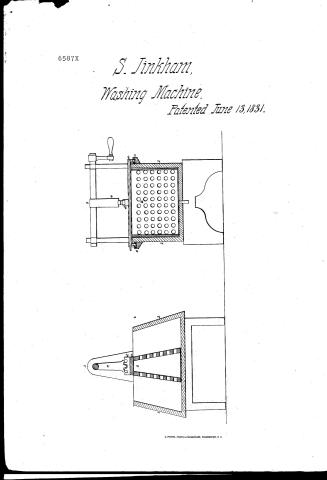
S. Jinkham's Patent Drawing for a Washing Machine

National Archives, Restored Patent Drawings (Record Group 241) · Full-size scan at the National Archives · Catalog record
Show the text on the drawing Hide (79 words)
Words on the drawing as machine-read by the National Archives; not checked. Useful mainly for searching.
63. / UNDR / Vol. 12. nage 507 / [91] Washing POUNDERS. Mach's / $200 / S. O JINKHAM / 6587.4 DIVISION. / Washing Mach / Patented 13" Juna 1831 / 1. Receiver / 2. Dasher or prejs / 3. Lever or/candle / a. Plank / b. Slide / C. Grooves / d. Rach / e. Inveror handle having teeth playing / in Rach.d / OIR / Patent office Febry 22 1842. / Strickland Del / Made under the derection of the commusiouer of Patents / in conformily with achoy 3 March 1837 / Commessionery of Patents
USPTO scan
The patent as scanned by the USPTO
-
 Page 1
-
 Page 2
-
 Page 3


U.S. Patent and Trademark Office · Google Patents
Show the transcription Hide (757 words)
Machine transcription (LightOnOCR) of the pages as scanned by the USPTO, most of them the handwritten copies made when the records were restored after the 1836 fire. Not checked; it can misread handwriting, so compare it with the scan.
Page 1.
6587X
S. Jinkham,
Washing Machine,
Patented June 13, 1831.

Page 2.
June 13, 1831 6587X 507.
Samuel Sinkham,
Letters Patent.
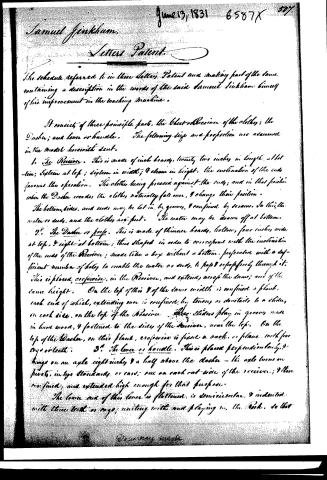
The schedule referred to in these Letters Patent and making part of the same, containing a description in the words of the said Samuel Sinkham himself of his improvement in the washing machine.
It consists of three principle parts, the chest or Receiver of the clothes; the Dasher; and lever or handle. The following size and proportion are assumed in the model herewith sent.
1. The Receiver. This is made of inch boards, twenty two inches in length at bottom; eighteen at top; eighteen in width; 9 eleven in height. The inclination of the ends favours the operation. The clothes being pressed against the ends; and in that position when the Dasher reaches the clothes naturally fall over, & change their position. The bottom, sides, and ends may be let in, by grooves, & confined by screws. In this, the water is used, and the clothes are put. The water may be drawn off at bottom.
2. The Dasher or prop. This is made of thinner boards, bottom, four inches wide at top, 9 eight at bottom; thus shaped in order to correspond with the inclination of the ends of the Receiver; made like a box without a bottom, perforated with a sufficient number of holes to enable the water or ends, to pass & repossess through it. This is placed, crosswise, in the Receiver, and extends across the same; and of the same height. On the top of this 9 of the same width is confined a plank, each end of which, extending over is confined, by tenons or dowels, to a slider, in each side, on the top of the Receiver. These sliders play in grooves made in hard wood, 9 fastened to the sides of the Receiver, near the top. On the top of the Dasher, on this plank, crosswise is fixed a rack, or plane, with four tugs or teeth.
3. The lever or handle. This is placed perpendicularly, 9 hangs on an axle eight inches 9 a half above the dasher - the axle turns on pivots, in two standards, or ears; one on each side of the receiver; 9 there confined; and extended high enough for that purpose. The lower end of this lever is flattened, is semicircular, 9 indented with three teeth or cogs, uniting with and playing on, the Rack, so that
Witnesses
Page 3.
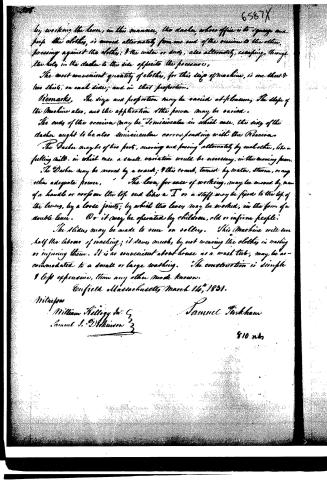
by working the lever, in this manner, the dasher, whose office is to squeeze and press the clothes, is moved alternately from one end of the receiver to the other, pressing against the clothes; & the water or suds, also alternately, escaping through the hole in the dasher to the side opposite the pressure.
The most convenient quantity of clothes, for this size of machine, is one sheet & two shirts, on each side; and in that proportion.
Remarks. The size and proportion may be varied at pleasure, The shape of the Machine also, and the application of the power may be varied.
The ends of the receiver may be semicircular in which case, the side of the dasher ought to be also semicircular corresponding with the Receiver.
The Dasher may be of two parts, moving and pressing alternately by each other, like a folding table, in which case a small variation would be necessary, in the moving part.
The Dasher may be moved by a crank; & this crank, turned by water, steam, or any other adequate power. The lever, for ease of working, may be moved by means of a handle or cross on the top end like a T or a staff may be fixed to the top of the lever, by a loose joint; by which the lever may be worked, in the form of a double lever. Or it may be operated by children, old or infirm people.
The Slides may be made to rise or roll up. This Machine will save half the labour of washing; it saves much, by not wearing the clothes in washing or injuring them. It is as convenient about house as a wash tub, may be accommodated to a small or large washing. The construction is simple & less expensive, than any other mode known.
Enfield Massachusetts March 14th, 1831.
Witnesses
William Kelley Jr.
Samuel S. Wilkinson
Samuel Parkham
$10 net
Published accounts: journal notice
Notice in the monthly list of patents, with remarks
Journal of the Franklin Institute, new ser., vol. 8 (1831), p. 333 · View the page
21. For a Washing Machine; Samuel Jinkham, Enfield, Hampshire county, Massachusetts, June 13.
Remarks. The dasher of this washing machine is made in the usual form of those which are suspended to a frame, and which are usually made to vibrate like a pendulum; but in the present case it is placed in a trough, in which it is made to slide from end to end. This is effected by placing a rack on the top of the dasher, and using a segment wheel or pinion, which is worked by a lever, to move it. The clothes, placed in each end of the trough, are thus squeezed between the dasher and the trough. The patentee tells of many variations which may be made in his machine, but makes no claim to any part.
About this record
- Patentee
- DATAMP, Burke's List of Patents (1847)
- Date
- the Name and Date index of patents, DATAMP, USPTO records
- Invention
- DATAMP
- Listed in
- the Name and Date index of patents, DATAMP, USPTO records, Jim Shaw's X-patent list, the Journal of the Franklin Institute, Burke's List of Patents (1847)
- The name conflict was settled by Burke's 1847 list.
- Burke's 1847 Patent Office list gives the same patent.