

Drawings and documents
National Archives restored drawings: drawing
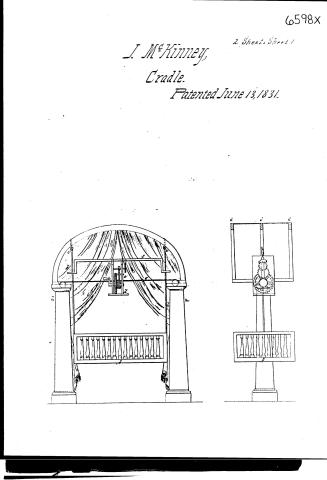
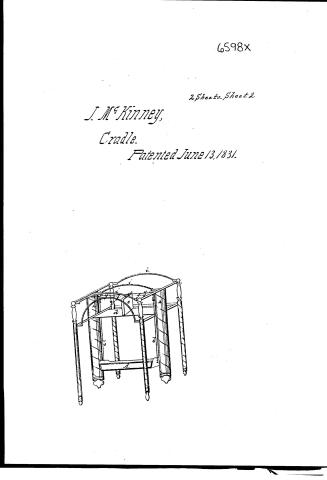
J. McKinney's Patent Drawing for a Swinging Cradle


National Archives, Restored Patent Drawings (Record Group 241) · Full-size scan at the National Archives · Catalog record
Show the text on the drawing Hide (113 words)
Words on the drawing as machine-read by the National Archives; not checked. Useful mainly for searching.
Sheet 1. [6] 5. BEDS. / Cradles, Motor Operated. / Jhonse ed / J. .M*KINEY / $ 500 Ciadle / CLASSIFICATION / Surnging cradle / Patented) 13" June 1831 / 6598-X / DIVISION. / on / A. Cradle / TOWN / b.b. Pendulum Wires / C.C. Pivot hooks / a. Platform / C. Box containing Works / f.f. axle of Pullet / 9.9. cords with weights / h.h. Centre Posts / iii arches supporting lester / OIR / Patent office Nov 30 1841 / Made under the direction of the Commy of / Strickland Del / An compormity with ach of 3' March 1834 / Md illnooth / Commprown of Patiently
Sheet 2. 4. / 5. BEDS. / Gradles, Motor Operated. / JOHN M.KINNEY'S / CLASSIFICATION / 6598-+ / SWINGING CRADLE. / DIVISION. / Patented 13th June 1831. / d. / DIR
USPTO scan
The patent as scanned by the USPTO
-
 Page 1
-
 Page 2
-
 Page 3
-
 Page 4


U.S. Patent and Trademark Office · Google Patents
Show the transcription Hide (684 words)
Machine transcription (LightOnOCR) of the pages as scanned by the USPTO, most of them the handwritten copies made when the records were restored after the 1836 fire. Not checked; it can misread handwriting, so compare it with the scan.
Page 1.
6598x
2 Sheets Sheet 1
J. McKinney,
Cradle.
Patented June 13, 1831.
Page 2.
6598x
2 Sheets. Sheet 2
J. M. Kinney,
Cradle.
Patented June 13, 1831.

Page 3.
June 13, 1831
John McKinney, Chester, Ohio
Letters Patent
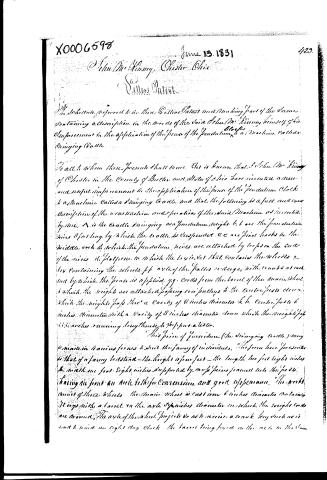
We respectfully refer to the Letters Patent and Drawing part of the same, containing a description in the words of the said John McKinney himself of his improvement in the application of the power of the pendulum to a machine, called a Swinging Cradle.
To all to whom these presents shall come, but is known that John McKinney of Chester in the County of Butler and State of Ohio have invented a new and useful improvement in the application of the power of the pendulum clock to a machine, called a Swinging Cradle, and that the following is a full and exact description of the construction and operation of the said machine as invented by me.
A is the cradle swinging as a pendulum. Weights b, b are the pendulum wires of a long pendulum by which the cradle is suspended. C, C are fixed hooks in the middle arch to which the pendulum wires are attached by loops on the ends of the wires. D, platform on which the toy is set that contains the wheels, etc., by containing the wheels for axle of the pallets or verge, with cranks at each end by which the power is applied. G, G, cords from the barrel of the main wheel to which the weights are attached passing over pulleys to the centre posts down which the weights pass through a variety of 8 inches diameter holes. Centre posts 6 inches diameter with a variety of 8 inches diameter down which the weights pass in an arches running lengthwise to the posts at either end.
This piece of furniture (the Swinging Cradle) may be made in various forms to suit the fancy of individuals. The form here presented is that of a fancy bedstead—the height is four feet—the length two feet eight inches and the width one foot eight inches supported by a variety of pieces joined into the posts having in front an axle tosh for convenience and good appearance. The parts consist of three wheels—the main wheel is cast iron 6 inches diameter containing 12 cogs with a barrel on the axle 3 inches diameter on which the weights cords are wound. The axle of the wheel projects so as to receive a crank key such as is used to wind an eight day clock the barrel being fixed on the axle in the same manner.
Page 4.
1434.
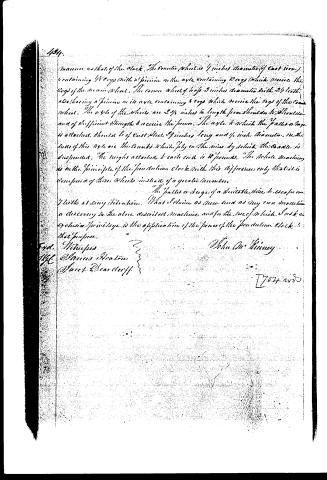
Manner as that of the clock. The counter wheel is 4 inches diameter (of Cast Iron) containing 45 cogs with a pinion in its axle containing 2 cogs which receive the cogs of the mean wheel. The crown wheel is 3 inches diameter with 24 teeth also having a pinion in its axle containing 6 cogs which receive the cogs of the crown wheel. The axles of the wheels are 2 1/2 inches in length from shoulder to shoulder and of sufficient strength to receive the power. The axle to which the pallet or hop is attached should be of cast steel 3 inches long and 1/2 inch diameter. In the ends of this axle are the banks which fly on the wires by which the balance is suspended. The weight attached to each cord is 18 pounds. The whole machine is on the principle of the pendulum clock with this difference only that it is composed of three wheels instead of a greater number.
The pallet or hop is of a suitable size to escape only little at every vibration. What I claim as new and as my own invention is a discovery in the above described machine and for the use of which I ask an exclusive privilege is the application of the power of the pendulum clock to that purpose.
John Du Winney
End. Witness
Thomas Newton
Jacob Dearcliff
Published accounts: journal notice
Notice in the monthly list of patents, with remarks
Journal of the Franklin Institute, new ser., vol. 8 (1831), p. 344 · View the page
56. For applying the power of a pendulum clock to a Swinging Cradle; John M'Kenney, Chester, Butler county, Ohio, June 13.
Remarks. The cradle is to be the bob of a pendulum, there being a wire rod at each end by which it is to be suspended. The proper wheel work, escapement, and weights, are supported by suitable frame work, the whole of which assumes a very formidable appearance, when the object in view is considered. The claim made is to the application of the power of the pendulum clock, to the rocking of a cradle. A former patent for rocking a cradle by clock work, upon similar principles, received due attention, (see vol. v. p. 126,) and we think it unnecessary to indite any thing new upon the subject.
About this record
- Patentee
- DATAMP
- Date
- the Name and Date index of patents, DATAMP, USPTO records
- Invention
- DATAMP
- Listed in
- the Name and Date index of patents, DATAMP, USPTO records, Jim Shaw's X-patent list, the Journal of the Franklin Institute, Burke's List of Patents (1847)
- The sources give the patentee's name differently; the name shown follows DATAMP and Shaw.
- The Franklin Institute's journal spells the name differently.
- Burke's 1847 Patent Office list gives the same patent.