

Drawings and documents
National Archives restored drawings: drawing
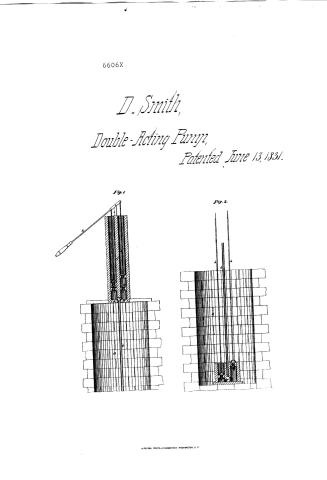
Daniel Smith's Patent Drawing for a Labor Saving Pump

National Archives, Restored Patent Drawings (Record Group 241) · Full-size scan at the National Archives · Catalog record
Show the text on the drawing Hide (87 words)
Words on the drawing as machine-read by the National Archives; not checked. Useful mainly for searching.
CLASS 103. PUMPS, / Valved Reciprocating Piston, / Multiple Cylinder, / Dan Amith / CLASCIFICATION / 6606-X / DIVISION. / Labour saving Sump. / Patented 13 June 1831. / Fig.2 2 / Fig. / Fig / Suction promp / Sections. / 2. Farcing pump / a. well / b. Leaden pipe / e. Body of pump / d. Plugs / e. Bosces / f Backets / g. Valves. / he Picton rods / Γ. Ears. / k Handle / F.B.2elt / Patent Office April 30th 1839 / Made under the direction of the Commifriener of Patents / in conform ity the that 3d March 1837
USPTO scan
The patent as scanned by the USPTO
-
 Page 1
-
 Page 2


U.S. Patent and Trademark Office · Google Patents
Show the transcription Hide (431 words)
Machine transcription (LightOnOCR) of the pages as scanned by the USPTO, most of them the handwritten copies made when the records were restored after the 1836 fire. Not checked; it can misread handwriting, so compare it with the scan.
Page 1.
6606X
D. Smith,
Double-Acting Pump,
Patented June 13, 1831.
Fig. 1
Fig. 2.
H. PETERS, PHOTO-LITHOGRAPHER, WASHINGTON, D.C.
Page 2.
June 13, 1831
Daniel Smith, of China, New York
Letter Patent,
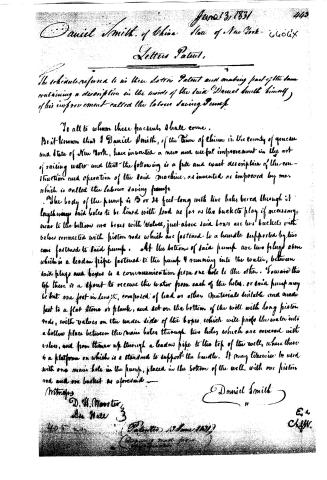
The schedule referred to in this Letter Patent and making part of the same containing a description in the words of the said Daniel Smith himself, of his improvement called the labour saving pump.
To all to whom these presents shall come,
Be it known that I Daniel Smith, of the Town of China in the county of Genesee and State of New York, have invented a new and useful improvement in the art of raising water and that the following is a full and exact description of the construction and operation of the said machine, as invented or improved by me, which is called the labour saving pump.
The body of the pump is 15 or 24 feet long with five holes bored through it lengthwise; said holes to be lined with lead as far as the buckets play if necessary, near to the bottom are boxes with valves, just above said boxes are two buckets with valves connected with piston rods which are fastened to a handle supported by two ears fastened to said pump. At the bottom of said pump are two plugs above which is a leaden pipe fastened to the pump & running into the water, between said plugs and boxes is a communication from one hole to the other. Towards the top there is a spout to receive the water from each of the holes, or said pump may be but one foot in length, composed of lead or other materials suitable and made fast to a flat stone or plank, and set on the bottom of the well with long piston rods, with valves on the under side of the boxes, which will prove the water into a hollow place between the main holes through two holes which are covered with valves, and from thence up through a leaden pipe to the top of the well, where there is a platform on which is a standard to support the handle. It may likewise be used with one main hole in the pump, placed in the bottom of the well, with one piston rod and one bucket as aforesaid.
Witnesses
D. H. Mooster
A. H. Hall
Daniel Smith
Patented 13 June 1831
Ex. Chf. W.
Published accounts: journal notice
Notice in the monthly list of patents, with remarks
Journal of the Franklin Institute, new ser., vol. 8 (1831), p. 340 · View the page
45. For an improvement in the art of Raising Water by means of what is called the labour saving pump; Daniel Smith, China, Genessee county, New York, June 13.
Remarks. This is merely a double lifting or forcing pump, such as is well known, and in established use. There are to be two barrels, pistons, and rods, worked by one lever without addition or variation from the old pump. If well made, therefore, experience tells us that it will work well, but not that it will save labour more effectually than its prototypes.
About this record
- Patentee
- DATAMP
- Date
- DATAMP, USPTO records, Burke's List of Patents (1847)
- Invention
- DATAMP
- Listed in
- the Name and Date index of patents, DATAMP, USPTO records, Jim Shaw's X-patent list, the Journal of the Franklin Institute, Burke's List of Patents (1847)
- The sources give different dates; the date shown is the one most of them agree on.
- The Franklin Institute's journal confirms the date shown.
- Burke's 1847 Patent Office list gives the same patent.