

Drawings and documents
National Archives restored drawings: drawing
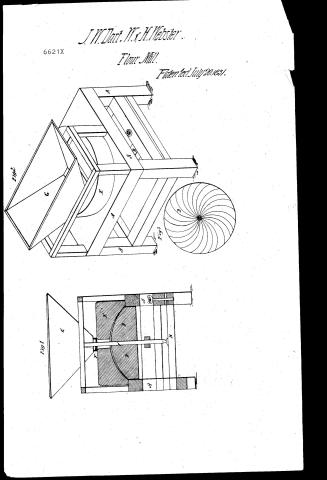
J. W. Dart and W. Webster's Patent Drawing for a Grist Mill

National Archives, Restored Patent Drawings (Record Group 241) · Full-size scan at the National Archives · Catalog record
Show the text on the drawing Hide (91 words)
Words on the drawing as machine-read by the National Archives; not checked. Useful mainly for searching.
(83) MILLS. / Grinding Mills. / Disk Action: Horizontal. / I W. Lart, W. Mibster & H, Wilster. / Vol 13, p,29, Vol 13.7.29. / #6621x / Grist Mill. Pat Only 20, 1831 / Patented 20July 1831 / CLASSIFICATION / 6621X / Fid 2 / DIV ISION. / Fuf.4, / BB / PA9 / Fuf 3. / Patent Office / Made under the direction of / References. / Figh1,Seetion. Fig. 2.perspective view, Fid,3, rullier detached, / Patents inconformity with Aut Abougrep 3 March 1937, / A.frame me B. bridge tree, C. spindle.D. runner, / Eucap. Eshoe. G. Hopper, / Memy h Ellmoth / Commupion of Patents,
USPTO scan
The patent as scanned by the USPTO
-
 Page 1
-
 Page 2
-
 Page 3


U.S. Patent and Trademark Office · Google Patents
Show the transcription Hide (697 words)
Machine transcription (LightOnOCR) of the pages as scanned by the USPTO, most of them the handwritten copies made when the records were restored after the 1836 fire. Not checked; it can misread handwriting, so compare it with the scan.
Page 1.
6621X
J. W. Dart. W. & H. Webster.
Flour Mill.
Patented July 20, 1831.
Fig. 1
Fig. 2
Fig. 3
Page 2.
66021X
July 20, 1831
29
Jesiel W. Dart, Willard Webster and Hiram Webster ... Trenton, New York — Letters Patent
The Schedule referred to in these Letters Patent and making part of the same containing a description in the words of the said Jesiel W. Dart, Willard Webster and Hiram Webster themselves of their improvement in the Grist mill.
To all to whom these Letters Patent shall come:
Jesiel W. Dart, Willard Webster and Hiram Webster of Trenton County of Burlington and State of New York have made an improvement in mills for grinding grain which is described as follows.
The frame is made of four posts framed together by two girts on each side of the frame. A piece of timber called the bridge tree or Mill beam is tenoned into a notch on the centre of two of the lower girts. One of the two girts on which rests the mill beam is moveable to set the stones for fine or coarse grinding — In addition to the above mentioned girts there is one above the moveable girt for the purpose of fastening the frame together & to receive a bolt running through the moveable girt and through the below mentioned girt with a nut and screw on the top for the purpose of raising the mill beam. The size of the timber varying with the size of the Mill, and the height is sufficient to receive the stones gearing and curb. The hopper and shoe are made in the usual way. The cap is stationary and rests on the upper girts and is fastened down by bolts of iron running through the girts on which it rests with an angle or clip on the upper end, a nut & screw on the lower end, or by a bar of iron or wood across the top of the cap and fastened down to the girts at each end. The cavity in the cap is made in a circular form to receive the grinding surface of the runner hereafter described — The runner is a flat surface on the bottom running up in a straight line on the sides two inches or more, then the grinding surface rises in a circular form from one eighth to three eighths of the diameter of the runner in the centre. The runner & cap are both
Drawing
Page 3.
made of stone and the medium diameter of the annulus for grinding grain is about sixteen inches, although not limited. The spindle or shaft running through the center of the annulus being fastened to it and of sufficient length below to receive the annulus and gearing through and above the cap, two inches or more for the purpose of keeping the annulus in the center & shaking the stone. Said spindle runs in a box placed on or in the mill beam and runs through a box at the top of the cap, or in a box of iron or wood. Said boxes are both movable to center the annulus & plumb the spindle. — This mill may be put in motion by water or any known power by means of a strap and pulley or cog wheel placed on the shaft or spindle — The mill being put in motion the grain enters at the opening in the cap near the spindle and runs into the furrows which are curved any direction required and is ground and carried off in the usual way — The invention hereby claimed is the plainness of the construction of the mills, the grinding surface as before described and in dispensing the usual power for grinding.
In testimony that the foregoing is a true description of our invention we have subscribed our names before two witnesses & made oath to the same this second day of June 1831.
6th Witness,
Abraham Stark
Edmund Harris
Schickel M. Ouel
Willard Webster
Hiram Webster
Published accounts: journal notice
Notice in the monthly list of patents, with remarks
Journal of the Franklin Institute, new ser., vol. 9 (1832), p. 43 · View the page
11. For an improvement in the Grist Mill; Jehiel W. Dart, Willard Webster, and Hiram Webster, Truxton, Courtland county, New York, July 20.
Remarks. A suitable frame is made to support the stones, and their gearing. The stones may be about sixteen inches in diameter. The upper stone is stationary, being bolted upon the framing, the lower stone is convex, to adapt it to the upper one. The spindle upon which the runner is fixed, has a step below, and passes through the cap stone into a box above. "The invention hereby claimed, is the cheapness of the construction of the mill, the grinding surface as before described, and lessening the usual power for grinding." Cheapness is a very acceptable quality, but, we think, scarcely patentable. Convex and conical surfaces have been before used in such mills, and why the power required for grinding will be less in this than in other mills of the same size, we do not see, and are not told. The difference between this and several other portable grist-mills is so trifling that we are at a loss how to divide the merit of the invention among the three patentees. Using all the light which the claim throws upon this subject, we are led to the conclusion that one of them may have invented the " cheapness," another the "grinding surface," and the third the "lessening the usual power for grinding."
About this record
- Patentee
- DATAMP
- Date
- the Name and Date index of patents, DATAMP, USPTO records
- Invention
- DATAMP
- Listed in
- the Name and Date index of patents, DATAMP, USPTO records, Jim Shaw's X-patent list, the Journal of the Franklin Institute, Burke's List of Patents (1847)
- Burke's 1847 Patent Office list gives the same patent.