

Drawings and documents
National Archives restored drawings: drawing
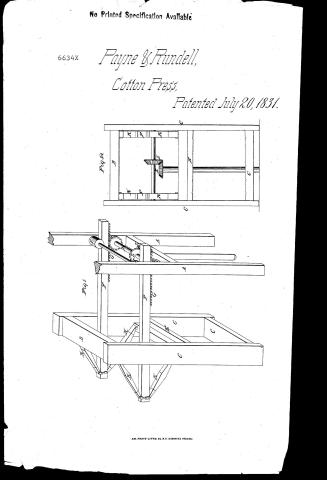
P. Payne and J. Rundell's Patent Drawing for a Cotton Press

National Archives, Restored Patent Drawings (Record Group 241) · Full-size scan at the National Archives · Catalog record
Show the text on the drawing Hide (91 words)
Words on the drawing as machine-read by the National Archives; not checked. Useful mainly for searching.
100. PRESSES. / Baling, / Toggle-Joint. / P. Payne & J. Rundell, / Vol.13.jo.45. / Cotton Prefs. no number / CLASSIFICATION / 6634.1 / DIV ISION. / Patented 20July. 1831. / Fig.1. / non / Fifi2. / 000000000000 / References. / Fid1 Perspective view. Fid.2. backview, / A. frame posts. B.cap. C. sill D.Side picces, / E. follower. F. ways. Grack. H, horizontal shaft, / I.friction rollers, K. toggle joint levers. / I. bevel gear. / Dee Deegth Patent office 1841 / Made under the the Commispion of Patents / in conformity brigrep 3 March 1837 / n Leumorth / Commission A
USPTO scan
The patent as scanned by the USPTO
-
 Page 1
-
 Page 2
-
 Page 3


U.S. Patent and Trademark Office · Google Patents
Show the transcription Hide (881 words)
Machine transcription (LightOnOCR) of the pages as scanned by the USPTO, most of them the handwritten copies made when the records were restored after the 1836 fire. Not checked; it can misread handwriting, so compare it with the scan.
Page 1.
No Printed Specification Available
6634X
Payne & Rundell,
Cotton Press,
Patented July 20, 1831.

AM. PHOTO-LITHO. CO. N.Y. (OSBORNE'S PROCESS)
Page 2.
July 20, 1831
60634 X Philargo Payne and Joshua Randall of Clarke Co. Mississippi
Letters Patent.
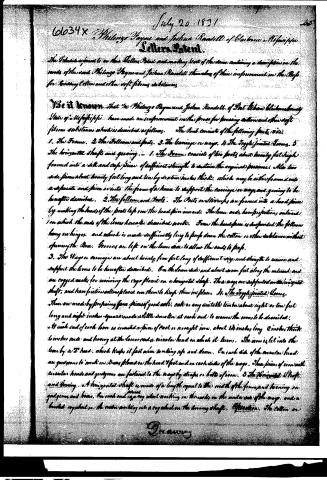
The Patentee agree to in their Letters Patent and making part of the same, containing a description in the words of the said Philargo Payne and Joshua Randall themselves of their improvement in the Press for pressing Cotton and other soft fibrous substances.
Be it known that the Philargo Payne and Joshua Randall, of Port Gibson, Clarke County, State of Mississippi, have made an improvement in the press for pressing cotton and other soft fibrous substances, which is described as follows. The Stock consists of the following parts, viz:
1. The Frame.
2. The followers and posts.
3. The carriage or ways.
4. The Toggle jointed Levers.
5. The horizontal shafts and gearing.
1. The Frame consists of two posts about twenty feet high, framed into a side and top piece of sufficient strength to sustain the required pressure. Also two side pieces about twenty feet long and ten by sixteen inches thick, which may be either framed into a separate side piece or into the frame of a house to support the carriage or ways and gearing to be hereafter described.
2. The followers and Posts. The Posts or struts are framed into a head piece by making the heads of the posts lap over the head piece inward. The lower ends have projections outward on which the ends of the levers hereafter described work. From the head piece is suspended the followers hanging on hinges, and which is made sufficiently long to press down the cotton or other substance without opening the Box. Grooves are left on the lower side to allow the ends to pass.
3. The Ways or carriage are about twenty-five feet long of sufficient size and strength to secure and support the levers to be hereafter described. On the lower side and about seven feet along the outward end are cogged racks for receiving the cogs placed on a horizontal shaft. These ways are supported on the horizontal shaft, and have friction rollers placed on them to keep them in place.
4. The Toggle jointed Levers. These are made by framing four pieces of good oak, oak or any suitable timber about eight or ten feet long and eight inches square made a little smaller at each end to receive the iron, to be described. At each end of each lever is inserted a piece of cast or wrought iron, about 14 inches long, 2 inches thick, 6 inches wide, and having at the lower end a circular head on which it turns. The iron is let into the lever by a T head, which keeps it fast when working up and down. On each side of the circular head are gutters to work in. Bars placed in the head itself and on each side of the ways. These pieces of iron with circular heads and gutters are fastened to the ways by straps or bolts of iron.
5. The Horizontal Shaft and Gearing. A horizontal shaft is made of a length equal to the width of the frame and having on gutters and bars. On each end is a key wheel working on the racks on the under side of the ways, and a bevel cogwheel on the center working into a cog wheel on the driving shaft.
Operation. The cotton or fibrous substance is placed in the Box, the levers are raised, the cogs are engaged with the racks, and the shaft is turned, causing the levers to descend and press the cotton or fibrous substance. The pressure is maintained until the desired degree of compression is achieved, and then the levers are raised again, releasing the pressure. This process is repeated as many times as necessary to achieve the desired compression of the cotton or fibrous substance.
Drawing
Page 3.
6634x
July 20, 1831
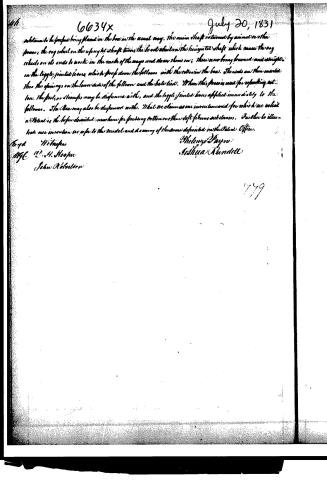
substance to be prepared being placed in the box in the usual way. The main shaft is turned by animal or other power; the cog wheel on the upright shaft turns the bevel wheel on the horizontal shaft which causes the cog wheels on its ends to work in the racks of the ways and draw them on; these ways bring forward and straighten on the toggle jointed levers which press down the followers with the cotton in the box. The cords are then marked thro' the openings on the lower side of the followers and the bale tied. When this process is used for exporting cotton, the parts or stoppers may be dispensed with, and the toggle jointed levers applied immediately to the followers. The box may also be dispensed with. What we claim as our invention and for which we solicit a Patent is the before described machine for pressing cotton or other soft fibrous substances. For the illustration of our invention we refer to the model and drawings of the same deposited in the Patent Office.
W. H. Hooper
John Robertson
Philippo Payne
William Rundle
779
Published accounts: journal notice
Notice in the monthly list of patents, with remarks
Journal of the Franklin Institute, new ser., vol. 9 (1832), p. 50 · View the page
32. For a Press for Cotton and other fibrous substances; Philenzo Payne, and Joshua Rundell, Port Gibson, Claiborn county, Mississippi, July 20.
Remarks. This is a vertical press, the follower of which is to be forced down by toggle joints. Within each of the cheeks of the press there is a toggle joint, from the middle of each of which an arm or shaft, extends forward of the press, in a horizontal direction. The power is applied to these arms, to draw them forward, and consequently, to bring the levers of the toggle joints in a right line with each other. The lower sides of the projecting arms form racks, which take into teeth upon a cylindrical shaft, crossing in front of the press. A vertical shaft turns the horizontal one by means of bevel gear. A horse, or other power, may be applied through the medium of a lever, or sweep, to the vertical or main shaft, when the follower will descend. The claim is to the press as described. We apprehend that this will not be a good press for the purpose intended, on account of the smallness of its range. When a follower is to go but a short distance, and to act with immense power at the end of its range, as in the printing press, the toggle joint offers every possible advantage: but the pressing of cotton, and other light fibrous articles, requires a press with a very long range, as well as of great power, and there are many presses now in use for this purpose, which combine these qualities in a way greatly superior to that now proposed.
About this record
- Patentee
- DATAMP
- Date
- the Name and Date index of patents, DATAMP, USPTO records
- Invention
- DATAMP
- Listed in
- the Name and Date index of patents, DATAMP, USPTO records, Jim Shaw's X-patent list, the Journal of the Franklin Institute, Burke's List of Patents (1847)
- Burke's 1847 Patent Office list gives the same patent.