

Drawings and documents
National Archives restored drawings: drawing
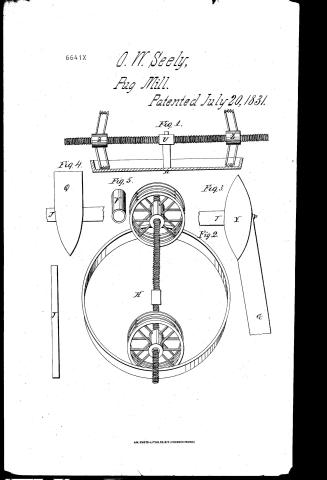
Oran W. Seely's Patent Drawing for a Machine for Preparing Mortar for Making Brick

National Archives, Restored Patent Drawings (Record Group 241) · Full-size scan at the National Archives · Catalog record
Show the text on the drawing Hide (46 words)
Words on the drawing as machine-read by the National Archives; not checked. Useful mainly for searching.
25. ULAY & POTTERY, / DIV. 15 / Pag Mills, / p2 / Ring Pits. / ORAN И SEELY / Mach for Preparing Mortar for making Brick / CLASSIFICATION / 6641-+ / Patented 20" July 1831.00 / DIVISION. / 9000 / 0.000 / I'igh / Figh3. / 0000 / Fig.5. / Fij.2. / of
USPTO scan
The patent as scanned by the USPTO
-
 Page 1
-
 Page 2
-
 Page 3


U.S. Patent and Trademark Office · Google Patents
Show the transcription Hide (867 words)
Machine transcription (LightOnOCR) of the pages as scanned by the USPTO, most of them the handwritten copies made when the records were restored after the 1836 fire. Not checked; it can misread handwriting, so compare it with the scan.
Page 1.
6641X
O. W. Seely,
Pug Mill.
Patented July 20, 1831.

AM. PHOTO-LITHO. CO. N.Y. (OSBORNE'S PROCESS)
Page 2.
6641X
July 20, 1831
Oran W. Seely of Williamson, New York
Letters Patent
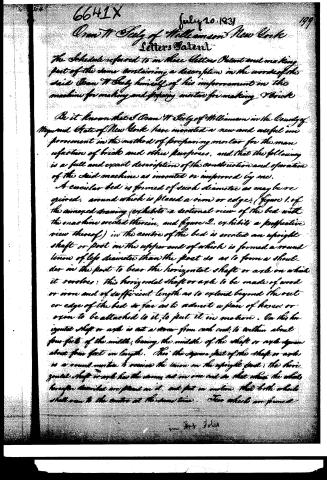
The Schedule referred to in these Letters Patent and making part of the same containing a description in the words of the said Oran W. Seely himself of his improvement in the machine for making and drying mortar for making bricks.
Be it known that I Oran W. Seely of Williamson in the County of Nassau and State of New York have invented a new and useful improvement in the method of preparing mortar for the manufacture of bricks and other purposes, and that the following is a full and exact description of the construction and operation of the said machine as invented or improved by me.
A circular bed is formed of such diameter as may be required, around which is placed a rim or edge; (Figure 1. of the annexed drawing exhibits a sectional view of the bed with the machine erected therein, and figure 2. exhibits a perspective view thereof) in the centre of the bed is erected an upright shaft or post on the upper end of which is formed a round tenon of less diameter than the post so as to form a shoulder in the post to bear the horizontal shaft or axle on which it revolves; this horizontal shaft or axle to be made of wood or iron and of sufficient length as to extend beyond the outer edge of the bed so far as to admit a pair of horses or oxen to be attached to it, to put it in motion. On this horizontal shaft or axle is cut a tenon from each end, to within about four feet of the middle, leaving the middle of the shaft or axle open about four feet in length. Then the open part of the shaft or axle is a round mortise to receive the tenon on the upright post; the horizontal shaft or axle has the tenons cut on one end so that when the wheels hereafter described are placed on it, and put in motion, that both wheels shall run to the centre at the same time. Two wheels are formed
Page 3.
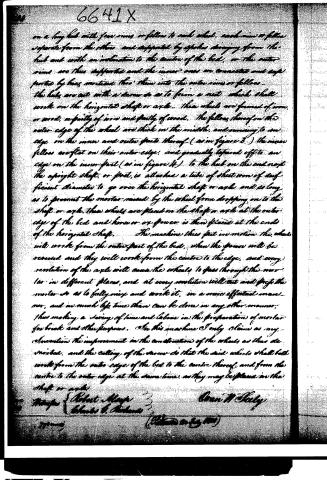
on a long hub with four rims or felloes to each wheel, each rim or felloe separate from the other, and supported by spokes diverging from the hub end with an inclination to the centre of the bed, or the outer rims are thus supported and the inner ones are connected and supported by bars mortised there, then into the outer rims or felloes. The hubs are cut with a screw so as to form a nest which shall work on the horizontal shaft or axle. These wheels are formed of iron, or wood, a felloe of iron and felloe of wood. The felloes thereon the outer edge of the wheel are thick in the middle, and running to an edge on the inner and outer parts thereof (as in figure 3) the inner felloes are flat on their outer edge, and gradually tapered off to an edge on the inner part (as in figure 4) to the hub on the end next the upright shaft, or post, is attached a tube of sheet iron of sufficient diameter to go over the horizontal shaft or axle and as long as to prevent the mortar raised by the wheel from dropping on to the shaft or axle. These wheels are placed on the shaft or axle at the outer edge of the bed and here or on power is then fixed at the ends of the horizontal shaft. The machine thus put in motion the wheels will work from the outer part of the bed, when the power will be reversed and they will work from the centre to the edge, and every revolution of the axle will cause the wheels to pass through the mortar in different places, and at every revolution will cut and froth the mortar so as to fully mix and work it, in a more efficient manner, and in much less time than can be done in any other manner, thus making a saving of time and labour in the preparation of mortar for brick and other purposes. In this machine I only claim as my invention the improvement in the construction of the wheels as thus described, and the cutting of the mortar so that the said wheels shall both work from the outer edge of the bed to the centre thereof, and from the centre to the outer edge at the same time, as they may be placed in the shaft or axle.
Witnesses: Robert M. H. Charles H. Andrews
Allen H. Seely
(Sealed 20 July 1861)
Published accounts: journal notice
Notice in the monthly list of patents, with remarks
Journal of the Franklin Institute, new ser., vol. 9 (1832), p. 54 · View the page
42. For a Machine for preparing Mortar for making Bricks; Oran W. Seeley, Williamson, Wayne county, New York, July 20.
Remarks. This machinery, in its general structure, resembles some others now in use for the same purpose. A circular trough is prepared into which the clay is to be put. A horizontal shaft, working upon an upright in the centre of the trough, when forced round, causes wheels to run over the clay, the wheels having a traversing motion to and from the centre. The arms of the horizontal shaft have each a screw cut upon them, these work in the hubs of the wheels, and cause them to traverse; one of them is a right, and the other is a left handed screw; in consequence of which, both the wheels recede from and approach the centre at the same time. Each wheel, instead of having a single rim, has four rims, or sets of felloes, supported by spokes from one common hub, the advantage of which is manifest.
About this record
- Patentee
- DATAMP
- Date
- the Name and Date index of patents, DATAMP, USPTO records
- Invention
- DATAMP
- Listed in
- the Name and Date index of patents, DATAMP, USPTO records, Jim Shaw's X-patent list, the Journal of the Franklin Institute, Burke's List of Patents (1847)
- The Franklin Institute's journal spells the name differently.
- Burke's 1847 Patent Office list gives the same patent.