

Drawings and documents
USPTO scan
The patent as scanned by the USPTO
-
 Page 1
-
 Page 2
-
 Page 3
-
 Page 4
-
 Page 5


U.S. Patent and Trademark Office · Google Patents
Show the transcription Hide (1,485 words)
Machine transcription (LightOnOCR) of the pages as scanned by the USPTO, most of them the handwritten copies made when the records were restored after the 1836 fire. Not checked; it can misread handwriting, so compare it with the scan.
Page 1.
6655X
T. Wadson,
Cook Stove.
Patented July 20, 1831.
Page 2.
July 20, 1851
6055X Thomas Woolson's looking stove
Letter Patent
The Schedule referred to in these Letters Patent and making part of the same containing a description in the words of the said Thomas Woolson himself of his Improvements in the looking stove.
To all to whom these Presents shall come
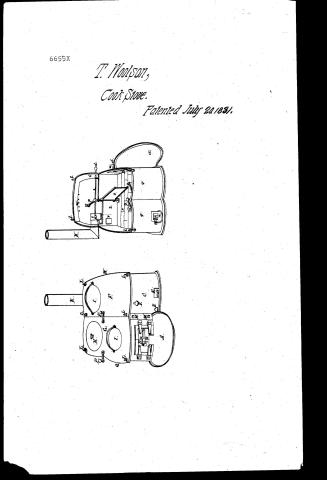
Be it known that I Thomas Woolson of Clarendon in the County of Sullivan and State of New Hampshire have invented and constructed a new and useful improvement in domestic economy, which I do nominate a Double Horizontal Looking Stove and that the following is a full and exact description of the said Stove as invented and improved by me. The Stove is usually constructed partly of cast iron and partly of sheet iron, but may be built wholly of either as convenience may dictate. The form of the stove resembles that of two oblong stoves, the ends and sides moderately curved, placed one beside the other, so connected as to form one stove, between the two parts is a straight cast iron division plate, which constitutes the inner side of both sections of the stove.
The Stove described is No. 1, the largest contemplated, but different sizes will be built to suit different families. The height of this stove is 14 inches throughout, on the left of the division plate is situated the fire place 16 inches wide on the front side, where the fire doors are situated, which open from the centre, to the right and left. On a level with the bottom of the doors, a hearth projects about one foot and a half from right to left about 22 inches. It is secured to the iron frame 2 inches above the bottom of the stove, a course of bricks being laid in the stove where the fire is kept, brings the surface on which the fire lies to a level with the hearth, which rests on the projecting end of an iron bar which attaches to the frame on which the stove stands; from the fire doors to the back side of the stove is 80 inches which is the length of the fire place; the plate on the left side of the fire place, which is called the fire end of the stove, is formed by two curves thus $\mathcal{C}$ , the frame which holds the
Page 3.
the fire doors is made fast by bolts to the division plate on the right (and to the fire end plate at figure 3 on the left. On the back side opposite the fire doors is a curved plate of equal size to the door frame, made fast to the fire end plate at figure 1, and to the division plate at the other end by bolts. To the centre of the fire end plate at fig 2 is hung a small cast iron plate with one pivot resting on a knob in the end plate about 3 inches from the lower side of said plate (and one pivot extending through the top of the stove by which it may be swung round; opposite to this, on the division plate another similar plate is hung in the same way; when these plates are swung together they meet in the centre and form the fire place into two nearly equal parts, one each of which circular holes are formed in the top of the stove for the admission of vessels for boiling and other culinary purposes. Through the fire end plate between fig 1 and 2, a door is made for the purpose of kindling a fire under the back when the movable plates are swung together, so as to make two parts of the fire place, the movable plates come within 2 inches of the top of the stove, which leaves room for the smoke from the fire in the front apartment to pass over them to the funnel. The object of the movable plates is to enable the occupier to heat one vessel at a time when necessary, thereby to save fuel and not occasion so much heat during the warm season of the year; when it is necessary to heat both vessels at once or a large fire is convenient, the plate which is hung at fig 2 on the one plate may be turned to fig 1 or 3 (and the other plate turned to the division plate, thereby forming one long fire place; it is intended that these movable plates should be taken out of the stove in the winter season. The section of the stove to the right of the division plate contains the oven (and is constructed as follows. The shape and size of the oven part are similar to that on the left except that the oven end plate consists of one curve of a larger sweep instead of the two small curves as in the fire end plate, the oven is usually made of sheet iron by itself, nine inches deep and broad enough to reach from the division to the end plates, the back side of the oven is confined between two plates on the division plate and made fast
Page 4.
fast with rivets to the end plate through which is the oven's mouth and on which the oven's door is hung. The oven being but nine inches deep (and twenty-four inches wide) and being placed midway between the top and bottom of the stove and between the back and front plates gives the smoke room to play completely round the oven when required for heating it. The smoke is let out on the back side of the stove against the oven by a funnel seven inches in diameter, the division plate is cut out from the top plate as low as the top of the oven about one half its length on the back part in order to let the smoke pass round the oven and thence out at the funnel on the back side, where by the oven is heated; through the division plate a hole is made three inches wide and four high just back of the oven and below the top of the oven against which a strong damper is hung which is opened and shut at pleasure by means of a rod connected therewith and extending in over the oven and through the front side of the stove near the hearth. The space between the upper side of the oven and the back plate of the stove is closed with a plate of iron except an aperture three inches wide and six inches long from the division plate to the right, which aperture is closed with a horizontal damper which slides on the top of the oven by means of a rod extending over the oven and through the front plate four to five inches to the right of the division plate; by means of these dampers the heat of the oven can be regulated to any degree required, for it will be readily seen that when both dampers are open the blaze (and smoke) pass directly into the funnel without going round the oven, and when both are closed all the blaze and smoke has to pass round the oven, thus by adjusting the dampers, the whole or any part of the heat may be turned round the oven till the heat suits the occasion. The top of the stove consists of two cast iron plates rivetted together over the division plate; the plate which covers the fire place has two round openings for boilers, one each with circles to receive different sized vessels, the plate over the oven has one opening for frying, near the funnel. What I claim as original is the following: By placing the two parts of the stove, to wit, that which contains the fire and that containing the oven horizontally side by side, thereby communicating heat to one side of the oven; the particular
Page 5.
6655x
July 20, 1831
method of turning the blaze (and smoke) around the oven as described, giving heat to the top and bottom (and to the front and back sides, leaving but one side exposed to the air, viz. where the oven door is hung); also the particular method of letting the blaze in into the furnace without passing round the oven by opening the dampers, thus regulating not only the heat of the oven, but in a considerable degree the draught of the stove, and heat communicated to the room; (and also the particular method described, of making the fire place into two parts or one, by means of the moveable plates hung therein
Thomas Wilson
To: Mr. Samuel Stewart Jr.
Lucina M. Stewart
1475 words
Published accounts: journal notice
Notice in the monthly list of patents, with remarks
Journal of the Franklin Institute, new ser., vol. 9 (1832), p. 47 · View the page
23. For a Cooking Stove; Thomas Woolson, Claremont, Sullivan county, New Hampshire, July 20.
Remarks. The form of this stove is such as to give it the appearance of two ordinary cooking stoves joined together. One of these parts consti- tutes the fire place, the other the oven, and surrounding flues; the back plate of the fire place forming one side of the oven. The claims made are the placing the two parts of the stove, horizontally, side by side; the mode of turning the blaze and smoke round the oven; the arrangement of dampers, by which the blaze may be admitted into the funnel without passing round the oven; and the method described in the specification, of making the fire place in one, or dividing it into two parts, by a moveable plate.
About this record
- Patentee
- DATAMP
- Date
- the Name and Date index of patents, DATAMP, USPTO records
- Invention
- DATAMP
- Listed in
- the Name and Date index of patents, DATAMP, USPTO records, Jim Shaw's X-patent list, the Journal of the Franklin Institute, Burke's List of Patents (1847)
- Burke's 1847 Patent Office list gives the same patent.