

Drawings and documents
National Archives restored drawings: drawing
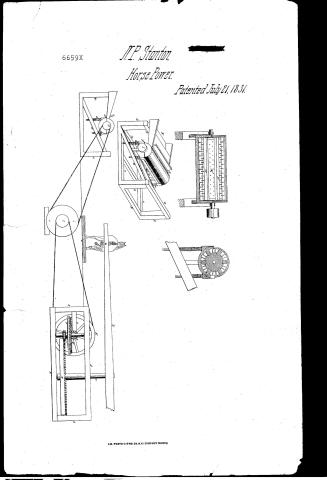
N. P. Stanton's Patent Drawing for a Thrashing Machine and Horse Power

National Archives, Restored Patent Drawings (Record Group 241) · Full-size scan at the National Archives · Catalog record
Show the text on the drawing Hide (125 words)
Words on the drawing as machine-read by the National Archives; not checked. Useful mainly for searching.
tabs / Motors. / Pum / Cylinder,wom Sectionatrien of Concuve Bed / Crojs Section / N.P. STANTON / Thrashing Machine & Horse Power / 12221 / Sat July 21-1831 / Patented 21 "In / _A. Posts. B Plates- . c Cills.- D Girls / E. Brace._F. Circular or concave-bed bed / CLASSIFICATION / G. Four spiral Springs.- H. Cylinder / 6659-X / I.Whir. - K: Beaters. Dirt discharge. M. Feeding table / DIVISION. / Horse Power / A Frame. B. Crown wheel. C. Shaft. D.Lever / E. Pmon...e. F. 3- Bevel wheel / G. -Pinion .g.Head-hlock H. Bandwheel / I. 12th Pulleyed 30th Pulley.- K. Bridge overputhes & strapes / Made under the direction / of Patents in conformity / Meny Sumorth / On / Horse Power
USPTO scan
The patent as scanned by the USPTO
-
 Page 1
-
 Page 2
-
 Page 3
-
 Page 4


U.S. Patent and Trademark Office · Google Patents
Show the transcription Hide (1,190 words)
Machine transcription (LightOnOCR) of the pages as scanned by the USPTO, most of them the handwritten copies made when the records were restored after the 1836 fire. Not checked; it can misread handwriting, so compare it with the scan.
Page 1.
6659X
J.P. Stanton
Horse Power.
Patented July 21, 1831.
A.M. PHOTO-LITHO. CO. N.Y. (OSBORNE'S PROCESS)
Page 2.
July 21, 1831
Schemiah D. Stanton
Letter Patent
The Schenectady referred to in their Letter Patent and making part of the same containing a description in the words of the said Schemiah D. Stanton himself of his improvement in the threshing machine together with the application of Horse Power for operating said machine.
To all to whom these presents shall come. Be it known that I, Schemiah D. Stanton of the village of Syracuse in the County of Onondaga State of New York have invented a new and useful improvement on a machine for threshing grain and the Horse Power to operate said machine which Horse power may be applied to all other uses and purposes to which these powers may be applied and that the following is a full and exact description of the construction & operation of the said machine Horse Power as invented or improved by me. Said machine is constructed with a frame five feet long three feet two inches wide & two feet four inches high made with four posts, two plates, two sills, three guides or cross timbers, with a brace from the foot of each forward post to the top of each back post calculated to receive the cylinder or concave box which is to be made of hard wood plank & faced with wrought iron three fourths of an inch wide & three sixteenths of an inch thick to be fastened on with screws or said box may be lined with a cast iron concave plate fluted as aforesaid. The box stands on four spiral springs placed between the said braces & the box for the purpose of suffering hard substances to escape between the box & cylinder without injuring either. The length of the box may be at least two feet six inches & the width may be twelve inches faced with iron where the grain enters the machine. The box is to be garaged by legs passing through the said box & cylinder from the box through the spring & braces. The cylinder is to be the same length of the box made round of solid hard wood nine inches diameter with an iron shaft running through it one inch and a half square with a bearing at each end of the cylinder one end of the shaft runs far enough out to receive a wheel of about six inches diameter. There are six wooden levers one inch & three quarters thick & two inches wide running lengthways of the cylinder.
Page 3.
cylinder & ground in so as to project one inch on each side & fastened with spikes & fastened on the side towards the hopper with wrought iron plates two inches wide & three eighths of an inch thick secured by screws or rivets. There are twenty-five spikes between each heater made of wrought iron half an inch square with a screw cut on one end & drawn to a square point at the other which are to be screwed into the cylinder so as to project two inches. They are to be set in two courses space forming a cylinder with six heaters & one hundred and fifty spikes. The ends of the cylinder are secured by iron bands. The cylinder plays into the concave or circular bed before described & is covered with a circular case of sheet iron. There is a focusing table with a throat to receive the grain & directly over it a throat to discharge the dust. The improvement which I claim in the above threshing machine is the constructing & uniting of spikes & heaters in the same cylinder with the cast iron concave bed, the sheet iron case & the construction of the dust discharger. The description & specification of the above powers & how machines is as follows. The frame is to be nine feet long & eight feet wide & three feet high with three sides. Three plates, six posts and two girts & the frame contains the following gears. One crown wheel six feet diameter with spur gearing of each side with wooden shaft, arms and pins. The shaft is two feet eight inches long & stands perpendicular with a slip gear on it the lower end which slip rests a boy in the middle side with a wing gear on it the top with a neck passing through the middle plate, on the top of the neck is a cammed head upon which the lever is let on to by means of a motion in the centre. The whole length of the lever is nearly four feet; it is made eight inches square in the middle & tapers to three inches square at each end. Said crown wheel meshes into a low inch pinion on another upright shaft sloped into the same side at the bottom & remaining in a boy on the same place at the top with the crown wheel shaft. The shaft of the pinion wheel is supported by keys at the top & bottom so as to mesh in & out with the crown wheel as may be necessary. On the shaft of the pinion wheel is also a bevel wheel three feet diameter to form a spur wheel which meshes into an eight inch pinion wheel on another shaft to go long on cast & remaining head block one of which is mounted into a sheave belt & the other into a worm. Just towards the rear end
Page 4.
with keys on which last mentioned shaft is attached a three foot four inch band wheel from which a band or strap is taken to a twelve inch pulley having thereon a shaft the quagons of which run in boxes fixed eight feet inches below the path of the horses and between the machine and horse power frame on the side of and adjoining which pulley is a thirty inch pulley from which a band is taken to the wheel or pulley on the threshing machine. A bridge is built over the pulleys and straps which are situated under the horses path. I claim as my invention or improvement the construction of the gearing of this horse power to run beneath the lever by which the horses draw, also the placing said horse power frame substantially on the ground & the communication between the threshing machine and horse power under the walk of the horses by means of bands, straps, ropes, chains, or shafts. I also claim as my invention or improvement the lever passing around on the top of the frame of the horse power and the steam on a quagons projecting above the entire plate of the horse power to which said lever is attached. June 25 1831.
Witnesses
B.D. Nixon
Robt. Vayou
Nehemiah P. Stanton.
Published accounts: journal notice
Notice in the monthly list of patents, with remarks
Journal of the Franklin Institute, new ser., vol. 9 (1832), p. 56 · View the page
47. For a Thrashing Machine, and a Horse Power, for operating said machine; Nehemiah P. Stanton, Syracuse, Onondaga county, New York, July 21.
Remarks. The thrashing machine is described in the usual terms, applied to this instrument; we have talked about the different parts so frequently, that we are tired of the subject. There, however, is a claim made in the present instance, which is to "the uniting beaters and spikes on the same cylinder with the cast iron concave bed, and the sheet iron cap, and the construction of the dust discharger." All that is said about the dust discharger is, that" there is a feeding table, with a throat to receive the grain, and directly over it a throat to discharge the dust." The horse power consists of a large horizontal wheel turned by a lever, projecting from its vertical shaft; this is geared to a smaller wheel which turns a horizontal shaft carrying a drum and strap, which gives motion to the thrashing machine, or to any other machinery required to be operated upon. So far all is according to the well established plan of such machines; the novelty of this horse power consists in placing the wheel work under ground, and allowing the main shaft to project up through the framing, the horse walk being above them. A diamond gudgeon is to be formed on the top of the vertical shaft, to receive the mortice of the lever by which the horse draws. The claims relating to the horse power are to the running of the gearing below the lever by which the horse draws. The communications from it to the thrashing machine, by bands, ropes, &c. &c. &c., the placing the lever at top, and the diamond gudgeon. This patent is taken, not only plainly, but confessedly, for two distinct machines, the application of the horse power to other purposes being particularly noticed; they should, of course, have been the subject of two patents; the claims to the two are separately made as to two machines. But independently of this consideration, there are parts of each of the machines claimed, which present no novelty whatever.
About this record
- Patentee
- DATAMP
- Date
- the Name and Date index of patents, DATAMP, USPTO records
- Invention
- DATAMP
- Listed in
- the Name and Date index of patents, DATAMP, USPTO records, Jim Shaw's X-patent list, the Journal of the Franklin Institute, Burke's List of Patents (1847)
- Burke's 1847 Patent Office list gives the same patent.