

Drawings and documents
National Archives restored drawings: drawing
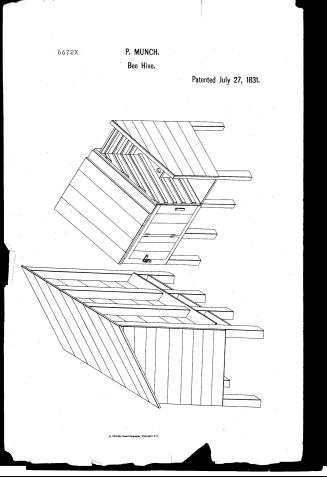
Philip Munch's Patent Drawing for a Bee House

National Archives, Restored Patent Drawings (Record Group 241) · Full-size scan at the National Archives · Catalog record
Show the text on the drawing Hide (102 words)
Words on the drawing as machine-read by the National Archives; not checked. Useful mainly for searching.
6. / 6. BEE CULTURE. / Bee-Hives. / Philipe Aunch, / V.T.13p.69. / Bee House, / Patented Palentat 27July. 1831, / CLASSIFICATION / 6672-7 / DIVISION. / OIR / References, / A posts, B. "alighting boards" C. shelteringboards. / D. apartment with back & roof removed. È. hive. / Patent Cffice Mar Mar 11/1842 / I. cleates. G. doors. H.trough. / Fig.1. showing front of house. Fig. 2, back of ditte. / Made under the direction of the Commificate of Patents / in conformity with act of bougry 3March 1837 / Bara / alighting board if different colors to enable been more / of Patiets / madily find them hou,
USPTO scan
The patent as scanned by the USPTO
-
 Page 1
-
 Page 2
-
 Page 3
-
 Page 4
-
 Page 5


U.S. Patent and Trademark Office · Google Patents
Show the transcription Hide (1,468 words)
Machine transcription (LightOnOCR) of the pages as scanned by the USPTO, most of them the handwritten copies made when the records were restored after the 1836 fire. Not checked; it can misread handwriting, so compare it with the scan.
Page 1.
6672X
P. MUNCH.
Bee Hive.
Patented July 27, 1831.
N. PETERS, Photo-Lithographer, Washington, D. C.
Page 2.
69
July 27, 1831
Philip Munch of Putnam Ohio.
Letters Patent
The Schedule referred to in these Letters Patent and making part of the same containing a description in the words of the said Philip Munch himself of his improvement in the Re-house and management of Bees.
To all to whom these presents shall come, Be it known that I Philip Munch of Putnam in the county of Muskingham and State of Ohio, have invented a new and useful improvement in the construction of Bee Houses, and for the cultivation of Bees, and that the following is a full and exact description of the invention made by me.
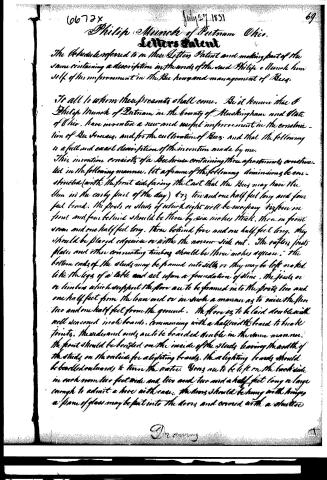
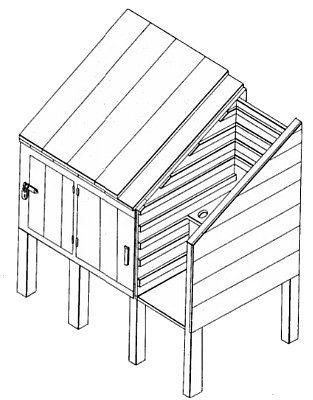
This invention consists of a Bee house containing three apartments constructed in the following manner. Let a frame of the following dimensions be constructed (with the front side facing the East that the Bees may have the Sun in the early part of the day) 6' 13" ten and one half feet long and four feet broad. The posts or studs of which eight will be necessary, fifteen in front and four behind should be three by six inches thick. Those in front seven and one half feet long. Those behind five and one half feet long. They should be placed edgewise or with the narrow side out. The rafters, posts, plates and other connecting timbers should be three inches square. The bottom ends of the studs may be framed into sills or they may be left naked like the legs of a table and set upon a foundation of stone. The posts or timbers which support the floor are to be framed into the posts two and one half feet from the lower end or in such a manner as to raise the floor two and one half feet from the ground. The floor is to be laid double with well seasoned iron boards, commencing with a half width board to break joints. The sides and ends are to be boarded double in the same manner. The front should be boarded on the inside of the studs leaving the width of the studs on the outside for a lighting board. The a lighting board should be boarded outwards to turn the water. Doors are to be left on the back side in each room two feet wide and two and two and a half feet long or large enough to admit a horse with ease. The doors should be hung with hinges a pane of glass may be put into the doors and covered with a shutter.
Drawing
Page 3.
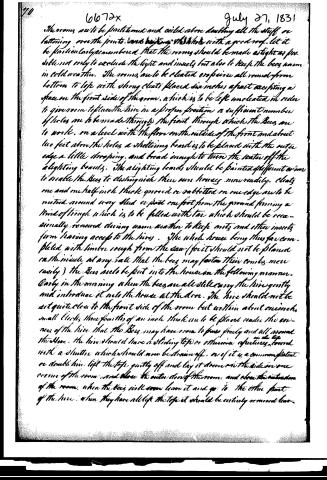
The rooms are to be positioned and cailed above doubling all the stuff or battering over the fronts, and building the whole with a good roof. Let it be particularly remembered that the rooms should be made as tight as possible not only to exclude the light and insects but also to keep the bees warm in cold weather. The rooms are to be elevated or raised all round from bottom to top with strong cleats placed six inches apart excepting a space on the front side of the room, which is to be left unelevated in order to give room to place the hive in a proper position. A sufficient number of holes are to be made through the front through which the bees are to work. On a level with the floor on the outside of the front and about five feet above the holes, a sheltering board is to be placed with the outer edge a little drooping, and broad enough to turn the water off the alighting boards. The alighting boards should be painted different colors to enable the bees to distinguish their own hives more readily. Cleats one and one half inch thick, grooved or rabbeted on one edge, are to be fitted around any stud or post one foot from the ground forming a kind of trough which is to be filled with tar which should be occasionally renewed during warm weather to keep out ants and other insects from having access to the hives. The whole house being thus far completed with timber rough from the saw (for it should not be planed in the inside at any rate that the bees may fasten their combs more easily), the bees are to be put into the house in the following manner. Early in the morning when the bees are all still away, the hive gently and introduce it into the house at the door. The hive should not be set quite close to the front side of the room but within about one inch. Small cleats, three-fourths of an inch thick, are to be placed under the corners of the hive that the bees may have room to pass freely and all around the hive. The hive should have a sliding top or otherwise an opening covered with a shutter which should now be drawn off, or if it is a common flat-topped or double hive, lift the top gently off and lay it down on the side in one corner of the room, and close the outer door of the room, and close the outer door of the room, when the bees will soon leave it and go to the other part of the hive. When they have all left the top, it should be entirely removed.
Page 4.
6672x
July 27, 1831
ing only the bottom part remaining. crop sticks are now to be placed on the clefts, six inches apart reaching clear across the room, and upon these other sticks are to be laid at right angles nine or ten inches asunder. a few small sticks should be placed about the tops of the hive in addition to give the bees a fair opportunity of commencing their operations. The door should now be closed and the whole left undisturbed. only examining them occasionally— if they are young swarms they will commence working inside of the hive first but if they are old swarms having the hive already filled, they will immediately commence building their combs outside of the hive. Bee houses may be constructed on this principle to any extent. any number may be joined together. They may be made of any materials even of brick or stone, and of any dimensions desirable. in short they may be successfully placed in any room out house or other suitable place, so that it is light and sticks placed in a proper position to support the combs. if it should be found that a house of the above construction would not be warm enough in a cold climate a form of open construction may be made and cataract boards on the outside, lined on the inside and filled in with clay and oat straw or other suitable materials which will effectually guard against cold. instead of putting the bees into the houses before directed, they may be put in without a hive, by disengaging the sting or other substance upon which they may have settled after swarming and thus placing them in the situation which they are intended to occupy. the object not being the particular size or construction of the house or the manner of putting the bees into it as the principle of preventing the bees from swarming and also of taking the honey without killing the bees. This method of managing bees possesses important advantages over any other hitherto discovered. in the common method for want of room owing to the smallness of the hive the bees are obliged annually to send forth new swarms which occasions considerable trouble to hive them, and often the entire lots of the swarm they sent out. swarms which come out late in the season owing to the scarcity of flowers in the latter part of the summer, are frequently unable to collect a sufficient quantity of honey to support them during the ensuing winter and they consequently perish. in this method there will be no necessity of changing or taking the tops off of the hives or the cruel practice of killing the
Page 5.
July 27, 1831
bees to come at the honey, but it may be cut out at any time when wanted for use especially in winter without in the least disturbing the operations of the bees. In this method all the above mentioned inconveniences will be avoided. The bees having ample room to work and not being obliged to send out new swarms will increase and collect their honey with astonishing rapidity.
Philip Munch
(1442 words)
Published accounts: journal notice
Notice in the monthly list of patents, with remarks
Journal of the Franklin Institute, new ser., vol. 9 (1832), p. 61 · View the page
A swarm of fresh bees may, if preferred, be put in without a hive; the great object being to give them abundant room, that they may not be compelled to swarm, as from a common hive. By thus giving them ample space, it is said that many advantages are secured Swarms often perish from their swarming late in the fall, which this plan prevents; the practice of killing the bees is rendered entirely unnecessary, as the comb may be cut out at any time when it may be wanted for use, especially in winter; the bees having ample room, will have no inclination to swarm, and will therefore collect honey much more rapidly than usual. 61. For a Hoop Split Shaving Machine; Gabriel Heatwoal, Harrisonburg, Rockingham county, Virginia, July 27.
Remarks. Splits are first to be made out of white oak, or hickory, in the usual way. The machine for shaving them consists of a bar of iron, or steel, which is fixed upon a bench; and upon this the knife, or shaver, is brought down in the manner of the upper blade of a pair of shears, it working on a joint for that purpose. On the edge of this knife there are notches, the size of the hoops to be shaved. The ends of the splits are fastened upon a drum, or cylinder, in front of, and close to, the knife, which is then closed upon them. The cylinder is turned by a crank, which draws the splits through, and at the same time bends them round the cylinder.
DATAMP: illustration
Illustrations from DATAMP

DATAMP (Directory of American Tool and Machinery Patents), via the Internet Archive · Archived DATAMP page
About this record
- Patentee
- DATAMP
- Date
- the Name and Date index of patents, DATAMP, USPTO records
- Invention
- DATAMP
- Listed in
- the Name and Date index of patents, DATAMP, USPTO records, Jim Shaw's X-patent list, the Journal of the Franklin Institute, Burke's List of Patents (1847)
- Burke's 1847 Patent Office list gives the same patent.