

Drawings and documents
National Archives restored drawings: drawing
Isaac Fobes' Patent Drawing for a Stave Jointner

National Archives, Restored Patent Drawings (Record Group 241) · Full-size scan at the National Archives · Catalog record
Show the text on the drawing Hide (85 words)
Words on the drawing as machine-read by the National Archives; not checked. Useful mainly for searching.
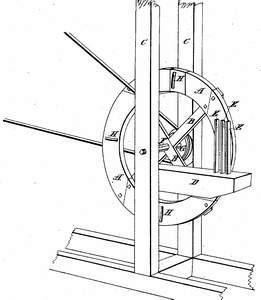
144. WOOD WORKING. / 3. SPECIAL WORK MACHINERY. / [40] Jointing Staves, / CLASSIFICATION / 6684.X / DIVISION. / ISAAC FOBES / STAVE JOINTER / Patenteds / A. Face of Iter Jointer / B. ATMS / C. Posts / D. Rest / E' Guides / F. Axis / Staves / G. Driving pulley / H. Jointer Trons / Section through Jointer the ginler Trons / G. Strecklar a DAL / Patent offine 60st 1838 / Made under the direction of the Communismer / of Patents in conformity with acto March 1837 / Memps Sumorth / Comminiour of Patients
USPTO scan
The patent as scanned by the USPTO
-
 Page 1
-
 Page 2
-
 Page 3
-
 Page 4


U.S. Patent and Trademark Office · Google Patents
Show the transcription Hide (1,040 words)
Machine transcription (LightOnOCR) of the pages as scanned by the USPTO, most of them the handwritten copies made when the records were restored after the 1836 fire. Not checked; it can misread handwriting, so compare it with the scan.
Page 1.
6684X
I. FOBES.
STAVE JOINTER.
Patented Aug. 3, 1831.

Page 2.
Aug. 3, 1831 6684X 573
Leane Forbes, Bridgewater, Massachusetts
Letters Patent.
The Schedule! referred to in these Letters Patent, & making part of the same, containing a description in the words of the said Leane Forbes himself of his improvement called the Stave Sinter.
To all to whom these presents shall come.
Be it known that Leane Forbes, of Bridgewater, in the county of Plymouth and State of Massachusetts, have invented, caused to be made, and applied to use, a new and useful improvement in the art of keeping or of making barrels or casks; which consists in joining the staves by a machine which seals the concave stave joints, and that the following is a full and exact description of the construction and operation of the said machine as invented by me. This sinter consists in the form of a wheel or section of a hollow sphere to turn on an axis which passes through the centre thereof. The joints (one or cutting side thereof) should be turned out in a concave form like or similar to the inner surface of a common flat glass crystal, or (to form the staves straighter near the ends so that top strain shall come on the shins help of the bark) the face of the sinter should be somewhat flatter or less concave toward the periphery approaching the form of a turn pot mouth. Said wheel or sinter is perforated near its periphery and at proper distances to receive four or more stout irons or rollers which are held in their places by wedges or screws, and the edges thereof are ground and adjusted to correspond to the concavity of the face of the sinter so that when the joints are caused to revolve briskly on its axis by the application of power thereto (by means of a crank, pulley and belt or gear) and the edge of a stave is properly held against the face thereof in the direction of a short line to the circle of the joints the cutting edges so projecting therefrom will each in succession cut shavings from the stave and this immediately reverse its whole length to the required force.
Page 3.
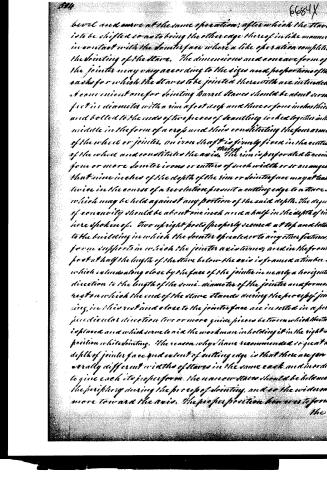
level and move at the same operation; after which the Stave is to be shifted so as to bring the other edge thereof in like manner in contact with the douter face where a like operation completes the joining of the Stave. The dimensions and convenient form of the joints may vary according to the size and proportions of the staves for which the Stave is to be joined therewith are intended. A convenient one for joining Barrel Staves should be about seven feet in diameter with a rim a foot deep and three or four inches thick and bolted to the ends of two pieces of scantling locked together in the middle in the form of a crop and this constituting the four arms of the wheel or jointer. An iron shaft is firmly fixed in the center of the wheel and constitutes the axis. The rim is perforated to receive four or more douter irons or cutters of such width or so arranged that nine inches of the depth of the rim or douter face may at least twice in the course of a revolution present a cutting edge to a Stave which may be held against any portion of the said depth. The depth of concavity should be about one inch and a half in the depth of rim here spoken of. Two upright posts properly secured at top and bottom to the building in which the douter operates or to any other fixture form supports in which the jointer axis turns, and in the front post at half the length of the Stave below the axis is framed a timber which extends along close by the face of the jointer in nearly a horizontal direction to the length of the semi-diameter of the jointer and forms a rest on which the end of the Stave Stands during the process of joining, in this rest and close to the jointer face are inserted in a perpendicular direction two or more guide pieces between which the Stave is placed and which serve to aid the workman in holding it in the right position while joining. The reason why I have recommended so great a depth of jointer face and extent of cutting edge is that there are generally different widths of Staves in the same cask and in order to give each its proper form the narrow Staves should be held nearer the periphery during the process of joining, and so the wider ones more toward the axis. The proper position however to form the
Page 4.
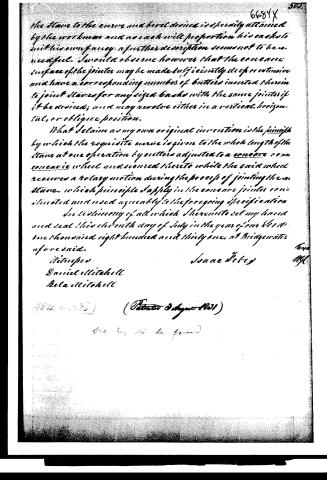
the stone to the curve and bevel desired is speedily attained by the workman and no cash will proportion his cash to suit his own fancy. a further description seems not to be needed. I would observe however that the concave surface of the jointer may be made sufficiently deep or extensive and have a corresponding number of buttons inserted therein to joint stones for any sized basins with the same jointer if it be desired; and may revolve either in a vertical, horizontal, or oblique position.
What I claim as my own original invention is the principle by which the requisite curve is given to the whole length of the stone at one operation by buttons adjusted to a concave or convex wheel and secured thereto while the said wheel receives a rotary motion during the process of jointing the stone. which principle I apply in the concave jointer constituted and used agreeably to the foregoing specification.
In testimony of all which I hereunto set my hand and seal this 1st day of July in the year of our Lord one thousand eight hundred and thirty one, at Bridgewater aforesaid.
Witnesses
Daniel Mitchell
Bela Mitchell
Isaac Stokes
(Patented 3 August 1831)
Published accounts: journal notice
Notice in the monthly list of patents, with remarks
Journal of the Franklin Institute, new ser., vol. 9 (1832), p. 112 · View the page
5. For machinery for Jointing Staves; Isaac Fobes, Bridgewater, Plymouth county, Massachusetts, August 3.
Remarks. This jointing machine consists of a wheel turning horizontally, through the upper side, or face, of which project four, or any convenient number of irons, or cutters, passing in from below in the manner of plane irons. The face of this circular jointer is made concave from the outer towards the inner edge, the irons being adapted to this curvature; which is such that when the edge of a stave is placed upon it, the jointing shall leave it with the proper swell in the middle. A rest is provided, against which to bear the stave whilst jointing. The claim is to the principle upon which the machine operates, or, in other words, to the concave faced revolving jointer. Among the many jointing machines which we have seen and described, there certainly is not one which operates upon this principle. The only objection which we see to it is that the irons work against the grain for one half the length of the stave.
DATAMP: illustration
Illustrations from DATAMP

DATAMP (Directory of American Tool and Machinery Patents), via the Internet Archive · Archived DATAMP page
About this record
- Patentee
- DATAMP
- Date
- the Name and Date index of patents, DATAMP, USPTO records
- Invention
- DATAMP
- Listed in
- the Name and Date index of patents, DATAMP, USPTO records, Jim Shaw's X-patent list, the Journal of the Franklin Institute, Burke's List of Patents (1847)
- Burke's 1847 Patent Office list gives the same patent.