

Drawings and documents
National Archives restored drawings: drawing
Jesse Reed's Patent Drawing for a Pump

National Archives, Restored Patent Drawings (Record Group 241) · Full-size scan at the National Archives · Catalog record
Show the text on the drawing Hide (139 words)
Words on the drawing as machine-read by the National Archives; not checked. Useful mainly for searching.
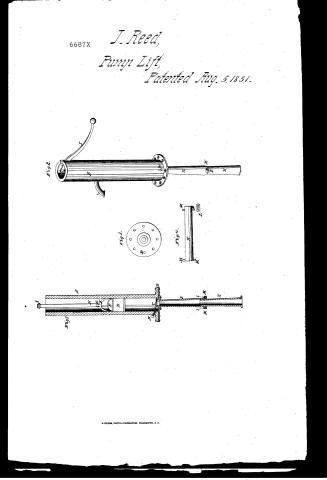
VOL.13.p.261, 261, / CLASS 103. PUMPS / Assembling. / TH / Restored Palents. / fifse Pump. Лид Patented aug. 5'-1831- / Fig.1. / CLASSIFICATION / 6687+ / DIVISION. / References, / Fur 1.section of Joump Fill. sideview. / Fight. / II / F28 3. bottom plate, Fight one length of pipe, / A. body of pump B.botten plate. C. lower value / AG / D. moveable Box. Evalve. Estaple. G. joint.- H. rod / Ihandle K pipe.Inconnecting link. M. ears. / N thrub screw / Salential / Fig.3. / aug 57 1831 / Fid 5 4 / ZM / Patent Office Jefut ii. - 1841 / K Cart iron Triled orhihe / II / Made under the direction of the Comming / being longer at one Ind than / of Patients in conf onnity with act of / the other, Dip that they may / for /rui tog ther Innikar " / Congrefe 3 March 1837 / to from furnel of a alove. / Commissional
USPTO scan
The patent as scanned by the USPTO
-
 Page 1
-
 Page 2
-
 Page 3
-
 Page 4


U.S. Patent and Trademark Office · Google Patents
Show the transcription Hide (945 words)
Machine transcription (LightOnOCR) of the pages as scanned by the USPTO, most of them the handwritten copies made when the records were restored after the 1836 fire. Not checked; it can misread handwriting, so compare it with the scan.
Page 1.
6687X
J. Reed,
Pump Lift,
Patented Aug. 5, 1831.

M. PETERS, PHOTO-LITHOGRAPHER, WASHINGTON, D. C.
Page 2.
2057 August 5th 1834 2057
X6687 Jesse Reed.
Letters Patent. August 5th 1834.
The schedule referred to in these Letters Patent, and making part of the same, containing a description in the words of the said Jesse Reed himself of his improvement in the Pump.
The following is a description of the Pump used for pumping water, & the improvements claimed thereon, viz:
The principal parts consist of a perpendicular tube in the form of the upper part of a pump, with its flange, bottom plate, valve, movable top, rod, lever, screws &c. &c. This pump is made of cast iron, wrought iron, or other metal. The body of this pump now used, is about two feet in length; the caliber is from two to three inches according to the quantity of water required; at the bottom of the caliber is a projection or flange extending about eight inches in diameter; under the flange is a plate about twelve inches in diameter, of suitable thickness for the strength required. Through the centre of said plate is a hole about an inch and a quarter to an inch and a half diameter, on the upper side of the hole is an elevation about an eighth of an inch in height, and a little more than an eighth of an inch in width, in a circular form corresponding with the hole, on which the lower valve shuts. Across the circumference of the plate are a sufficient number of holes for wood screws or bolts, that said plate may be attached to any board or plank in whatever place said pump may be used. The thickness of the pump from the caliber to the surface is a little more than a quarter of an inch. The flange of the perpendicular tube is put together by screws centrally over the lower outlet; it is made tight by placing a circular piece of thin leather, or any other suitable material between the bottom plate and flange. The lower valve is attached to the lower plate, by a piece of wire.
Page 3.
6681X
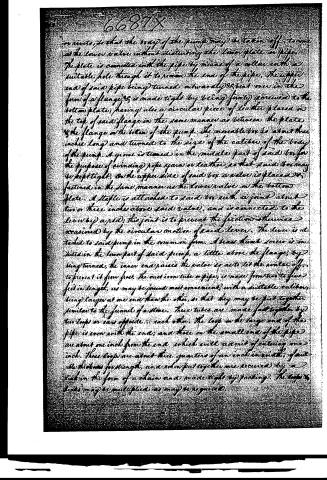
or rivets, so that the way of the pump may be taken off, to come at the lower valve without disturbing the lower plate or pipe. The plate is connected with the pipe by means of a collar with a suitable hole through it to receive the end of the pipe, the upper end of said pipe being turned outwardly & beat over in the form of a flange, & is made tight by being firmly screwed to the bottom plate, having also a circular piece of leather placed on the top of said flange in the same manner as between the plate & the flange at the bottom of the pump. The movable box is about three inches long and turned to the size of the caliper of the body of the pump. A groove is turned in the middle part of said box for the purpose of winding rope yarn or leather, so that said box may be kept tight. On the upper side of said box a valve is placed & fastened in the same manner as the lower valve on the bottom plate. A staple is attached to said box with a joint about two or three inches above said valve, and is connected to the lever by a rod; this joint is to prevent the friction otherwise occasioned by the circular motion of said lever. The lever is attached to said pump in the common form. A brass thumb screw is inserted in the lower part of said pump, a little above the flange, by being turned, the inner end passes the valve & acts to let the water off, to prevent it from frost. The cast iron tube or pipes, is made from two to five feet in length, as may be found most convenient, with a suitable caliper being larger at one end than the other, so that they may be put together similar to the funnel of a stone. These tubes are made fast together by two loops or ears opposite each other. The loop on the large end of the pipe is iron with the end; and those on the small end of the pipe are about one inch from the end, which will admit of entering one inch. These loops are about three quarters of an inch in width, of suitable thickness for strength, and when put together are secured by a link in the form of a chain and made tight by packing. The loops & links may be multiplied as may be required.
Page 4.
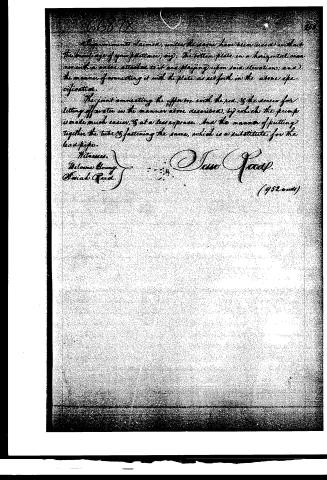
Improvements claimed, unless the same have been used without the knowledge of your petitioner, viz: The bottom plate in a horizontal manner with a valve attached to it and playing upon said elevations; and the manner of connecting it with the plate as set forth in the above specification.
The joint connecting the effluent with the rod, & the screw for letting off water in the manner above described, by which the pump is made much easier, & at a less expense. And the manner of putting together the tube & fastening the same, which is a substitute for the lead pipe.
Witnesses.
Wilcome Young
Sarah Reed
Issac Yead.
(952 words)
Published accounts: journal notice
Notice in the monthly list of patents, with remarks
Journal of the Franklin Institute, new ser., vol. 9 (1832), p. 112 · View the page
An endless apron is to be made of wove wire, which is divided into segments held together by leather straps; each segment is to be of such a width as to correspond with the flat sides of two hexagonal rollers, by which the endless apron is made to revolve. The straw and grain, as they leave the thrashing machine, are to be conducted in between the two sides of the revolving apron, at its upper end, which is a little elevated above the delivering end. The grain is to fall through the screen, and to be conducted to a winnowing machine, and the straw, when it arrives near to the second roller is to be thrown off the screen by a sloping board placed for that purpose. There is no claim made. 8. For an improvement in the common Pump for pumping water, Jesse Reed, Marshfield, Plymouth county, Massachusetts, August 5.
Remarks. The chamber, and the whole of that part of this pump which is above ground, is to be of cast iron, and is to be attached to the descending shaft by a flanch with suitable bolts, allowing it to be removed with ease for the purpose of examination and repair. There is to be a thumb screw which, by being turned, will raise the valves, let off the water, and thus prevent freezing. There is but little of tangible novelty in the whole thing, and the patentee appears to be rather uncertain about his claims, as he makes them with this proviso, "unless the same have been used without the knowledge of your petitioner."
About this record
- Patentee
- DATAMP
- Date
- the Name and Date index of patents, DATAMP, USPTO records
- Invention
- DATAMP
- Listed in
- the Name and Date index of patents, DATAMP, USPTO records, Jim Shaw's X-patent list, the Journal of the Franklin Institute, Burke's List of Patents (1847)
- Burke's 1847 Patent Office list gives the same patent.