

Drawings and documents
National Archives restored drawings: drawing
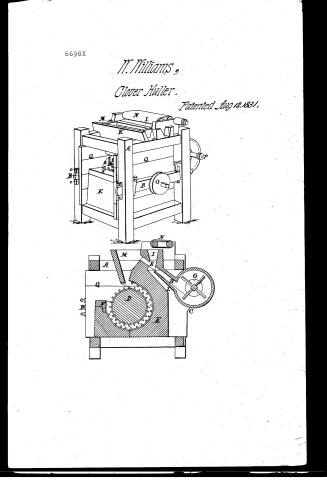
William William's Patent Drawing for a Machine for Hulling and Cleaning Clover Seed

National Archives, Restored Patent Drawings (Record Group 241) · Full-size scan at the National Archives · Catalog record
Show the text on the drawing Hide (128 words)
Words on the drawing as machine-read by the National Archives; not checked. Useful mainly for searching.
130. THRASHING. / [159] Clover Hullers. / Mills Houlling / $350 / CLASSI TICATION / William Williams Mashine for Hulling I Cleaning blover seed. / 6698-X / Patented. 12 Ang. 1831. / DIVISION. / by / CL / C'U / ELA / Perspective View / Longitudinal section. / Deferences / A The frame / B Head-blocks Head blocks / I Palsage for the clovers sud, dirt, yes / K. Continuation of flue H for paping the clover to the happer / Keys to regulate ditto / Toothed Cylinder / I Papage Heapper. for the dirt stones, ye to paps out from the machine / burved bed of teeth / N Feeder / F Grate 7 inclus wide / bommon Fan / Pulley on the will of the Fair. cylinders.- / H. / The from the fan / side pices, movemble - / Drawn by W.P.blist
USPTO scan
The patent as scanned by the USPTO
-
 Page 1
-
 Page 2
-
 Page 3
-
 Page 4


U.S. Patent and Trademark Office · Google Patents
Show the transcription Hide (937 words)
Machine transcription (LightOnOCR) of the pages as scanned by the USPTO, most of them the handwritten copies made when the records were restored after the 1836 fire. Not checked; it can misread handwriting, so compare it with the scan.
Page 1.
6698X
W. Williams,
Clover Huller.
Patented Aug 12, 1831.

Page 2.
6098X
Aug. 12. 1831
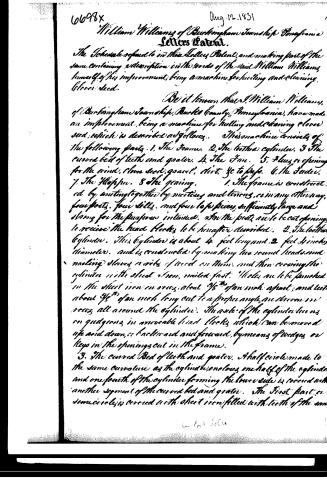
William Williams of Buckingham Township Pennsylvania
Letters Patent.
The Schedule referred to in this Letters Patent, and making part of the same, containing a description in the words of the said William Williams himself of his improvement, being a machine for hulling and cleaning clover seed.
Be it known that W. William Williams, of Buckingham Township, Bucks County, Pennsylvania, have made an improvement, being a machine for hulling and cleaning clover seed, which is described as follows. This machine consists of the following parts. 1. The frame. 2. The toothed cylinder. 3. The curved bed of teeth and grater. 4. The Fan. 5. A box or opening for the wind, clover seed, gravel, dirt, &c to pass. 6. The Fader. 7. The Hopper. 8. The gearing.
1. The frame is constructed by uniting together by mortises and tenons, or in any other way, four posts, four sills, and four top pieces, sufficiently large and strong for the purposes intended. In the posts are to be cut openings to receive the head blocks, to be hereafter described.
2. The toothed cylinder. This cylinder is about 4 feet long and 2 feet 4 inches diameter, and is constructed by making two round heads and nailing slivers or ribs of wood on them, and then covering the cylinder with sheet iron, nailed fast. Holes are to be punched in the sheet iron in rows, about 3/8" of an inch apart, and with about 3/8" of an inch long cut to a proper angle, are driven in rows all around the cylinder. The axle of the cylinder turns on guidons in moveable head blocks which can be moved up and down, or back and forward, by means of wedges or keys in the openings cut in the frame.
3. The curved Bed of teeth and grater. A half circle made to the same curvature as the cylinder, enclosing one half of the cylinder and one fourth of the cylinder forming the lower side is covered with another segment of the curved bed and grater. The first part or semicircle is covered with sheet iron filled with teeth of the same
See 162 162a
Page 3.
102 6698x Aug 12, 1831
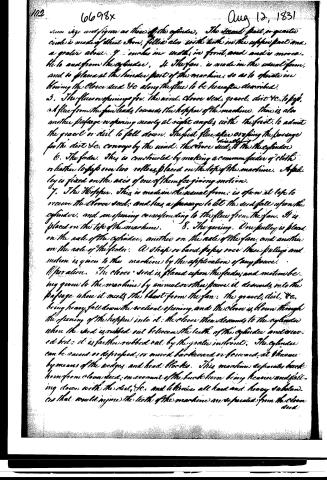
same size and figure as those of the cylinder. The head part, or greater circle is made of sheet iron, filled also with teeth in the upper part and a greater about 7 inches in width in front, and and is moved 6 to and from the cylinder. 4. The fan. is made in the usual form, and is placed at the hinder part of the machine, so as to operate in blowing the clover seed &c along the flue to be hereafter described.
5. The flue or openings for the wind. Above seed, gravel, dirt &c. to pass. A flue from the fan leads towards the hopper of the machine. There is also another passage or opening nearly at right angles with the first, to admit the gravel or dirt to fall down. The first flue after opening the passage for the dirt &c. conveys by the wind, the clover seed, to the the cylinder.
6. The feeder. This is constructed by making a common feeder of cloth or leather to pass over two rollers placed on the top of the machine. A pulley is fixed on the axis of one of them for giving motion.
7. The Hopper. This is made in the usual form; is open at top to receive the clover seed; and has a passage to let the seed fall upon the cylinder, and an opening corresponding to the flue from the fan. It is placed on the top of the machine.
8. The gearing. One pulley is placed on the axle of the cylinder, another on the axle of the fan, and another on the axle of the feeder. A strap or band passes over these pulleys and motion is given to the machine by the application of any power.
Operation. The clover seed is placed upon the feeder, and motion being given to the machine by animal or other power, it descends into the passage where it meets the blast from the fan: the gravel, dirt, &c. being heavy fall down the vertical opening, and the clover is blown through the opening of the hopper into it: the clover then descends to the cylinder where the seed is rubbed out between the teeth of the cylinder and screwed belt: it is further rubbed out by the grates in front. The cylinder can be raised or depressed, or moved backward or forward, at pleasure by means of the wedges and head blocks. This machine separates buckhorn from clover seed, on account of the buckhorn being heavier and falling down with the dirt, &c. and leaves all hard and heavy substances, as that would injure the teeth of the machine are separated from the clover seed.
Page 4.
Aug 12, 1831
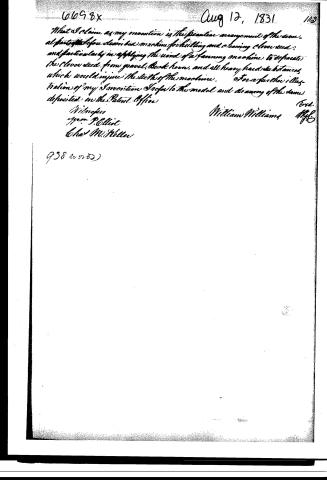
What I claim as my invention is the peculiar arrangement of the several parts of the described machine for hulling and cleaning clover seed; and particularly in applying the wind of a fan to separate the clover seed from gravel, buckhorn, and all heavy hard substances which would injure the teeth of the machine. For a farther illustration of my invention I refer to the model and drawing of the same deposited in the Patent Office.
Witnesses:
John P. Elliot
Chas M. Heller
William Williams
938 words
Published accounts: journal notice
Notice in the monthly list of patents, with remarks
Journal of the Franklin Institute, new ser., vol. 9 (1832), p. 116 · View the page
19. For a machine for Hulling and Cleaning Clover Seed; William Williams, Buckingham, Bucks county, Pennsylvania, August 12.
Remarks. There is a feeding apron upon which the clover is laid, and by which it is carried towards the body of the machine; the clover falls from off this apron into a vertical opening, situated between a revolving fan wheel and the hopper. Stones, sand, and other heavy articles descend entirely through this opening, as do seeds which are heavier than the clover, whilst the latter is driven by the air from the fan up an inclined plane into a hopper. Below the hopper there is a revolving cylinder, covered with sheet iron, and set with fine teeth; this revolves within a hollow segment which embraces nearly threefourths of its circumference. This segment is also set with teeth, excepting the last portion of it which is punched so as to form a grater. The cylinder and segment are adjustible by wedges.
About this record
- Patentee
- DATAMP
- Date
- the Name and Date index of patents, DATAMP, USPTO records
- Invention
- DATAMP
- Listed in
- the Name and Date index of patents, DATAMP, USPTO records, Jim Shaw's X-patent list, the Journal of the Franklin Institute, Burke's List of Patents (1847)
- Burke's 1847 Patent Office list gives the same patent.