

Drawings and documents
National Archives restored drawings: drawing
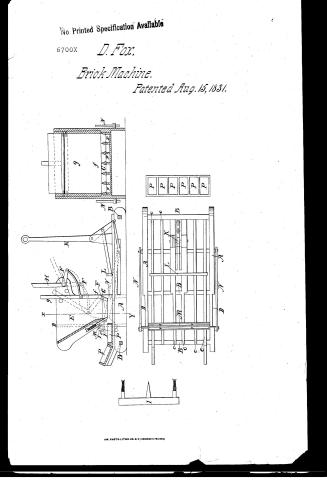
David Fox's Patent Drawing for a Machine for Brick Moulding

National Archives, Restored Patent Drawings (Record Group 241) · Full-size scan at the National Archives · Catalog record
Show the text on the drawing Hide (130 words)
Words on the drawing as machine-read by the National Archives; not checked. Useful mainly for searching.
25. Clay & Pottery, / DAVIND FOX / Brick Machines, / DIV 15 / fr / Portable Moid: in Mold Race, / *Fiunger Feed. / BRICK MOULDING / CLASSIFICATION / A. Side sills / 6700-+ / Patented 1.5" aug 183/m / B. CTASS- sills / DIVISION. / C. Mould-bearers / D. Stanchions / E: Hopper / H' Three connected perces movable 072 joints connected / with Hee Press L-Š jollower / G. Generator / H. Knot Lever with link fastened to top of Press / 7. Scraper / crofs Section / through.X.Y. / H. PrincihalLever / 1,. Poreet with link connected cated 10 leg ofprencipal lever / M. Strike / Go. / N. Regulator / D. Water-box / P. Brink Moulds as / Side Section / be / Plan / G. Strickland Del / Patents office 6 Crt 1838 / Madi under the direction of the Commition / of Patients in conforminty with act 30 March 683 / Vimit SMorth
USPTO scan
The patent as scanned by the USPTO
-
 Page 1
-
 Page 2
-
 Page 3
-
 Page 4


U.S. Patent and Trademark Office · Google Patents
Show the transcription Hide (1,219 words)
Machine transcription (LightOnOCR) of the pages as scanned by the USPTO, most of them the handwritten copies made when the records were restored after the 1836 fire. Not checked; it can misread handwriting, so compare it with the scan.
Page 1.
No Printed Specification Available
6700X D. Fox,
Brick Machine.
Patented Aug. 15, 1831.

AM. PHOTO-LITHO. CO. N.Y. (OSBORNE'S PROCESS)
Page 2.
Aug. 15, 1831
David Fox of Ashtabula, State of Ohio.
Letters Patent.
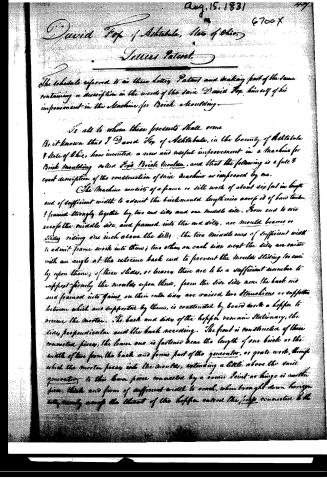
The schedule referred to in these Letters Patent and making part of the same containing a description in the words of the said David Fox himself of his improvement in the Machine for Brick moulding.
To all to whom these presents shall come
Be it known that I David Fox of Ashtabula, in the County of Ashtabula & State of Ohio, have invented a new and useful improvement in a Machine for Brick Moulding called Fox's Brick Moulder, and that the following is a full & exact description of the construction of said Machine as improved by me.
The Machine consists of a frame or sill work of about six feet in length and of sufficient width to admit the brick mould lengthwise across it of hard timber & framed strongly together by two end sills and one middle sill. From end to end across the middle sill, and framed into the end sills, are mould beams or sides rising one inch above the sills, the two middle ones of sufficient width to admit frame work into them; two others on each side next the sills are raised with an angle at the extreme back end to prevent the moulds sliding too easily upon them; of these sides, or beams there are to be a sufficient number to support firmly the moulds upon them, from the side sills near the back end and framed into joints on their outer sides are raised two stanchions or supports between which and supported by them, is constructed by board work a hopper to receive the mortar. The back and sides of the hopper remain stationary, the sides perpendicular and the back meeting. The front is constructed of three concentric pieces, the lower one is fastened near the length of one brick or the width of two from the back and forms part of the generator, or gate work, through which the mortar passes into the moulds, extending a little above the said generator, to this lower piece connected by a swivel joint or hinge is another piece, thick and firm of sufficient width to reach, when brought down horizontally, nearly across the throat of the hopper except the space connected to the
Page 3.
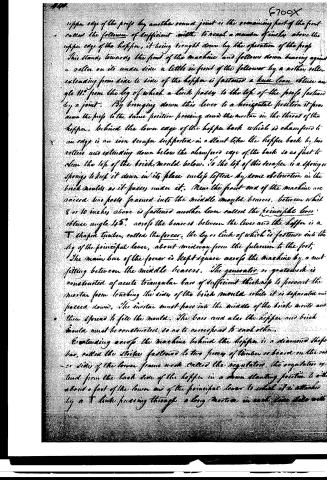
upper edge of the press by another round joint is the remaining part of the front cover the follower of sufficient width to reach a number of inches above the upper edge of the hopper, it being brought down by the operation of the press. This stands towards the front of the machine and follows down bearing against a roller on its under side a little in front of the follower by a motion roller extending from side to side of the hopper is fastened a knee lever obtuse angle 11° from the leg of which a link passes to the top of the press fastened by a joint. By bringing down this lever to a horizontal position it forces down the press to the same position pressing down the mortar in the throat of the hopper, behind the lower edge of the hopper back which is chamfered to an edge is an iron scraper supported in a slant like the hopper back by two rollers and extending down below the chamfered edge of the back so as just to clear the top of the brick mould below. To the top of this scraper is a spring or springs to keep it down in its place unless lifted by some obstruction in the brick mould as it passes under it. Near the front end of the machine are raised two posts framed into the middle mould beavers, between which 8 or 10 inches above is fastened another lever called the principle lever obtuse angle 145°. across the beavers between the lever and the hopper is a T shaped timber called the forcer, the leg or link of which is fastened into the leg of the principle lever, about midway from the fulcrum to the foot. The main bar of the forcer is kept square across the machine by a nut fitting between the middle beavers. The generator or grated brick is constructed of acute triangular bars of sufficient thickness to prevent the mortar from touching the sides of the brick mould while it is separated and passed down. The mortar must pass into the middle of the brick mould and then spread to fill the mould. The bars and also the hopper and brick mould must be constructed so as to correspond to each other.
Extending across the machine behind the hopper is a diamond shaped bar, called the striker fastened to two pieces of timber or board on the outer sides of the lower frame work called the regulators, the regulators extend from the back side of the hopper in a down slanting direction to within about a foot of the lower end of the principle lever to which it is attached by a T link passing through a long mortise in each time side with
Page 4.
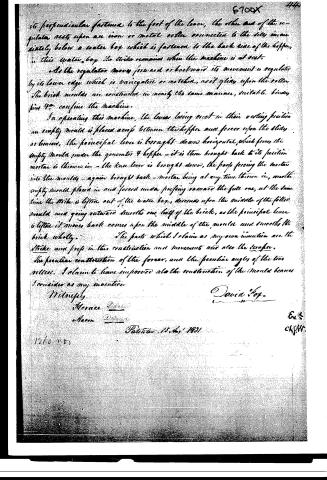
its perpendicular fastened to the foot of the lever, the other end of the regulator rests upon an iron or metal roller connected to the side immediately below a water box which is fastened to the back side of the hopper, in this water box the strike remains when the machine is at rest.
As the regulator moves forward or backward its movement is regulated by its lower edge which is variegated or notched, as it glides upon the roller. The brick moulds are constructed in nearly the same manner, suitable binding pins &c. confine the machine.
In operating this machine, the levers being erect in their resting position an empty mould is placed asemp between the hopper and forcer upon the slides or levers, the principal lever is brought down horizontal, which forces the empty mould under the generator & hopper - it is then brought back to its position mortar is thrown in - the knee lever is brought down, the forcer forcing the mortar into the moulds - again brought back - mortar being at any time thrown in, another empty mould placed in and forced under pressing onward the full one, at the same time the strike is lifted out of the water box, descends upon the middle of the filled mould and going outward smooths one half of the brick, as the principal lever is lifted it moves back comes upon the middle of the mould and smooths the brick wholly.
The parts which I claim as my own invention are the strike and forcer in this construction and movement and also the scraper. The peculiar construction of the forcer, and the peculiar angles of the two rollers. I claim to have improved also the construction of the mould beavers I consider as my invention.
Witness
Morace
Mason
David Fox.
Patented 15 Aug 1831
1260 no.
Ex. 5
ckp.w.
Published accounts: journal notice
Notice in the monthly list of patents, with remarks
Journal of the Franklin Institute, new ser., vol. 9 (1832), p. 117 · View the page
23. For an improvement in Brick Moulding; David Fox, Ashtabula, Ashtabula county, Ohio, August 15.
Remarks. This machinery is too complex to be described in words, excepting in a very general way. There is a hopper into which the prepared clay is to be put; under this hopper the moulds are made to pass in succession by the action of a lever, the empty moulds pushing the full ones forward, whilst another lever gives motion to a follower and other apparatus which forces the clay from the hopper into the mould, and also operates upon a scraper which removes what is superfluous. The claims are to the strike and press as constructed in this machine, and also to the scraper, the forcer, the peculiar angles of the two levers, and some other parts which it is unnecessary to mention.
About this record
- Patentee
- DATAMP
- Date
- the Name and Date index of patents, DATAMP, USPTO records
- Invention
- DATAMP
- Listed in
- the Name and Date index of patents, DATAMP, USPTO records, Jim Shaw's X-patent list, the Journal of the Franklin Institute, Burke's List of Patents (1847)
- Burke's 1847 Patent Office list gives the same patent.