

Drawings and documents
National Archives restored drawings: drawing
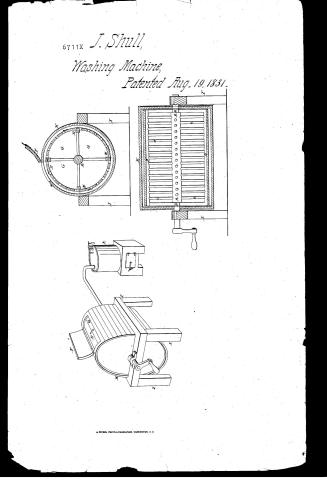
J. Shull's Patent Drawing for washing Machine

National Archives, Restored Patent Drawings (Record Group 241) · Full-size scan at the National Archives · Catalog record
Show the text on the drawing Hide (68 words)
Words on the drawing as machine-read by the National Archives; not checked. Useful mainly for searching.
CS. LAUNDRY, / HINES, / Cylinder. / vol. 12 hage 175, / Patented Aug. 19, 1821, / $2.50 / CLASSIFICATION / J SHULL / 6711-7 / DIVISION. / Hashing. Mach / IIIII / INFORMATION / AMOUNT / A. Shaft / B. Circular peices of timber / C. Small arms / D. B " Hous / E'. Shutters / F! outside Shutter / nw / G. Open or inner Cylinder / H. Itghtor outer Cyhnder / I. Frame / K. K.Boiler
USPTO scan
The patent as scanned by the USPTO
-
 Page 1
-
 Page 2
-
 Page 3
-
 Page 4


U.S. Patent and Trademark Office · Google Patents
Show the transcription Hide (779 words)
Machine transcription (LightOnOCR) of the pages as scanned by the USPTO, most of them the handwritten copies made when the records were restored after the 1836 fire. Not checked; it can misread handwriting, so compare it with the scan.
Page 1.
6711X J. Shull,
Washing Machine,
Patented Aug. 19, 1831.
Page 2.
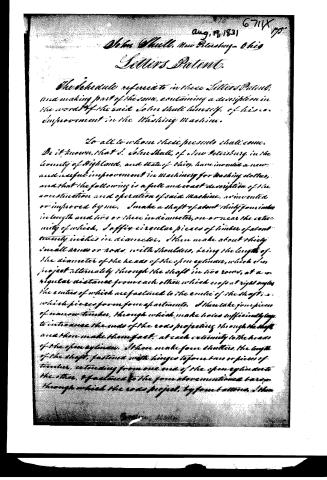
John Shull, New Petersburg - Ohio
Letters Patent.
The schedule referred to in these Letters Patent, and making part of this one, containing a description in the words of the said John Shull himself, of his improvement in the Washing Machine.
To all to whom these presents shall come. Be it known, that I, John Shull, of New Petersburg, in the county of Highland, and state of Ohio, have invented a new and useful improvement in Machinery for washing clothes, and that the following is a full and exact description of the construction and operation of said Machine, as invented or improved by me. I make a shaft of about thirty-four inches in length and two or three inches in diameter, on or near the extremity of which, I affix circular pieces of timber of about twenty inches in diameter. I then make about thirty small rods or rods with shoulders, being the length of the diameter of the heads of the open cylinder, which I project alternately through the shaft in two rows, at a regular distance from each other, which cross at right angles the center of which are fastened to the center of the shaft, which pieces form four apartments. I then take four pieces of narrow timber, through which make holes sufficiently large to introduce the ends of the rods projecting through the shaft and then make them fast, at each extremity to the heads of the open cylinder. I then make four shutters, the length of the shaft, fastened with hinges to four bars or pieces of timber, extending from one end of the open cylinder to the other, and fastened to the four above mentioned bars through which the rods project, by four latches. I then
Page 3.
fill up the circumference of the open cylinder with narrow pieces of timber for the purpose of containing the garments to be washed, and of admitting the water which is introduced into an outer cylinder, constructed so as to be watertight, and in which the open cylinder is made to revolve upon iron judgons fixed in the ends of the shaft, one of sufficient length to project through one end of outer cylinder so that a crank may be attached by a screw or spade on the end of the judgon. I make the outer cylinder sufficiently large to admit of the open or inner cylinder running clear. The outer or tight cylinder shall be fixed in a frame so constructed as to keep it firm, with an opening sufficiently large to admit clothes for washing, and the opening of the shutters of the inner cylinder.
To prepare clothes for washing soak or wet them in water; introduce them into the open cylinder; fasten the shutters; then add five or six gallons of warm water with sufficiency of soap to produce suds; then closing the shutters of the outer cylinder which fits in such a manner as to prevent the escape of either suds or steam, the latter of which, after having been generated in a small boiler (say of the capacity of five or six gallons) burns over a fire within, being so constructed thereby a small tube, admitted into the end of the outer cylinder, through a small aperture, between the outer and top.
I affix a guard upon the end of the tub on the head of the cylinder, to prevent its interference with the inner works. The clothes, after having been subject to the heat of the steam and action of the water, (the last being effected by the revolutions of the open cylinder)
Page 4.
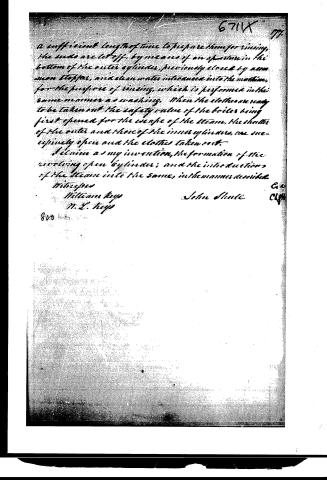
a sufficient length of time to prepare them for rinsing, the seeds are let off, by means of an aperture in the bottom of the outer cylinder, previously closed by a common stopper, and clean water introduced into the machine, for the purpose of rinsing, which is performed in the same manner as washing. When the clothes are ready to be taken out the safety valve of the boiler being first opened for the escape of the steam, the shutters of the outer and those of the inner cylinders, are successively open and the clothes taken out.
I claim as my invention, the formation of the revolving open cylinder; and the introduction of the steam into the same, in the manner described.
Witnesses
William Key
N. L. Key
John Shule
Published accounts: journal notice
Notice in the monthly list of patents, with remarks
Journal of the Franklin Institute, new ser., vol. 9 (1832), p. 121 · View the page
31. For a Washing Machine; John Shull, New Petersburg, Highland county, Ohio, August 19.
Remarks. This is a steam washing machine, and not very different from several others already patented. The body of the machine is in the form of a barrel churn, and is placed on trussels. There is a cover fitting closely at the top of this barrel; within it a shaft revolves, carrying an interior cylinder, perforated with holes, and operating like the dashers of a churn. The clothes are to be put within this inner cylinder through openings prepared for the purpose. There is a boiler with a safety valve, and a steam tube leading through the end of the outer vessel. The operation need not be further described. The claim is to the formation of the inner revolving cylinder, and the admission of steam in the manner described.
About this record
- Patentee
- DATAMP
- Date
- the Name and Date index of patents, DATAMP, USPTO records
- Invention
- DATAMP
- Listed in
- the Name and Date index of patents, DATAMP, USPTO records, Jim Shaw's X-patent list, the Journal of the Franklin Institute, Burke's List of Patents (1847)
- Burke's 1847 Patent Office list gives the same patent.