

Drawings and documents
USPTO scan
The patent as scanned by the USPTO
-
 Page 1
-
 Page 2
-
 Page 3
-
 Page 4
-
 Page 5
-
 Page 6
-
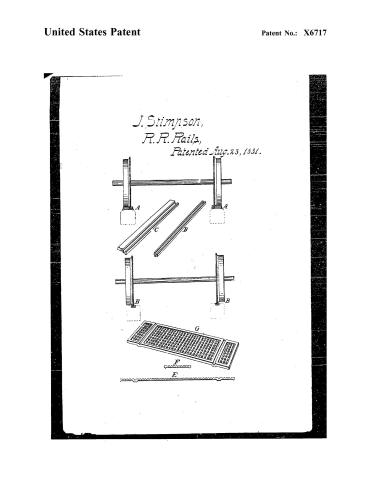 Page 7
-
 Page 8


U.S. Patent and Trademark Office · Google Patents
Show the transcription Hide (1,203 words)
Machine transcription (LightOnOCR) of the pages as scanned by the USPTO, most of them the handwritten copies made when the records were restored after the 1836 fire. Not checked; it can misread handwriting, so compare it with the scan.
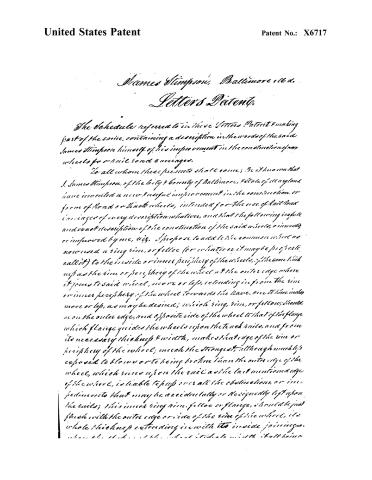
Page 2.
United States Patent
Patent No.: X6717
James Simpson, Baltimore, Md.
Letters Patent.
The Schedule referred to in these Letters Patent, making part of the same, containing a description in the words of the said James Simpson himself of his improvement in the construction of wheels for rail road carriages.
To all whom these presents shall come; Be it known that I, James Simpson, of the City & County of Baltimore, State of Maryland have invented a new & useful improvement in the construction or form of Road or Track wheels, intended for the use of Rail Road Carriages of every description whatever, and that the following is a full and exact description of the construction of the said wheels, as invented or improved by me, viz. I propose to add to the common wheel as now used a ring rim, or felloe (or whatever it may be properly called) to the inside or inner periphery of the wheels, of the same thickness as the rim or periphery of the wheel at the outer edge where it joins to said wheel, more or less, extending in from the rim or inner periphery of the wheel towards the nave, one to three inches more or less, as may be desired; which ring, rim, or felloe, should be on the outer edge, and opposite side of the wheel to that of the flange which flange guides the wheels upon the track rails, and from its necessary thickness & width, makes that edge of the rim or periphery of the wheel; much the strongest, although much less exposed to blow or to being broken than the outer edge of the wheel, which runs upon the rail as the last mentioned edge of the wheel, is liable to jump over all the obstructions, or impediments that may be accidentally or designedly left upon the rails; this inner ring rim, felloe or flange, should be just flush with the outer edge or side of the rim of the wheel, its whole thickness extending in with its inside joining on
Page 3.
United States Patent
Patent No.: X6717
cast solid at the same time with the wheel. The whole object of the ring or felloe being to obtain the greatest strength possible with the least weight of metal, and I have no doubt fifteen pounds of iron thus disposed will afford as much protection to the wheel against breaking from severe percussion as upon the road, as one hundred pounds equally distributed throughout the whole of the rim. What I claim as my invention or improvement, is the application of the rim, ring or felloe inside the tread, or rim, or inner periphery of the wheel in opposite to the flange as set forth in the above specification.
Witnesses
Geo. Wilson
William A. Stimpson
James Stimpson
530.15
(Drawing)
Page 4.
United States Patent
Patent No.: X6717
James Simpson
Letter Patent
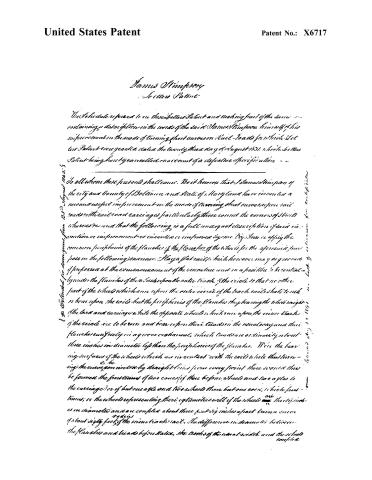
The Legislature referred to in this Letter Patent and making part of the same ... containing a description in the words of the said James Simpson himself of his improvement in the mode of turning short curves on Rail Roads for which Letter Patent were granted dated the twenty third day of August 1831, which Letter Patent being hereby cancelled on account of a defective specification.
To all whom these presents shall come. Be it known that James Simpson of the city and County of Baltimore and State of Maryland has invented a new and useful improvement in the mode of turning short curves upon rail roads with rail road carriages particularly those round the corners of streets &c. and that the following is a full and exact description of said invention or improvement as invented or improved by me. By these presents I apply the common peripheries of the flanches of the flanches of the wheels for the aforesaid purpose in the following manner. I lay a flat rail which however may be curved if preferred at the commencement of the curvature and in a position to be entirely under the flanches of the wheels upon the outer track of the circle so that no other part of the wheel which runs upon the outer side of the track can be touched or bear upon the rails but the peripheries of the flanches they bearing the whole weight of the cars and carriages while the opposite wheels which run upon the inner track of the circle are to bear and bear upon their tracks in the usual way and their flanches entirely in a groove or channel, which turns are ordinarily about three inches in diameter less than the peripheries of the flanches. We the bearing surfaces of the wheels which are in contact with the rails while thus turning the curve connected by straight lines from every point there will thus be formed the frustums of two cones (if there be four wheels and two ayles to the carriage) or if but one ayle and two wheels there but one cone, which frustums, or the wheels representing their cymbalities will if the wheels are thirty inches in diameter and are coupled about three feet six inches apart form a curve of about sixty feet of the inner track rail. The difference in diameter between the flanches and bears before stated, the tracks of the usual width and the wheels coupled
Page 5.
United States Patent
Patent No.: X6717
confined as stated would turn a curve of a somewhat smaller radius if the wheels were not confined to the carriage in a parallel position with each other but this being generally deemed necessary the wheels run upon lines of tangents and there upon the inner track being as wide a part in the coupling as the outer ones keep constantly enrolling the carriage outwards and thus cause the carriage to tend to run upon a larger circle than the difference in diameter of the tracks and flanges would otherwise give but the depth of the flanges and couplings may be so varied as to turn any other radius of a circle desired. What I claim as my invention or improvement is the application of the flanges of the wheels on one side of rail road carriages and of the tracks of the wheels on the other side, to turn curves upon railways particularly such as turning the corners of the streets, wharves, etc. in cities and elsewhere operating upon the principle herein set forth.
Witnesses
James H. Stimpson
Geo. G. Penniman
James H. Stimpson
( Drawing )
End.
M.G.
Page 6.
United States Patent
Patent No.: X6717
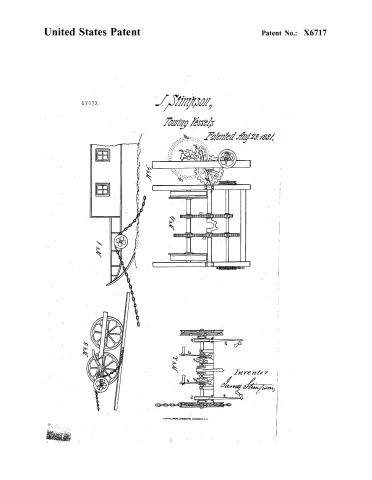
67-17X
J. Stimpson,
Towing Vessels
Patented Aug. 23, 1881.
Inventor
James Stimpson
H. PETER, PHOTO-LITHOGRAPHER, WASHINGTON, D.C.
Page 7.
United States Patent
Patent No.: X6717
J. Stimpson,
R.R. Rails,
Patented Aug. 23, 1831.

Page 8.
United States Patent
Patent No.: X6717
NO PRINTED SPECIFICATIONS AVAILABLE
J. Stimpson.
Railroad Switch.
Patented Aug. 23, 1831

Witness
J. H. Walsh
Inventor
J. Stimpson
THE GRAPHIC CO. PHOTO-LITH. 30 & 32 PARK PLACE, N.Y.
Published accounts: journal notice
Notice in the monthly list of patents, with remarks
Journal of the Franklin Institute, new ser., vol. 9 (1832), p. 122 · View the page
34. For an improvement in the Turnabouts for Rail-roads; James Stimpson, city of Baltimore, Maryland, August 23.
Remarks. The turnabouts for rail-roads are circular platforms large enough to receive a rail-road car, and placed level with the track. By their means a car can be turned entirely round, or into a road crossing that upon which it originally stood. Turnabouts have been patented in this country; (see vol. vi. p. 291.) When Mr. Fairlamb's patent was issued, we were not aware that such turnabouts had been already introduced in England, but this being the fact, the patent here was not valid, although the patentee might have been a real, though a second, inventor. The present patent is taken for improvements upon the mode of forming them; some idea of the nature of which improvements may be derived from the claim, which is as follows:
About this record
- Patentee
- DATAMP
- Date
- the Name and Date index of patents, DATAMP, USPTO records
- Invention
- DATAMP
- Listed in
- the Name and Date index of patents, DATAMP, USPTO records, Jim Shaw's X-patent list, the Journal of the Franklin Institute, Burke's List of Patents (1847)
- Burke's 1847 Patent Office list gives the same patent.