

Drawings and documents
National Archives restored drawings: drawing
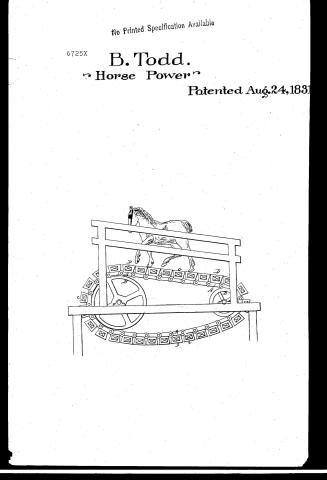
B. Todd's Patent Drawing for Self-Supporting Chains

National Archives, Restored Patent Drawings (Record Group 241) · Full-size scan at the National Archives · Catalog record
Show the text on the drawing Hide (70 words)
Words on the drawing as machine-read by the National Archives; not checked. Useful mainly for searching.
185. MECHANICAL MOTORS. / Horse-Powers, / Treads. / 74 / 31 / coassification / 6425+ / DIVISION. / B O TODD / Self supporting Chains / Patented 24" cuio 1831. / A Cast Iron chain / B. Shajis / C. Projection onLank / D. Ends of Plank supporting Floor / ---------- / G. strickland Del / Patent office June 14th / Made under the direction the nof patents / in conformity with ach of 3 March 1837 / Communismer of patents
USPTO scan
The patent as scanned by the USPTO
-
 Page 1
-
 Page 2
-
 Page 3


U.S. Patent and Trademark Office · Google Patents
Show the transcription Hide (683 words)
Machine transcription (LightOnOCR) of the pages as scanned by the USPTO, most of them the handwritten copies made when the records were restored after the 1836 fire. Not checked; it can misread handwriting, so compare it with the scan.
Page 1.
No Printed Specification Available
6725X
B. Todd.
Horse Power
Patented Aug. 24, 1831
![Diagram of a horse-powered machine with a horse standing on a platform connected to a series of wheels and gears. The machine appears to be designed for harnessing the power of a horse for mechanical work. The diagram includes labeled parts such as "a," "b," "c," and "d," indicating various components of the mechanism. The horse is depicted in a harness, pulling a chain or belt that drives the wheels and gears below. The overall structure is rectangular, with the horse positioned at the top and the mechanical components arranged beneath it. The diagram is a black-and-white line drawing, typical of patent illustrations from the 19th century.]
Page 2.
Aug. 24/1831
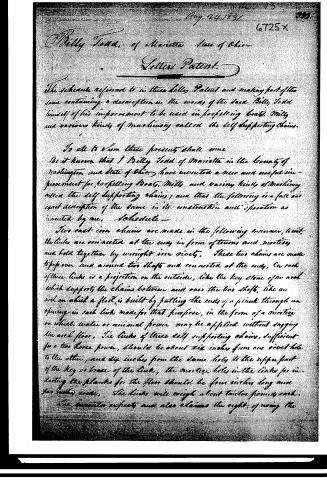
Billy Todd, of Marietta, State of Ohio
Letter Patent.
The schedule referred to in these Letters Patent and making part of the same containing a description in the words of the said Billy Todd himself of his improvement to be used in propelling boats, Mills and various kinds of machinery called the self supporting chains.
To all to whom these presents shall come
Be it known that I Billy Todd of Marietta in the County of Washington and State of Ohio have invented a new and useful improvement for propelling boats, Mills and various kinds of machinery called the self supporting chains; and that the following is a full and exact description of the same in its construction and operation as invented by me, Schedule—
Two cast iron chains are made in the following manner, first, the links are connected at the ends in form of tenons and mortises and hold together by wrought iron rivets. These two chains are made to pass over and around two shafts and connected at the ends, on each of these links is a projection on the outside, like the key stone of an arch which supports the chains between and over the two shafts, like an arch on which a floor is built by putting the ends of a plank through an opening in each link made for that purpose, in the form of a mortise on which water or animal power may be applied without sagging the arch floor. The links of these self supporting chains, sufficient for a two horse power, should be about six inches from one rivet hole to the other, and six inches from the same hole to the upper part of the key or brace of the link, the mortise holes in the links for inserting the planks for the floor should be four inches long and two inches wide. The links will weigh about twelve pounds each.
The inventor expressly and also claims the right of using the
Page 3.
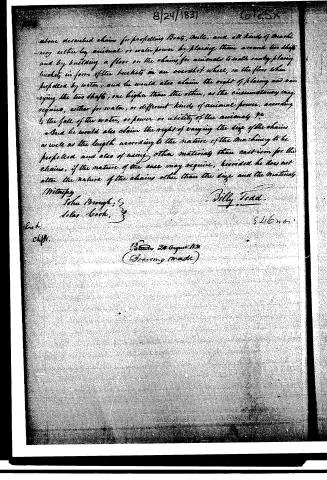
about described chains for propelling boats, mills, and all kinds of machinery either by animal or water power by placing them around two shafts and by building a floor on the chains, for animals to walk on, by placing buckets in form of the buckets in an overshot wheel, on the floor when propelled by water, and he would also claim the right of placing and varying the two shafts, one higher than the other, as the circumstances may require, either for water, or different kinds of animal power, according to the fall of the water, or power or ability of the animals, &c.
And he would also claim the right of varying the size of the chains as well as the length according to the nature of the machinery to be propelled and also of using other materials than cast iron for the chains, if the nature of the case may require, provided he does not alter the nature of the chains other than the size and the materials.
Witnesses
John Brough
John Cook
Dilly Todd.
5216 no.
Patented 24 August 1831
(Something made)
Published accounts: journal notice
Notice in the monthly list of patents, with remarks
Journal of the Franklin Institute, new ser., vol. 9 (1832), p. 127 · View the page
46. For a method of Propelling Boats, and various kind of machinery, called the "self-supporting chains;" Billy Todd, Marietta, Washington county, Ohio, August 24.
Remarks. When Redheffer's perpetual motion refused to go, a gentleman who had formerly been numbered among its advocates, when reminded of his former opinion, observed that he should insist upon it that it was "perpetual motion, still." The present patentee may derive a lesson from this anecdote, when his propellers refuse to do their duty. Two endless chains are to be made of cast iron; the links are to be in the shape of key stones, and are to be hinged together at their narrower ends, so that they will form an arch when their wide ends are uppermost; each of the links may measure about six inches each way. The two endless chains thus formed, are to be passed over a shaft, at the distance of a few feet from each other. Planks are to extend from one chain to the other, mortises being cast in the links for the purpose of receiving them, so that each pair of links has its plank, the whole forming a continued floor. For a two horse power, the links are to be of the size above mentioned, and will weigh about twelve pounds each, and, according to the drawing, from fifty to sixty of these will form one of the chains. These, with the floor, and the cattle, or water, by which it is to be operated upon, will form a load which has to be sustained by the cast iron links, and the wrought iron pins which form the joints, or hinges; and should these pins, or the cast iron, give way, wo to the animals employed. The inventor says that he expects and claims the right to use this apparatus for propelling boats, and all other kinds of machinery, either by animals walking upon the floor, or by placing upon it buckets like those of an overshot wheel, and moving it by water. He also claims the right of placing one shaft higher than the other. He also claims the right of varying the size of the chains, and of making them of other materials than cast iron.
About this record
- Patentee
- DATAMP
- Date
- the Name and Date index of patents, DATAMP, USPTO records
- Invention
- DATAMP
- Listed in
- the Name and Date index of patents, DATAMP, USPTO records, Jim Shaw's X-patent list, the Journal of the Franklin Institute, Burke's List of Patents (1847)
- Burke's 1847 Patent Office list gives the same patent.
- Burke's 1847 Patent Office list gives a slightly different date; the date shown follows the standard lists.