

Drawings and documents
National Archives restored drawings: drawing
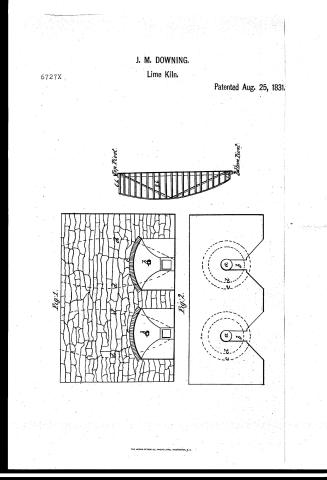
Joseph M. Downing's Patent Drawing for an Improvement in the Kiln for the Burning of Lime with Anthracite Coal

National Archives, Restored Patent Drawings (Record Group 241) · Full-size scan at the National Archives · Catalog record
Show the text on the drawing Hide (248 words)
Words on the drawing as machine-read by the National Archives; not checked. Useful mainly for searching.
222. Hydraulic Cement & Lime, / DIV.15 / Kilns. / Joseph M. Downing / Improvement in the Kiln for the burning of lime with anthracite Coal. / Patented 25th August 1831. / CLASSIFICATION / 6727 + / DIV ISION. / Ground Flan Fig.2. / Front Elevation. Jig.1. / 13 feet / al / 20 feet / a Centre, in the bottom, in which the pivot of the gage is fixed. / b Aperture for drawing the Lime - 18 inches wide 22 in heighth. / Diameter at the widest part, skfeet. / d Diameter at top, 6½ feet. / a The aperture from which the Lime is drown / 6 The with regulating door 02 value / 6.6 / Top Fivot The gage is supported erect by a cross beam secured / C Arch to support the brest of the Kilns. / by upright posts at each end, and braced. / The dotted lines d 2, d d, represent the form of the Kilns. / Note. It is found to be good economy to construct two kilns adjoining, and / Gage oz Pattern used in building the Kilns. / these drawings are made from two, now in successful operation / at Bristol. The size of these is found to be very convenient, / 8.6 / but may nevertheless be varied. / The upright post w a piece of scantling about 4 inches Iquare.- / The cross pieces may be made of strips of board 02 lath. / The circular lath 02 hoop zound the ends of the strips, may used / Seale sfeet to an Inch. / 02 dispensed with at pleasure 02 according to the accuracy ofthe mason. / 1.10 / Bottom Proot. / Copy from the patent.
USPTO scan
The patent as scanned by the USPTO
-
 Page 1
-
 Page 2
-
 Page 3


U.S. Patent and Trademark Office · Google Patents
Show the transcription Hide (622 words)
Machine transcription (LightOnOCR) of the pages as scanned by the USPTO, most of them the handwritten copies made when the records were restored after the 1836 fire. Not checked; it can misread handwriting, so compare it with the scan.
Page 1.
6727X
J. M. DOWNING.
Lime Kiln.
Patented Aug. 25, 1831.

THE MORRIS PETERS CO., PHOTO-LITHO., WASHINGTON, D. C.
Page 2.
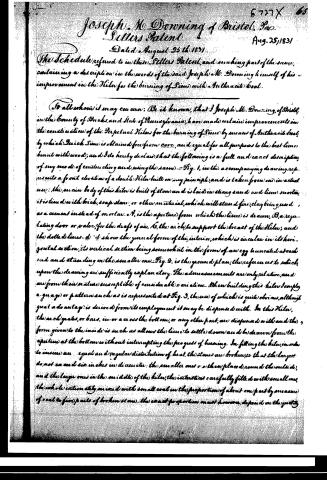
Joseph M. Downing of Bristol, Pa.
Letters Patent
Dated August 25th, 1831.
The Schedule referred to in these Letters Patent, and making part of the same, containing a description in the words of the said Joseph M. Downing himself of his improvement in the Kiln for the burning of Lime with Anthracite Coal.
To all whom it may concern: Be it known, that I Joseph M. Downing, of Bristol, in the County of Bucks, and State of Pennsylvania, have made certain improvements in the construction of the Perpetual Kilns for the burning of Lime by means of Anthracite Coal, by which Quick Lime is obtained free from cove, and equal for all purposes to the best lime burnt with wood; and I do hereby declare that the following is a full and exact description of my mode of constructing and using the same. Fig. 1, in the accompanying drawing, represents a front elevation of a double Kiln built on my principle, and is taken from one in actual use. The main body of this kiln is built of stone and is laid in strong sand and lime mortar; it is lined with brick, soap stone, or other material, which will stand fire, clay being used as a cement instead of mortar. A, is the aperture from which the lime is drawn, B, a regulating door or valve, for the draft of air, C, the arch to support the breast of the kiln; and the dotted lines d-d show the general form of the interior, which is circular in its horizontal section; its vertical section being somewhat in the form of an egg hunched at each end and standing on the smaller one. Fig. 2, is the ground plan, the references to which, upon the drawing are sufficiently explanatory. The above measurements are only relative, and are from their nature susceptible of considerable variation. When building this kiln I employ a gauge or pattern such as is represented at Fig. 3, the use of which is quite obvious, although great advantage is derived from its employment it may be dispensed with. In this kiln, the arch gates, or bars, in or across the bottom, or any other part, are dispensed with and the form given to the inside is such as allows the lime to settle down and be drawn from the aperture at the bottom without interrupting the progress of burning. In filling the kiln, in order to insure an equal and regular distribution of heat, the stones are broken so that the larger do not exceed six inches in diameter; the smaller ones are then placed round the outside, and the larger ones in the middle of the kiln; the interstices are fully filled with small ones, the whole interior being covered with small coal in the proportion of about one part by measure of coal to five parts of broken stone, the exact proportion must however depend on the quality
Page 3.
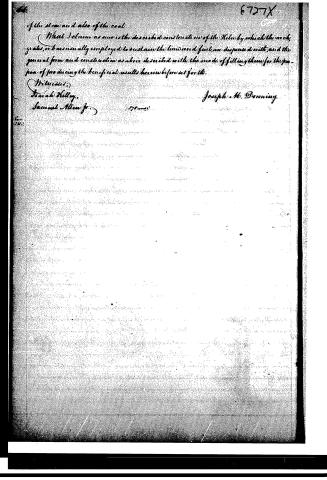
of the stone and also of the coal.
What I claim as new is the described construction of the kiln by which the arch, grate, or bars usually employed to sustain the lime and fuel, are dispensed with, and the general form and construction as above described with the mode of filling them for the purpose of producing the beneficial results hereinbefore set forth.
Witnesses:
Sarah Kelly,
Samuel Allen Jr.
Joseph H. Downing
6727X
Published accounts: journal notice
Notice in the monthly list of patents, with remarks
Journal of the Franklin Institute, new ser., vol. 9 (1832), p. 128 · View the page
48. For a Kiln for Burning Lime, with anthracite coal; Joseph M. Downing, Bristol, Bucks county, Pennsylvania, August 25.
Remarks. This kiln is for the burning of lime by means of anthracite, and the patentee, who has had it in actual operation, states that the lime produced by it is free from coar, and equal for all purposes to the best lime burnt with wood. The kiln is built of stone, with lime mortar, and is lined with fine brick, soap stone, or some similar substance. The general form of the interior is that of an egg standing vertically, with its top truncated, so as to leave an opening for feeding. There are no grates, or bars, at the bottom, the lime being allowed to settle down, and is to be withdrawn through an opening left for that purpose. The stone to be burnt is broken into pieces, the largest of which shall not exceed six inches in diameter. In charging, the larger stones occupy the middle of the kiln. About one-fifth as much coal, broken fine, as there is of stone, is intimately mixed therewith, when both are of the ordinary quality, with this, however, the quantities must be varied. The claim is to the so constructing the kiln as to dispense with the arch, bars, or grates, to sustain the lime and fuel; and to the general form of the structure.
About this record
- Patentee
- DATAMP
- Date
- the Name and Date index of patents, DATAMP, USPTO records
- Invention
- DATAMP
- Listed in
- the Name and Date index of patents, DATAMP, USPTO records, Jim Shaw's X-patent list, the Journal of the Franklin Institute, Burke's List of Patents (1847)
- The Franklin Institute's journal spells the name differently.
- Burke's 1847 Patent Office list gives the same patent.