

Drawings and documents
National Archives restored drawings: drawing
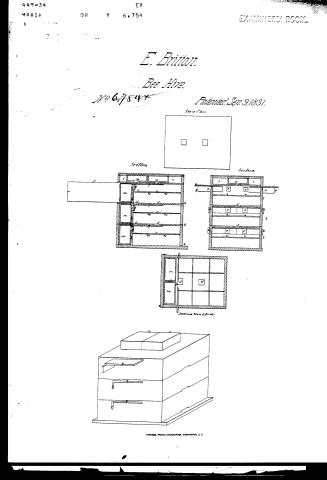
E. Britton's Patent Drawing for a Bee Hive

National Archives, Restored Patent Drawings (Record Group 241) · Full-size scan at the National Archives · Catalog record
Show the text on the drawing Hide (142 words)
Words on the drawing as machine-read by the National Archives; not checked. Useful mainly for searching.
Be Hoires agriculture / Nol. 12 page / 6. BEE HIVES. / $950, / V [9] Bee Hives. / 12p 240 / E O BRIT TON / Bee Hive / Patented 9th sep 1831- / CLASSIFICAT TION / Top of "Box / 6754-x / DIV / 1.2.3. ThreeBoxes K partition / and two small boxes in , ear of ofeach / a. Grooves cut in boxes to l andle them / b. Partition / c. Crojs sticks / a. Apertures in top of Bote / e. Apertures impartition / f. Back board hung upon hinges / Section / Section / g. Slides to cover apartures / h Mouth or Orifice / K. Rear partment filled by two stuall- / Boxes.The / dio / n. Small boxes ploced 071 top / o. Cover / Patent Office sep 30 182at / Made under the disction of the Com methoner / of Patents in confor mety with aoh of March 183 / Commissions Patents / Section at Plan of Boxes / Strickland)
USPTO scan
The patent as scanned by the USPTO
-
 Page 1
-
 Page 2
-
 Page 3
-
 Page 4
-
 Page 5
-
 Page 6


U.S. Patent and Trademark Office · Google Patents
Show the transcription Hide (1,608 words)
Machine transcription (LightOnOCR) of the pages as scanned by the USPTO, most of them the handwritten copies made when the records were restored after the 1836 fire. Not checked; it can misread handwriting, so compare it with the scan.
Page 1.
449-34
EX
M8818 OR X 6,754
EXAMINER'S ROOM.
E. Britton.
Bee Hive.
No 6,754
Patented Sep. 9, 1831.
Top of 1st Box.
Section
Section
Sectional Plan of Boxes.
Page 2.
John Britton, Littlefalls, New York
Letters Patent.
The Schedule referred to in these Letters Patent, and making part of the same, containing a description in the words of the said John Britton himself, of his improvement in the Beehive and the art of managing Bees.
Be it known that I John Britton of the Town of Littlefalls in the County of Herkimer and State of New York, have invented a new and useful improvement in the Beehive and in the Art of Managing Bees & that the following is a full & exact description of the construction & operation of the same as invented or improved by me, to wit:
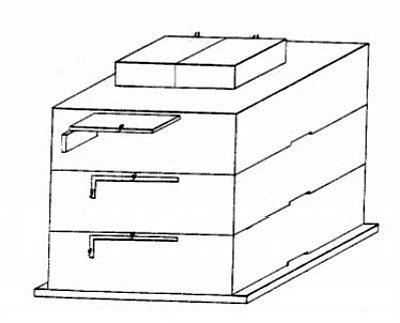
The Hive is chiefly composed of three boxes of equal dimensions, being each two feet one inch in length, one foot eight inches in width and eight inches in height, or in nearly that proportion. The boards of which these boxes are made may be an inch or more in thickness at the ends and sides - but the board on the top should be about a half inch in thickness and placed lengthwise of the board on across the hive. At the upper edge of each box on each side near the end and just under the lower edge of the top board are two grooves cut out of the depth of half an inch and the length of two inches, forming four places to take hold of each box in order to handle or remove it. Each box is divided within by a partition board a half inch or more in thickness, so placed as to divide the box into two unequal apartments, the front or main part being in about four fifths and the rear about one fifth of the whole box, within the front or main part of each box are four angled sticks made round or square, two running
Page 3.
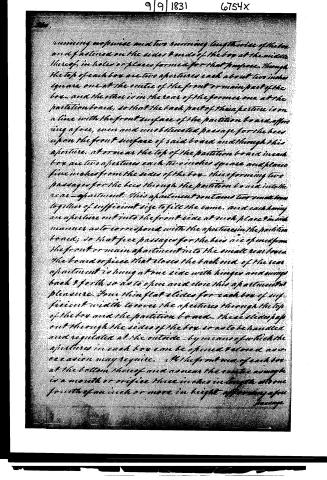
running one-wise and two running lengthwise of the box and fastened on the sides and ends of the box at the middle thereof, in holes or places formed for that purpose, though the top of each box are two apertures each about two inches square one at the centre of the front or main part of the box and the other is in the rear of the former one at the partition board, so that the back part of these apertures is on a line with the front surface of the partition board, affording a free, even and unobstructed passage for the bees upon the front surface of said board and through this aperture, at or near the top of the partition board in each box are two apertures each two inches square and placed five inches from the sides of the box thus forming two passages for the bees through the partition board into the rear apartment. This apartment contains two small boxes together of sufficient size to fill the same, and each having an aperture cut into the front side at such place in said manner as to correspond with the apertures in the partition board; so that free passages for the bees are opened from the front or main apartment into the small rear boxes. The board or piece that closes the back end of the rear apartment is hung at one side with hinges and swings back & forth so as to open and close this apartment at pleasure. Four thin flat slides for each box of sufficient width to cover the apertures through the top of the box and the partition board, these slides pass out through the sides of the box so as to be handled and regulated at the outside by means of which the apertures in each box can be opened & closed as occasion may require. At the front end of each box at the bottom thereof and across the centre as much is a mouth or orifice three inches in length and one fourth of an inch or more in height affording a free passage
Page 4.
9/9/1831 6754 X
261.
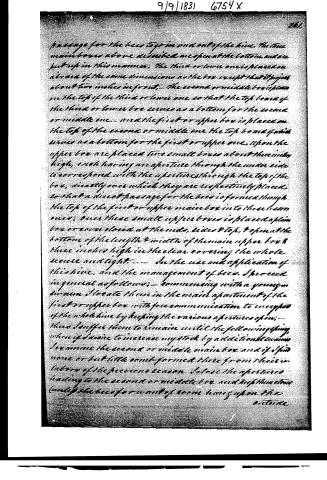
passage for the bees to go in and out of the hive. The three main boxes above described are open at the bottom, and are put up in this manner; the third or lower one is placed on a board of the same dimensions as the box except that it projects about two inches in front,—the second or middle box is placed on the top of the third or lower one so that the top board of the third or lower box serves as a bottom for the second or middle one,—and the first or upper box is placed on the top of the second or middle one the top board of which serves as a bottom for the first or upper one. Upon the upper box are placed two small boxes about three inches high, each having an aperture through the under side to correspond with the aperture through the top of the box, directly over which they are respectively placed, so that a direct passage for the bees is formed through the top of the first or upper main box into these lower ones; over these small upper boxes is placed a plain box or cover closed at the ends, sides & top, & open at the bottom of the length & width of the main upper box & three inches high in the clear covering the whole secure and tight. — In the use and application of this hive, and the management of bees, I proceed in general as follows:—commencing with a young swarm I locate them in the main apartment of the first or upper box with free communication to every part of the whole hive by keeping the various apertures open;—then I suffer them to remain until the following spring, when if I desire to increase my stock by additional swarms I examine the second or middle main box and if I find none or but little comb formed there from their labors of the previous season I close the apertures leading to the second or middle box and keep them down until the bees for want of room have gorged upon the outside
Page 5.
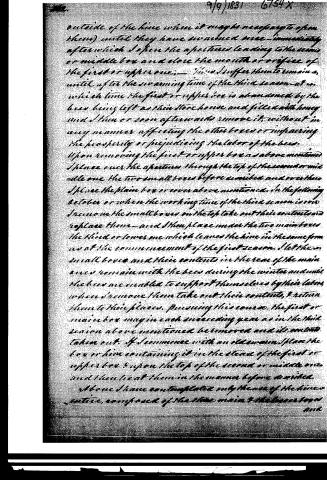
outside of the hive when it maybe necessary to open them) until they have swarmed once—immediately after which I open the apertures leading to the second or middle box and close the mouth or orifice of the first or upper one;—then I suffer them to remain, until after the swarming time of the third season—at which time the first or upper box is abandoned by the bees being left as their store house and filled with honey and I then or soon afterwards remove it, without in any manner affecting the other boxes or impairing the prosperity or prejudicing the labor of the bees. Upon removing the first or upper box as above mentioned I place over the apertures through the top of the second or middle one the two small boxes before described and over these I place the plain box or cover above mentioned. In the following October or when the working time of the third season is over I remove the small boxes on the top, take out their contents and replace them—and I then place under the two main boxes the blind or lower one which leaves the hive in the same form as at the commencement of the first season. I let the small boxes and their contents in the rear of the main ones remain with the bees during the winter and until the bees are enabled to support themselves by their labors, when I remove them, take out their contents, & return them to their places. Pursuing this course, the first or main box may in each succeeding year as in the third season above mentioned be removed and its contents taken out. If I commence with an old swarm I place the box or hive containing it in the stead of the first or upper box & upon the top of the second or middle one, and then treat them in the manner before described. Above I have contemplated only the use of the hive or entire, composed of the three main & the four lower and
Page 6.
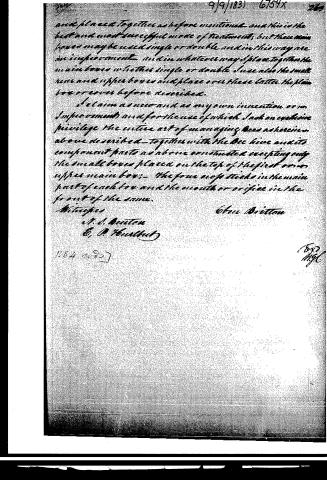
and placed together as before mentioned and this is the best and most successful mode of treatment; but these main boxes may be used single or double and in this way are an improvement and in whatever way I place together the main boxes whether single or double I use also the small box and upper boxes and place over these latter the plain box or cover before described.
I claim as new and as my own invention or improvement and for the use of which I ask an exclusive privilege the entire art of managing bees as herein above described—together with the bee hive and its component parts as above constructed excepting only the small boxes placed on the top of the first or upper main box; the four cross sticks in the main part of each box and the mouth or orifice in the front of the same.
Witnesses
N. A. Britton
E. A. Hurlbut
164 20 82
Published accounts: journal notice
Notice in the monthly list of patents, with remarks
Journal of the Franklin Institute, new ser., vol. 9 (1832), p. 163 · View the page
Will not some ingenious inventor add a roller at each angle, and then take out a patent for his improvement? 13. For an improvement in the Bee Hive and the art of managing Bees; Eben Britton, Littlefalls, Herkimer county, New York, September 9.
Remarks. We do not think it necessary to enter into a detailed description of the construction of this hive, or of the particular manner of using it. It consists generally of three boxes, which may be placed one upon the other. Each of these is divided into two compartments, and they are furnished with slides which open and close apertures leading from one box, or compartment, to another, the object of which is so to manage the bees that the contents of the upper box, and of smaller boxes, which are occasionally applied, may be obtained without disturbing the bees. The patentee appears to think the whole arrangement new, as he claims the entire art of managing bees as herein described; together with the bee hive and its component parts, as constructed; excepting only the small boxes placed at the top of the first or uppermost box, the four cross sticks in the main part of each box, and the mouth or orifice in front of the same." Boxes have been repeatedly placed upon each other, and sliding pieces have been applied to open and close the communication between the various compartments of hives so constructed, and, of course, a management of the bees very similar to that of the present patentee has been adopted. In the last number at p. 133, we had occasion to notice an arrangement of hives very similar to the present in its general principle.
DATAMP: illustration
Illustrations from DATAMP

DATAMP (Directory of American Tool and Machinery Patents), via the Internet Archive · Archived DATAMP page
About this record
- Patentee
- DATAMP
- Date
- the Name and Date index of patents, DATAMP, USPTO records
- Invention
- DATAMP
- Listed in
- the Name and Date index of patents, DATAMP, USPTO records, Jim Shaw's X-patent list, the Journal of the Franklin Institute, Burke's List of Patents (1847)
- Burke's 1847 Patent Office list gives the same patent.