

Drawings and documents
National Archives restored drawings: drawing
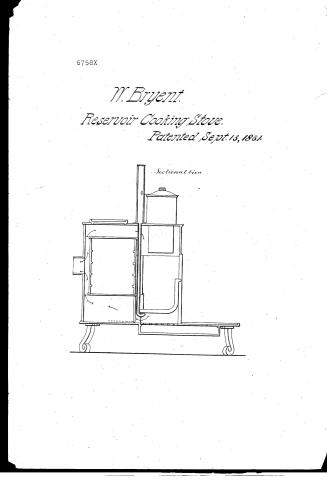
Walter Bryant's Patent Drawing for an Anthracite Cooking Stove

National Archives, Restored Patent Drawings (Record Group 241) · Full-size scan at the National Archives · Catalog record
Show the text on the drawing Hide (50 words)
Words on the drawing as machine-read by the National Archives; not checked. Useful mainly for searching.
126. STOVES&FURNACES / [154]. Reservoir Cooking Stove: / Ress / s/1- / CLASSIFICATION / 6458-X / DIVISION. / Walter Bryent's $) / Anthracite Cooking Stove. / Patented. Sept 13th 1831. / V.12. p. 203. / Verdilating Tube +flue / wash boiler / grate / dampers / ash sitter / O P
USPTO scan
The patent as scanned by the USPTO
-
 Page 1
-
 Page 2
-
 Page 3


U.S. Patent and Trademark Office · Google Patents
Show the transcription Hide (571 words)
Machine transcription (LightOnOCR) of the pages as scanned by the USPTO, most of them the handwritten copies made when the records were restored after the 1836 fire. Not checked; it can misread handwriting, so compare it with the scan.
Page 1.
6758X
W. Bryant.
Reservoir Cooking Stove.
Patented Sept. 13, 1831.
Sectional View

Page 2.
Walter Bryant
Letters Patent
The Schedule referred to in these Letters Patent and making part of the same containing a description in the words of the said Walter Bryant himself of his improvement denominated the Anthracite Cooking Stove.
1. The external shell or frame of the stove as of cast iron of convenient dimensions for different families or establishments. 2. A common grate suitable for anthracite coal or pipeless front the bars bounding under & extending back to about the middle of the stove with a sifter underneath to receive the embers which are deposited & removed when necessary in the usual manner. 3. A the rear of this grate is placed another grate consisting of perpendicular bars forming the rear wall of the furnace & a damper of cast iron is placed immediately behind this perpendicular grate governed by an eptain crank or handle. This damper is kept closed when the oven is not used & excludes the heat of the furnace from passing off to the rear. 4. The oven is placed on the rear of the stove, its bottom on a level with the top of the perpendicular grate. The heat from the furnace is communicated to its bottom by removing the damper before described & also passes freely from the furnace over the top but it may be increased or diminished as required by means of another damper placed on a level with the top of the oven & made to slide horizontally by means of eptain handles so as to close the whole or any part of the passage in the rear of the oven at pleasure. 5. The smaller boilers are placed forward immediately over the furnace & a larger one for washing &c. on the rear over the oven. 6. Near the centre of the stove is fixed a perpendicular tube or pipe the head of which rises considerably above the top of the stove & the bottom of which opens by an aperture immediately under the main grate or furnace. The sides of the boilers are furnished with short pipes which receive the steam & convey it to the perpendicular tube into which they are inserted by suitable apertures when used, which apertures may at other times be closed by slides. The steam is offensive in common stoves this passes off and is converted into
Page 3.
6758X
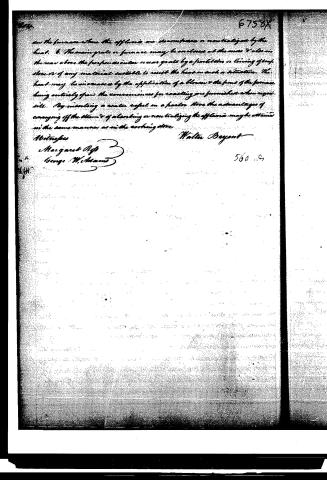
in the furnace where the effluvia are decomposed or neutralized by the heat. 6. The main grate or furnace may be enclosed at the rear & also on the rear above the furnace or under a rear grate by a partition or lining of clay, stone or of any material suitable to resist the heat in such a situation. The heat may be increased by the application of a blower & the front of the furnace being entirely open the convenience for roasting pre furnished when required. By inserting a water jacket in a heater stove the advantages of conveying off the steam & of absorbing or neutralizing the effluvia may be attained in the same manner as in the roasting stove.
Witnesses
Margaret Rigg
George McIlhenny
Walter Beyant
560 .9
Published accounts: journal notice
Notice in the monthly list of patents, with remarks
Journal of the Franklin Institute, new ser., vol. 9 (1832), p. 165 · View the page
17. For an Anthracite Cooking Stove; Walter Bryent, Boston, Massachusetts, September 13.
Remarks. The stove is to be made of cast iron, and the anthracite is to be burnt in a grate of the ordinary construction, but besides the front bars, the grate is also to have perpendicular bars at the back to admit of a draft through the fire to, and round, an oven, which stands behind the grate. Dampers are to be provided to regulate the draft; a boiler is to be placed directly above the fire, and a larger one above the oven; tubes from these boilers are to conduct the steam into another tube leading directly under the furnace, that it may pass into the fire. The parts considered as new are not designated, no claim being made; there is a drawing, but it is without written references.
About this record
- Patentee
- DATAMP
- Date
- the Name and Date index of patents, DATAMP, USPTO records
- Invention
- DATAMP
- Listed in
- the Name and Date index of patents, DATAMP, USPTO records, Jim Shaw's X-patent list, the Journal of the Franklin Institute, Burke's List of Patents (1847)
- Burke's 1847 Patent Office list gives the same patent.