

Drawings and documents
National Archives restored drawings: drawing
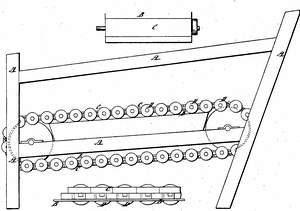
George Page's Patent Drawing for a Machine for Horse Power

National Archives, Restored Patent Drawings (Record Group 241) · Full-size scan at the National Archives · Catalog record
Show the text on the drawing Hide (78 words)
Words on the drawing as machine-read by the National Archives; not checked. Useful mainly for searching.
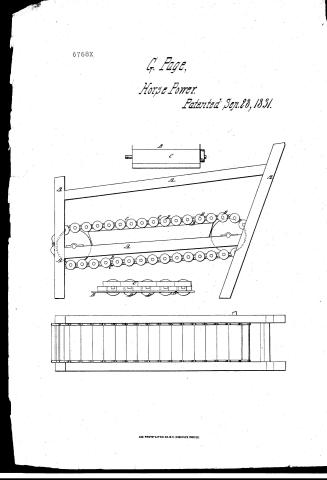
185. MECHANICAL MOTORS. / Horse-Powers, / Treads. / Gorge Page / Tol.13.7.159, p.159, / CLASSIFICATION / 6768.X / Ebs / Horse Power / DIVISION. / Patented 28 / Sept/831. / Deorge Page / References, / Fid,1. Side view, / Fig.2. top view. / Fig 3 Virtical section / Aframe B. leather band. c.plands / Drollers E. railway, / Patent offer Decg 1841 / Made under the direction of the Commission of Patents / in couf omity with act of bongrep 3 March 1837 / M Leumoth / Commipinium of Patuets
USPTO scan
The patent as scanned by the USPTO
-
 Page 1
-
 Page 2
-
 Page 3
-
 Page 4


U.S. Patent and Trademark Office · Google Patents
Show the transcription Hide (1,126 words)
Machine transcription (LightOnOCR) of the pages as scanned by the USPTO, most of them the handwritten copies made when the records were restored after the 1836 fire. Not checked; it can misread handwriting, so compare it with the scan.
Page 1.
6768X
G. Page,
Horse Power.
Patented Sep. 28, 1831.

A.M. PHOTO-LITHO. CO. N.Y. (OSBORNE'S PROCESS)
Page 2.
Sept. 28, 1831
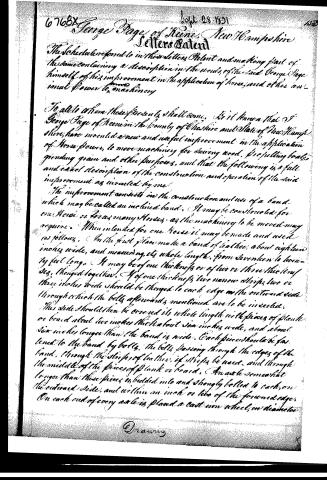
George Page of Keene, New Hampshire
Letters Patent
The Schedule referred to in these Letters Patent and making part of this same containing a description in the words of the said George Page himself of his improvement in the application of Horse and other animal Power to machinery.
To all to whom these presents shall come, Be it known that I, George Page of Keene in the County of Cheshire and State of New Hampshire, have invented a new and useful improvement in the application of Horse Power, to move machinery for sawing wood, propelling boats, grinding grain and other purposes, and that the following is a full and exact description of the construction and operation of the said improvement as invented by me.
The improvement consists in the construction and use of a band which may be called an inclined band. It may be constructed for one Horse or for as many Horses as the machinery to be moved may require. When intended for one Horse it may be made and used as follows. In the first place make a band of leather, about eighteen inches wide, and measuring its whole length, from seventeen to twenty feet long. It may be of one thickness or of two or three thicknesses, thonged together. If of one thickness, two narrow strips, two or three inches wide should be thonged to each edge on the outward side through which the belly afterwards mentioned are to be inserted. This side should then be covered its whole length with pieces of plank or board about two inches thick, about six inches wide, and about six inches longer than the band is wide. Each piece should be fastened to the band by bolts. The bolts passing through the edges of the band, through the strips of leather, if strips be used, and through the middle of the pieces of plank or board. An axle somewhat longer than these pieces is bolted into and strongly bolted to each, on the outward side, and within an inch or two of the forward edge. On each end of every axle is placed a cast iron wheel, in diameter.
Drawing
Page 3.
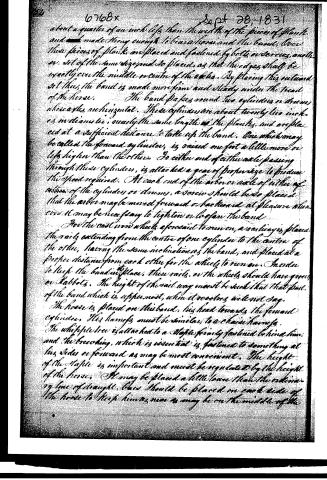
about a quarter of an inch less than the width of the pieces of plank, and made strong enough to bear a horse and the band. Over these pieces of plank are placed and fastened by bolts or screws, another set of the same size and so placed, as that the edges shall be exactly over the middle or centre of the aples. By placing this outward set thus, the band is made more firm and steady under the tread of the horse.
The band passes round two cylinders or drums, whose axes are horizontal. These cylinders are about twenty-two inches in diameter; nearly the same length as the planks, and are placed at a sufficient distance to take up the band. One which may be called the forward cylinder, is raised one foot a little more or less higher than the other. To either end of either axle passing through these cylinders, is attached a gear of proper size to produce the speed required. At each end of the arbor or axle of either of the cylinders or drums, a screw should be so placed that the arbor may be moved forward or backward at pleasure when ever it may be necessary to tighten or loosen the band.
For the cast iron wheels aforesaid to run on, a railing is placed the rails extending from the centre of one cylinder to the centre of the other, having the same inclination as the band, and placed at a proper distance from each other for the wheels to run on. In order to keep the band in place, these rails, or the wheels should have grooves or rabbets. The height of the rail way must be such that that part of the band which is uppermost, when it revolves will not sag.
The horse is placed on this band, his head towards the forward cylinder. His harness must be similar to a chain harness. The whistle tree is attached to a staple firmly fastened to him, and the breeching, which is essential is fastened to something at his sides or forward as may be most convenient. The height of the staple is important and must be regulated by the height of the horse. It may be placed a little lower than the ordinary line of straight. Bars should be placed on each side of the horse to keep him as near as may be on the middle of the
Page 4.
67168x
Sept 28, 1831
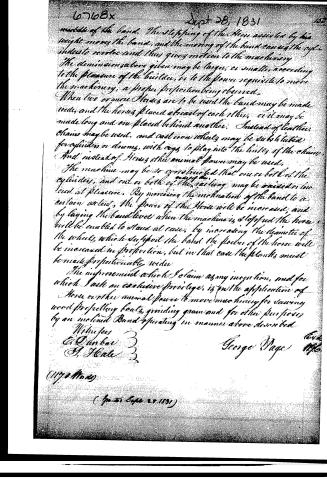
middle of the band. The stopping of the Horse assisted by his weight moves the band, and the moving of the band causes the cylinders to rotate and thus gives motion to the machinery. The dimensions above given may be larger, or smaller according to the pleasure of the builder, or to the force requisite to move the machinery, a proper proportion being observed.
When two or more Horses are to be used the band may be made wide, and the horses placed abreast of each other, or it may be made long and one placed behind another. Instead of leather, chains may be used, and cast iron wheels may be substituted for cylinders or drums, with cogs to play into the holes of the chain. And instead of Horses other animal power may be used.
The machine may be so constructed that one or both of the cylinders, and one or both of the ends of the railway may be moved at pleasure. By increasing the inclination of the band to a certain extent, the power of the Horse will be increased, and by laying the band level when the machine is stopped the horse will be enabled to stand at ease. By increasing the diameter of the wheels, which support the band, the power of the horse will be increased in proportion, but in that case the plants must be made proportionately wider.
The improvement which I claim as my invention, and for which I ask an exclusive privilege, is in the application of Horse or other animal power to move machinery for sawing wood, propelling boats, grinding grain and for other purposes by an inclined Band operating in manner above described.
Witness
E. Dunbar 3
A. Heale 3
George Page
(1170 M. 29)
(1705 Sept 28, 1831)
Published accounts: journal notice
Notice in the monthly list of patents, with remarks
Journal of the Franklin Institute, new ser., vol. 9 (1832), p. 170 · View the page
32. For the application of Horse and other Animal Power, to move Machinery; George Page, Keene, Cheshire county, New Hampshire, September 28.
Remarks. There may be something very new in this horse power machine, but we have not yet found it out. An endless band is to pass over two cylinders placed at a proper distance from each other to allow the upper side of the band to form an inclined plane upon which a horse may walk. The band may be made of stout leather, and be covered with slats of wood bolted to it. Proper friction wheels sustain the slats, or floor, and run upon iron ways. The claim is to the "application of horse power to move machinery for sawing wood, propelling boats, &c. &c. by an inclined band operating in the manner above described.
DATAMP: illustration
Illustrations from DATAMP

DATAMP (Directory of American Tool and Machinery Patents), via the Internet Archive · Archived DATAMP page
About this record
- Patentee
- DATAMP
- Date
- the Name and Date index of patents, DATAMP, USPTO records
- Invention
- DATAMP
- Listed in
- the Name and Date index of patents, DATAMP, USPTO records, Jim Shaw's X-patent list, the Journal of the Franklin Institute, Burke's List of Patents (1847)
- Burke's 1847 Patent Office list gives the same patent.