

Drawings and documents
National Archives restored drawings: drawing
Woolley's Patent Drawing for an Improved Chair or Hospital Bedstead

National Archives, Restored Patent Drawings (Record Group 241) · Full-size scan at the National Archives · Catalog record
Show the text on the drawing Hide (168 words)
Words on the drawing as machine-read by the National Archives; not checked. Useful mainly for searching.
5. BEDS. / 62 Invalid Bedsteads / $2- / surger Invalid Bedsteads / The Patent recorded / Woolley's Improved Chair or Hospital Bedstead. / anew 21"May 1838. / CLASSIFICATION / 6775 X / DIVISION. / Signed in presence of ud. / 6775 X / Olve I Warren / Thomas I. Pates / Fug.2 / Sig. / REP / Description of the Draught. / This wa true representation of my / Hospital Redstead" as palented 289 Sept 1831. / Frig. 1 a view of the beastead arranged for the patient to sit or hecline. / Fig.2 A Plan A The posts and ordinary paine. B The head / Williams Working / part made to raise C arms which help support the back(B) / Swom is before me this 29tdor / D Part of the frame attached to the posts E that part of the inner / of ance 1838 / frame which drops down to form a chair I' sacking GMatuen / Ino R Hanagaw / H Head board I pindlass K for to support B when down / Commetioner MDeeds / L. Prace to support B when elevated.
USPTO scan
The patent as scanned by the USPTO
-
 Page 1
-
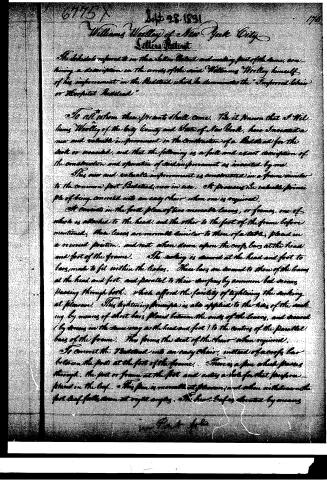 Page 2
-
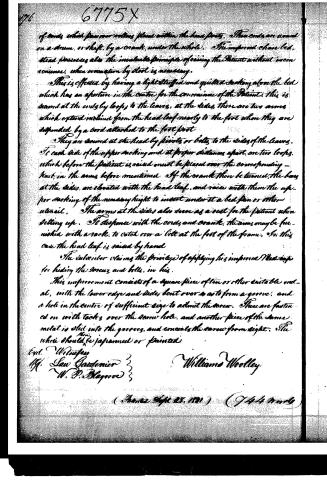 Page 3


U.S. Patent and Trademark Office · Google Patents
Show the transcription Hide (824 words)
Machine transcription (LightOnOCR) of the pages as scanned by the USPTO, most of them the handwritten copies made when the records were restored after the 1836 fire. Not checked; it can misread handwriting, so compare it with the scan.
Page 1.
6775X
W. WOOLLEY.
Hospital Bedstead.
Patented Sept. 28, 1831
Fig. 1.
Fig. 2.
Witnesses:
Oliver G. Warren
Thomas J. Oates
Inventor
William Woolley.
N. PETERS. Photo-Lithographer, Washington, D. C.
Page 2.
Sept 28, 1831
Williams Worley of New York City
Letters Patent
The schedule referred to in this Letters Patent and making part of the same, containing a description in the words of the said Williams Worley himself of his improvement in the Bedstead which he denominates the "Improved Chair or Hospital Bedstead."
To all whom these presents shall come. The it known that I Williams Worley of the city County and State of New York, have invented a new and valuable improvement in the construction of a Bedstead for the sick or wounded, and that the following is a full and exact description of the construction and operation of said improvement as invented by me.
This new and valuable improvement is constructed in a frame similar to the common foot Bedstead, now in use. It possesses the valuable principle of being converted into an easy chair when one is required.
It consists in the foot piece of two movable leaves, or frames, one of which is attached to the head, and the other to the foot of the frame before mentioned. These leaves are movable similar to those of a table, placed in a reared position, and rest when down upon the cross bars at the head and foot of the frame. The seating is secured at the head and foot to bars, made to fit within the leaves. These bars are secured to those of the leaves at the head and foot, and parallel to their surfaces by common bed screws passing through both, which afford the facility of tightening the seating at pleasure. This tightening principle is also applied to the sides of the seating by means of short bars placed between the ends of the leaves, and secured (by screws in the same way as the head and foot) to the centers of the parallel bars of the frame. This forms the seat of the chair when required.
To convert the Bedstead into an easy chair, instead of a cross bar between the feet at the foot of the frame. There is a pin which passes through the foot or frame at the foot and enters a hole for that purpose placed in the leaf. This pin is movable at pleasure, and when withdrawn the foot leaf falls down at right angles. The head leaf is elevated by means
Wm. P. Folsom
Page 3.
of cords, which pass over rollers placed within the head parts. These cords are wound on a drum or shaft, by a crank, under the whole. The improved chair bed, stead possesses also the invaluabie principle of raising the Patient without inconvenience, when elevation by stool is necessary.
This is effected by having a light stuffed and quilted backing above the bed which has an aperture in the centre for the convenience of the Patient. This is secured at the ends by loops, to the leaves, at the sides, there are two arms which extend inwards from the head leaf nearly to the foot where they are suspended by a cord attached to the foot post
They are secured at the head by pivots or bolts, to the sides of the leaves. To each side of the upper backing and at proper distances apart, are two loops, which before the patient is raised must be placed over the corresponding - bolt, in the arms before mentioned. If the crank then be turned, the bars at the sides, are elevated with the head leaf, and raise with them the upper backing of the necessary height to insert under it a bed pan or other utensil. The arms at the sides also serve as a rest for the patient when sitting up. To dispense with the cords and crank, the arms maybe furnished with a rack, to catch over a bolt at the foot of the frame. In this case the head leaf is raised by hand
The subscriber claims the privilege of applying his improved Bed supports for hiding the screws and bolts, in his.
This improvement consists of a square piece of tin or other suitable metal, with the lower edge and sides bent over so as to form a groove, and a hole in the centre of sufficient size to admit the screw. These are fastened on with tacks over the screw hole, and another piece of the same metal is slid into the grooves, and conceals the screw from sight. The whole should be japanned or painted
Exp. Witnesses
W. Saw Gardiner
W. P. Blagrove
Williams Woolley
(Phila Sept 28. 1831) (Jas 4 words)
Published accounts: journal notice
Notice in the monthly list of patents, with remarks
Journal of the Franklin Institute, new ser., vol. 9 (1832), p. 169 · View the page
29. For an improved Chair, or Hospital Bedstead; Williams Woolley, city of New York, September 28.
Remarks. A narrow bedstead is to be made in the form of the four post bedstead, but so constructed as to be capable of being readily converted into an easy chair. The bottom is to be divided into three parts, the centre one of which is to be stationary, but the upper part is capable of being raised by a crank and pulleys so as to form the back of the chair, whilst the lower, or foot part, is capable of being let down to VOL. IX. No. 3.-MARCH, 1832. 22 form the front of the chair, as it may then stand at right angles with the stationary part, which now forms the seat. There are contrivances which answer as arms to the chair, and some other appendages not requiring particular notice. There is no claim made to any of the parts described, which appears to us to be a serious omission, as bedsteads, or couches, have been constructed which are capable of being raised and lowered much in the manner of that before us, and we ought, therefore, to have been informed what is new in it.
About this record
- Patentee
- DATAMP
- Date
- the Name and Date index of patents, DATAMP, USPTO records
- Invention
- DATAMP
- Listed in
- the Name and Date index of patents, DATAMP, USPTO records, Jim Shaw's X-patent list, the Journal of the Franklin Institute, Burke's List of Patents (1847)
- Burke's 1847 Patent Office list gives the same patent.