

Drawings and documents
National Archives restored drawings: drawing
Paul Chase's Patent Drawing for a Mode of Applying High Steam and Hydrogen Gass to Aid in Producing Combustion in the Use of Anthracite Coal

National Archives, Restored Patent Drawings (Record Group 241) · Full-size scan at the National Archives · Catalog record
Show the text on the drawing Hide (148 words)
Words on the drawing as machine-read by the National Archives; not checked. Useful mainly for searching.
122. STEAM. / 2. / [149] BOILERS. Furnaces. Sh.Ble Turnace / $3- / Calonfics / CLASSIFICATION / 6789.+ / PAUL CHASE'S / DIV ISION. / Mode fapplying high Steam & Hydrogen Gafs to aid in producing / Combustion in The 77se of Anthracite Coal / Trever Beam / Strap or connecting rod to cross head of Engine / Blompipe Rod / Force pump rod & planger / Patented "" October 1831.00 / F. / Forcepunp / FE / pipe carrying water to retortor cylinder / V 12-4435 / Pipe leading. from reservour tosupply Forcepump / H. / Stop cock Engraduate Water zn prpe G. / Blowpipe conductor carrying airto retort appointZ / Compound Blowpipe / Platsurfoce g Grate BRRS Z.22 Furnace / Retort placed under Grate bars orin Furnace / End viem of Boiler / Reservoir from Which ForcePring is supplied / vibrating Standard / Side view ofBoiler / Valve atpoint Z formedon flange of retort / Hinge flue / Rod / Brickwall / 1.2. Valvesin BlowTine / ΓOT / "I / a.
USPTO scan
The patent as scanned by the USPTO
-
 Page 1
-
 Page 2
-
 Page 3
-
 Page 4


U.S. Patent and Trademark Office · Google Patents
Show the transcription Hide (1,073 words)
Machine transcription (LightOnOCR) of the pages as scanned by the USPTO, most of them the handwritten copies made when the records were restored after the 1836 fire. Not checked; it can misread handwriting, so compare it with the scan.
Page 1.
6789X
P. Chase,
Steam-Boiler Furnace,
Patented Oct. 7, 1831.
Page 2.
Oct 7, 1891 6789X 400
Paul Whare.
Letters Patent
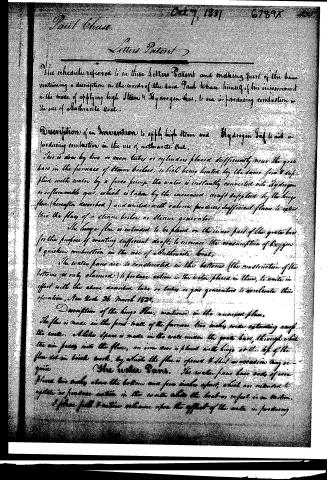
The schedule referred to in these Letters Patent and making part of the same containing a description in the words of the said Paul Whare himself of his improvement in the mode of applying high Steam & Hydrogen Gas, to aid in producing combustion in the use of anthracite coal.
Description of an Improvement to apply high Steam and Hydrogen Gas to aid in producing combustion in the use of anthracite coal.
This is done by two or more tubes or cylinders placed sufficiently near the grate bars in the furnace of steam boilers, which being heated by the same fire & supplied with water by a force pump, the water is instantly converted into Hydrogen or inflammable gas, which is taken by the increased draft supplied by the hinge flue (hereafter described) and united with oxygen, produces sufficient flame to supercede the flue of a steam boiler or steam generator.
The hinge flue is intended to be placed on the inner part of the grate bars for the purpose of creating sufficient draft, to increase the consumption of Oxygen & quicken combustion in the use of Anthracite coal.
The water pans are so constructed in the bottoms (the construction of the bottoms is only claimed) to produce action in the water placed in them, to unite in effect with the above described tube or tubes or gas generators to accelerate their operation. New York 26 March 1891.
Description of the hinge flue, mentioned in the annexed plan.
The flue is made in the front wall of the furnace two inches over extending across the same. A like space is made in the wall under the grate bars, through which the air passes into the flue, an iron door is placed with hinges at the top of the flue set in brick work, by which the flue is opened & shut as occasion may require.
The water Pans. The water pans have ends of iron placed two inches above the bottom and five inches apart, which are intended to agitate or produce action in the water while the heat or effect is in action.
I place full & entire reliance upon the effect of the water in producing
Page 3.
6789X
combustion & expansion of heat in steam boilers, and in all cases where electricity is used for other purposes. The compound Blow Pipe or air pump is considered capable to unite with the water in producing the same effect when the draft is not sufficient.
Description of the Compound Blow Pipe, or Force Pump, No. 1, mentioned in the annexed plan. The upper & lower ends of it are made of wood to be of a circular form, of the size or diameter of the cylinder of the steam engine and of the length of the piston rod, at the middle of the pump, that is to say equidistant from the ends, it is fixed to the guide rods, as represented in the plan. C, is fastened to a cross head, being the upper part of the frame & is connected with the lever beam for which the motion is obtained, a pipe I leads from one side to a point equidistant distant from each end as represented in the plan to point Z, and the covering or outside of the pump is made of leather supported by four wooden rings at equal distances from the ends and from each other as represented by the letter H.
The compound Blow Pipe or force Pump is to be placed in an iron frame as represented in the side view. C represents the rod connecting the pump with the lever beam, from which the motion up & down is obtained; the frame is fastened at the bottom, two iron rods one on each side of the pump fastened at the bottom run into the middle partition, which is also of wood & the top or upper end of the pump & are fastened to the cross head so as to play freely, the upper half or section of the pump from which pipe I proceeds operating as a reservoir.
At the rise of the lever beam A the bottom of the pump is lifted up & the air carried from its lower section into the valve N. 1. in the middle partition into pipe I. & fills at the same time the upper section of the pump or reservoir H into the down stroke of the lever beam A, the valve N. 1 is closed, and the air in the upper section or reservoir is carried forward into pipe I, which continues the blast. The same down stroke fills the lower section at valve N. 2 and is continued by every operation of the lever beam A carrying forward air to point Z, being the point of contact for air & water & is calculated to carry eight parts air to twenty in the hundred of water which unite at point Z, and are carried into reservoir.
The orifice O. is three inches in diameter, made of wrought iron, or cast iron, and placed under the grate bars, with holes between the grate
Page 4.
6789X
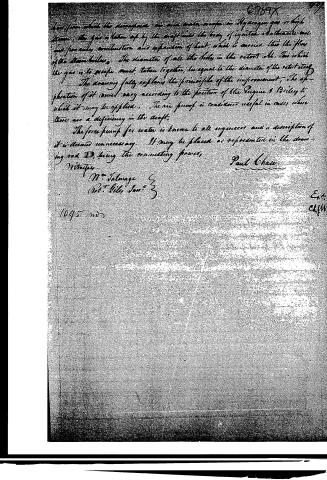
from which the decomposed air and water escape as hydrogen gas or high steam, the gas is taken up by the draft into the body of ignited substances and thereby conduction and expansion of heat, which is carried into the flow of the steamboiler. The diameter of all the holes in the retort A, into which the gas is to escape must, taken together, be equal to the diameter of the retort itself.
The drawing fully explains the principle of the improvement. The application of it must vary according to the position of the Engine & Boiler to which it may be applied. The air pump is considered useful in cases where there are a deficiency in the draft.
The force pump for water is known to all engineers and a description of it is deemed unnecessary. It may be placed as represented in the drawing and D, being the connecting power.
Paul Chase.
Witness
M. Talavage
Not. Giles Jan. 3
1095 mds
Ex.
CJH
Published accounts: journal notice
Notice in the monthly list of patents, with remarks
Journal of the Franklin Institute, new ser., vol. 9 (1832), p. 228 · View the page
11. For a mode of Applying High Steam, and Hydrogen Gas, to aid in producing Combustion in the use of Anthracite Coal; Paul Chase, city of New York, October 7.
Remarks. The principal object aimed at by the patentee, is to supply a portion of hydrogen gas, obtained by the decomposition of water, to aid the combustion of anthracite in the furnaces of steam engines. In the arrangement described and figured, there are circular bellows, worked by a rod from the lever beam, to assist in supplying atmospheric air; this air is conducted by a pipe into a tube, or retort, of iron, which is placed across the fire place immediately under the bars of the grate. This tube, or retort, has holes in its upper side, to allow air and steam to escape into the furnace, between each of the grate bars. The steam which is to accompany the air is to be generated from water furnished through another tube connected with a reservoir of that fluid, the supply being kept up by a force pump. The proportion of water to that of air is to be as twenty to eighty. When the air and water escape into the furnace, they do so, according to the statement of the patentee, in the form of "hydrogen gas, or high steam," which gas, or high steam, is to be taken up by the draft into the body of ignited coal, and cause a flame to extend throughout the fire-place and flues. The patentee, it appears, filed a description of his invention in the patent office in March, 1828; the proposition to aid the combustion of anthracite by means of steam, is, however, of older date than this; yet we infer that this is the only thing intended to be patented. We say infer, because we are not clearly informed in any part of the specification, what is meant to be claimed as new. The drawing referred to in the description is very well executed, and the instrument has been carefully written, still it gives no instruction respecting several important points, and more particularly that of the claim. There is mention made of water pans, which have rods of iron in them, to operate by the motion of a boat, and agitate the water in aid of the action of the above described tubes; this is all we hear respecting them. As regards the theory, the truth of which is so generally taken for granted, that because the flame from burning fuel is expanded, or rendered diffusive by the action of steam, the water must be decomposed into its elements, oxygen and hydrogen, we have never admitted it as true. This is not the place to discuss such a subject, but it will be at once apparent to every one acquainted with chemistry, that such a decomposition of water must be simultaneously, or instantaneously, accompanied by its recomposition, and so far as the generation and extinction of heat are concerned, it would appear that one of these processes must exactly balance the other. Water, when decomposed by passing over ignited charcoal, is converted into carbonic acid and hydrogen; if oxygen be supplied in sufficient quantities by the admission of atmospheric air, this hydroger will burn with flame, otherwise it will pass off with the products of combustion, without contributing in any degree to its intensity. In the year 1818, Mr. Morey and Mr. John L. Sullivan each obtained patents for what they called "water burners;" we have not those patents now before us, but we recollect that water, or steam, was admitted among the flaming bituminous fuel, and that its effect was greatly to increase the volume of the flame; we then thought it did this by its expansive force only, and not by any actual increase of the quantity of flame. The method was not found to be productive of the anticipated economy, and the plan was consequently abandoned.
About this record
- Patentee
- DATAMP
- Date
- the Name and Date index of patents, DATAMP, USPTO records
- Invention
- DATAMP
- Listed in
- the Name and Date index of patents, DATAMP, USPTO records, Jim Shaw's X-patent list, the Journal of the Franklin Institute, Burke's List of Patents (1847)
- Burke's 1847 Patent Office list gives the same patent.