

Drawings and documents
National Archives restored drawings: drawing
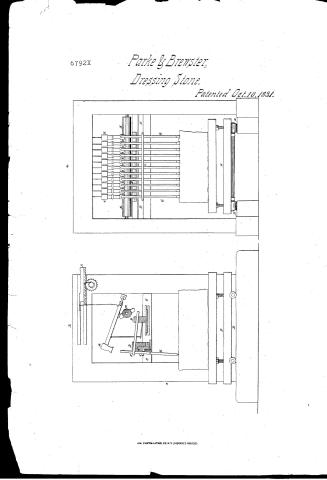
L. Z. Parke and I. Brewster's Patent Drawing for a Machine for Cutting and Chiselling Stone

National Archives, Restored Patent Drawings (Record Group 241) · Full-size scan at the National Archives · Catalog record
Show the text on the drawing Hide (94 words)
Words on the drawing as machine-read by the National Archives; not checked. Useful mainly for searching.
125, STONE WORKING, / Dressing Stone / Chane If & Blay / Vol. V2 16 / L 0 Z o PARKE & I O BREWS TER / ICATION / Cuttinge Chisolling Stone / 6792-X / Patented 10 "Ocl" 1831 / DI ISION. / 1 Frame / B Sills 07 bedreices / C. Girt / D. Rests / E. Slide / Slides / Is / ight Spring / spring / Torizontal morable bar / mmmers / terezontal Gate / dinder / N. / Carrenge / Patent Office aug 31 1841 / Made under the direction of the commynou of / Strickland)Del / Patents in conformity with act of 3 "March 1834 / Commissions of Patents
USPTO scan
The patent as scanned by the USPTO
-
 Page 1
-
 Page 2
-
 Page 3


U.S. Patent and Trademark Office · Google Patents
Show the transcription Hide (898 words)
Machine transcription (LightOnOCR) of the pages as scanned by the USPTO, most of them the handwritten copies made when the records were restored after the 1836 fire. Not checked; it can misread handwriting, so compare it with the scan.
Page 1.
6792X
Parke & Brewster,
Dressing Stone.
Patented Oct. 10, 1831.

A.M. PHOTO-LITHO. CO. N.Y. (OSBORNE'S PROCESS)
Page 2.
Oct. 10, 1831
Samuel T. Parks, Delaware, N.H. & Isaac Brewster, Schenectady, N.Y.
Letters Patent
The schedule referred to in these Letters Patent & making part of the same, containing a description in the words of the said Samuel T. Parks and Isaac Brewster themselves of their improvement in the machine for cutting and chiselling stone.
To all to whom these presents shall come, Be it known that we Samuel T. Parks of the County of Delaware & State of New York & Isaac Brewster of the County of Schenectady, N.Y. aforesaid have invented a new and useful machine for Cutting & Chiselling Stone & that the following is a full and exact description of the Construction & operation of said machine as invented by us.
The machine for Cutting & Chiselling Stone as herein claimed by the Subscribers, consists in the first place of an upright frame secured into two Sides to be cut, pieces & Construction of suitable binder.
The upright posts are securely bound by cross pieces at top and bottom & the whole firmly secured by Mortise and tenons. At a suitable height from the bottom of the frame two girds are attached to the upright posts & parallel with the Sides. Between the girds are placed two horizontal rests, the front one of which is secured by bolts or screws to the girds. While the back rest is movable being carried by means of slides in the sides of the girds. The front rest consists of two pieces parallel and joined together perpendicularly. In both Corresponding notches are made & receives a set of Slides. These extend also through the back rest by means of similar notches & apertures. These Slides have open slits between them & admits the chinks & fits closely.
The chinks are made of iron or other suitable substance & are furnished underneath the stone with a lip or projection which extends out from each side and intersects a corresponding projection on the lower extremity of an upright spring which is attached to the front of the main post. The upright spring acts so that it may be moved or ready at pleasure by hand.
Page 3.
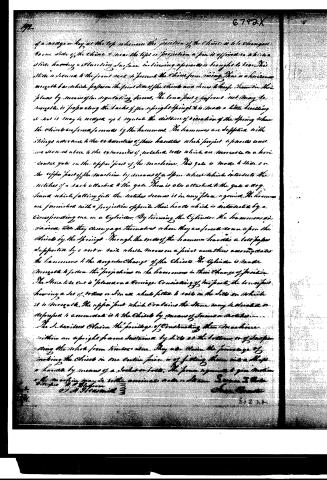
of a carriage or key at the top whenever the position of the chine is to be changed. On one side of the chine, near the lips or projection, a pin is affixed to which a slide having a slanting surface inclining upwards is brought to bear. This slide is secured to the front seat to prevent the chine from rising. There is also a movable mallet bar which passes on the front side of the chine and serves to keep them in their places by means of the regulating screws. The lower part of the front seat may be movable, it passes along the backs of five upright springs which make a little buckling so that it may be moved up to regulate the distance of elevation of the spring when the chine is forced forward by the hammer. The hammers are supplied with strings attached to the extremities of their handles which project upwards and are secured above to the extremities of notched rods which are movable on a horizontal center yoke on the upper part of the machine. This yoke is made to slide on the upper part of the machine by means of a screw wheel which interlocks the notches of a rack attached to the yoke. There is also attached to the yoke a regulating hand which falling into the notches secures it in any place required. The hammers are furnished with a projection opposite their heads which is interlocked by a corresponding one in a cylinder. By turning the cylinder, the hammers are raised till they engage themselves when they are forced down upon the chine by the spring. Through the ends of the hammer handles a bolt passes supported by a rest or rail which moves on a pivot and thus accommodates the hammers to the angular changes of the chine. The cylinder is made movable to follow the projections on the hammers in their change of position. The stone to be cut is placed on a carriage consisting of two parts, the lower part having a set of rollers or screws which fit to rails on the side on which it is movable. The upper part which contains the stone may be elevated or depressed to accommodate it to the chine by means of screws or notches.
The Inventors Claim the privilege of constructing their machine within an upright frame sustained by legs at the bottom or of suspending the whole from timbers above. They also claim the privilege of making the chine in one entire piece or of fitting them into a shape or handle by means of a solder or bolt. The frame is meant to give motion to the machine may be either animated or not.
S. H. H.
Wm. H. H.
Wm. H. H.
Wm. H. H.
Pat. No. 485
Oct. 18, 1851
332
Published accounts: journal notice
Notice in the monthly list of patents, with remarks
Journal of the Franklin Institute, new ser., vol. 9 (1832), p. 229 · View the page
12. For a Machine for cutting and chiseling Stone; Larman Z. Parke and Iram Brewster, the former of Delaware county, the latter of Schoharie county, New York, October 10.
Remarks. In this machine rows of chisels are to act simultaneously upon a block of stone; an upright frame being made to sustain the apparatus. The block of stone to be cut is placed upon a carriage, or platform, which rests upon rollers, and which can be raised and lowered by screws, or other means. The chisels are retained in their proper positions by moveable racks, or rests, and each of them is raised from the stone by means of a spring acting in a notch at its upper end. Hammers, which strike upon the chisels, are to be lifted by cams placed upon a revolving shaft. The arrangement of the parts, and the modes of adjusting them, appear to be well imagined, and likely to answer the purpose intended. The only claim made is to the privilege of varying the mode of construction and action, in certain particulars, from that designated in the description.
About this record
- Patentee
- DATAMP
- Date
- the Name and Date index of patents, DATAMP, USPTO records
- Invention
- DATAMP
- Listed in
- the Name and Date index of patents, DATAMP, USPTO records, Jim Shaw's X-patent list, the Journal of the Franklin Institute, Burke's List of Patents (1847)
- Burke's 1847 Patent Office list gives the same patent.