

Drawings and documents
USPTO scan
The patent as scanned by the USPTO
-
 Page 1
-
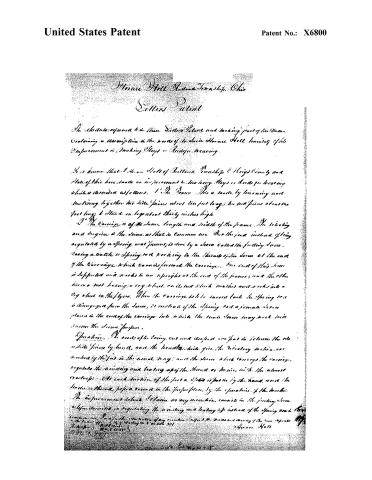 Page 2


U.S. Patent and Trademark Office · Google Patents
Show the transcription Hide (429 words)
Machine transcription (LightOnOCR) of the pages as scanned by the USPTO, most of them the handwritten copies made when the records were restored after the 1836 fire. Not checked; it can misread handwriting, so compare it with the scan.
Page 2.
United States Patent
Patent No.: X6800
Horace Holt, Rutland Township, Ohio
Letters Patent
The subscriber referred to in these Letters Patent and making part of the Drawings, containing a description in the words of the said Horace Holt himself of his Improvement in Making Stays or Rails for Drawing.
It is known that I Horace Holt of Rutland Township, Ohio, County and State of Ohio have made an improvement in making Stays or Rails for Drawing which is described as follows:
1. The Drawings are made by lowering and raising together the side pieces about two feet long; the end pieces about one foot long & Stand on legs about thirty inches high.
2. The Carriage is of the same length and width of the frame. The working end carriage is the same as that in common use. But the feed instead of being regulated by a Spring, as at present, is done by a Screw called the feeding Screw having a catch or Spring rod working in the threads of the Screw at the end of the Carriage which carries forward the Carriage. One end of this Screw is supported and works in an upright at the end of the frame, and the other lies in a rest having a cog wheel on its end which meshes with a cog wheel on the flywheel. When the Carriage is to be moved back the Spring rod is disengaged from the Screw, or instead of the Spring rod a female Screw placed in the end of the Carriage into which the male Screw may work, is inserted the Screw proper.
3. The ends of the being ends and supports are put in between the two side pieces by hand, and the handles which give the vertical motion are worked by the feet in the usual way; and the Screw which carries the Carriage regulates the winding and loosing up of the thread or basis with the utmost exactness. At each motion of the feet a space is put in by the hand, and the thread is threaded upon a second in the proper place by the operation of the machine.
The improvement which I claim as my invention consists in the feeding Screw being described in regulating the winding and loosing up instead of the Spring rod.
Witnesses:
Horace Holt
Witnesses: [Signature]
Date: [Date]
Published accounts: journal notice
Notice in the monthly list of patents, with remarks
Journal of the Franklin Institute, new ser., vol. 9 (1832), p. 235 · View the page
24. For Making Sleys and Reeds for Weaving; Horace Holt, Rutland, Meigs county, Ohio, October 17.
Remarks. The general construction of this engine, is that called the vibrating reed engine, but the feeding, instead of being regulated in the ordinary way by a spring, is effected by means of a screw having a cog wheel on its end, mashing into another cog wheel operating on the flyers. When the machine is to be drawn back, a spring box, forming the nut of the screw, is withdrawn, and the desired motion effected.
About this record
- Patentee
- DATAMP
- Date
- the Name and Date index of patents, DATAMP, USPTO records
- Invention
- DATAMP
- Listed in
- the Name and Date index of patents, DATAMP, USPTO records, Jim Shaw's X-patent list, the Journal of the Franklin Institute, Burke's List of Patents (1847)
- Burke's 1847 Patent Office list gives the same patent.