

Drawings and documents
National Archives restored drawings: drawing
Finn Haniford's Patent Drawing for a Tabular Improvement

National Archives, Restored Patent Drawings (Record Group 241) · Full-size scan at the National Archives · Catalog record
Show the text on the drawing Hide (51 words)
Words on the drawing as machine-read by the National Archives; not checked. Useful mainly for searching.
11 / 49. GLASS, / Denn J. Maniford of / Neck Forming. / Tubular Imprevement / Patented Oct. 17th 1831 / CLASSIFICATION / 6802-+ / DIVISION. / №3 / Figh Not. / No2 / No.3. / Fig 5. No.1. / Ni.2 / No.2 / Fig4 No 1 / OIR / Fig3.Mit / No.2, / Fig 2. Mo.1. Fig 2 / №2 / Fig 1. No. №1. / N.2
USPTO scan
The patent as scanned by the USPTO
-
 Page 1
-
 Page 2
-
 Page 3


U.S. Patent and Trademark Office · Google Patents
Show the transcription Hide (749 words)
Machine transcription (LightOnOCR) of the pages as scanned by the USPTO, most of them the handwritten copies made when the records were restored after the 1836 fire. Not checked; it can misread handwriting, so compare it with the scan.
Page 1.
No printed specification available
6802X
J. Stanford,
Making Glassware.
Patented Oct. 17, 1831.
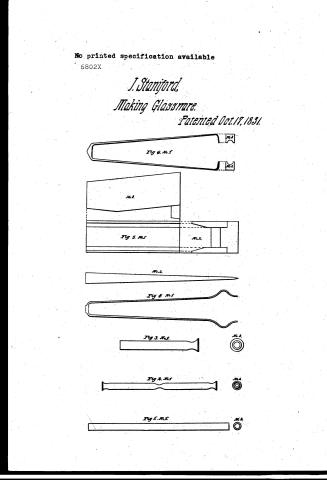
Fig 6. N.1
Fig 5. N.1
Fig 4. N.1
Fig 3. N.1
Fig 2. N.1
Fig 1. N.1
Page 2.
6802X Oct. 17, 1831 193
John Staniford of Boston Mass.
Letters Patent
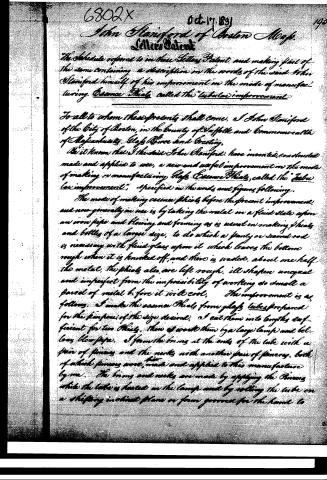
The schedule referred to in these Letters Patent, and making part of the same containing a description in the words of the said John Staniford himself of his improvement in the mode of manufacturing Essence Thials, called the "Tubular improvement."
To all to whom these presents shall come, I John Staniford of the City of Boston, in the county of Suffolk and Commonwealth of Massachusetts, Greeting.
Be it known that I the said John Staniford, have invented, constructed, made and applied to use, a new and useful improvement in the mode of making or manufacturing, Glass Essence Thials, called the "Tubular improvement", specified in the words and figures following.
The mode of making essence thials before the present improvement, and now generally in use is by taking the metal in a fluid state upon an iron pipe and blowing and forming as is usual in making thials and bottles of a larger size, to do which a flinty or second rod is necessary with fluid glass upon it which leaves the bottom rough when it is knocked off, and there is wasted, about one half the metal, the thials also, are left rough, ill shaped unequal and imperfect from the impossibility of working so small a parcel of metal before it will cool. The improvement is as follows. I make the essence thials from glass tubes prepared for the purpose of the size desired. I cut them into lengths sufficient for two thials, then I work them by a large lamp and bellows blow pipe. I form the brims at the ends of the tube with a pair of pincers and the necks with another pair of pincers, both of which pincers were made and applied to this manufacture by me. The brims and necks are made by applying the pincers while the tube is heated in the lamp and by setting the tube on a shifting inclined plane or from process for the hand to
Page 3.
move on and place, near the lamp, the lower end next the open fire. This plane having been first made and applied to this use by me, I then apply the heat to the middle of the tube and divide it, making the two bottoms by the same heat, and nearly at the same instant. The bottoms being made last are rendered perfectly smooth, (there being no faulty seam) by the simple application of an iron to the part while heated. Another great advantage of this improvement is, that the Thials can be made much smaller, of uniform size, smooth straight, and beautiful, and the waste of metal instead of being one half, is only about one in twenty. And this new article can be supplied in any quantity desired with great rapidity, and at a rate at least as low as the old and imperfect kind can be either imported from Europe or manufactured in this country.
The drawings & references herewith exhibit. Fig 1. No 1. The Glass tube as prepared for two Thials of a drachm each. No 2. The end of the tube. Fig 2. No 1. a tube with brims and necks formed and the formation of the bottoms commenced for two Thials of half drachm each. No 2. the end or brim. Fig 3. No 1. is a Thial in the finished state, of two drachms. No 2. the brim of the same. Fig 4. No 1. is an open view of the pinions to form brims. No 2. is a side view of the same. Fig 5. No 1. Stop view of the inclined plane or form half size. No 2. Highest end of plane or form half size. No 3. side view of Plane or form half size. Fig 6. No 1. pinions for forming the necks. No 2. & 3. End views of same.
In testimony that the above is a true specification of my said improvement as above described, I have here set my hand & seal this seventh day of September, in the year of our Lord Eighteen Hundred and thirty one.
Witnesses: William J. Andrews
J. A. Summers
John Stanford.
(Entered 7th Oct. 1831)
(100 lines)
Published accounts: journal notice
Notice in the monthly list of patents, with remarks
Journal of the Franklin Institute, new ser., vol. 9 (1832), p. 234 · View the page
21. For Tubular Essence Phials; John Staniford, city of Boston, October 17.
Remarks. Essence bottles, instead of being blown in the ordinary way, are to be made out of glass tubes; they will, consequently, be much more regular, neat and beautiful than usual. In this mode of making them the roughness upon the bottom is avoided, no punty being used in forming them; and the patentee states that they can be afforded at the same price which is paid for the inferior article. Tubes of the proper size are to be divided into lengths sufficient to form two phials; each end is to be successively heated by a glass-blower's lamp, and the brim and neck shaped by pincers made for the purpose; the tube is then to be heated in the middle, separated, and the bottoms rendered perfectly flat and smooth by pressure against a piece of iron. In shaping the phial, an inclined plane is placed beside the lamp, upon which the tube is rolled. There is no direct claim made, but the novelty, according to the statement of the patentee, appears to consist in the use of this inclined plane, and in the particular form given to the pincers to adapt them to the intended purpose. The making of phials from glass tubes is not new; we have occasionally seen in use such as have been so made, and there is, probably, no one in the habit of blowing glass by means of the lamp, who has not made them for his own amusement, although they may not have been manufactured for the purpose of giving a general supply. The patentee might fairly claim whatever there is of novelty in his mode of procedure, but not the mere making of phials from tubes.
About this record
- Patentee
- DATAMP
- Date
- the Name and Date index of patents, DATAMP, USPTO records
- Invention
- DATAMP
- Listed in
- the Name and Date index of patents, DATAMP, USPTO records, Jim Shaw's X-patent list, the Journal of the Franklin Institute, Burke's List of Patents (1847)
- Burke's 1847 Patent Office list gives the same patent.