

Drawings and documents
National Archives restored drawings: drawing
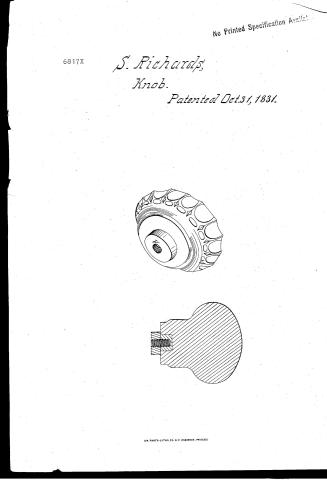
S. Richards' Patent Drawing for Glass Knobs

National Archives, Restored Patent Drawings (Record Group 241) · Full-size scan at the National Archives · Catalog record
Show the text on the drawing Hide (62 words)
Words on the drawing as machine-read by the National Archives; not checked. Useful mainly for searching.
70. LOCKS & LATCHES. / 223 / [93] Knobs. / CLASSI TICATION / 6817-+ / S.RICHARDS / DIV ISION. / Glass Knobs / Patented 31 "Oct 1831- / Section through. Knob / Showing the Nut embeded in Glaps / Nut / Patent office aug 31 1841 / Strickland Dol / Made under the direction of the commus / of Palents in conformity with ach of
USPTO scan
The patent as scanned by the USPTO
-
 Page 1
-
 Page 2
-
 Page 3


U.S. Patent and Trademark Office · Google Patents
Show the transcription Hide (413 words)
Machine transcription (LightOnOCR) of the pages as scanned by the USPTO, most of them the handwritten copies made when the records were restored after the 1836 fire. Not checked; it can misread handwriting, so compare it with the scan.
Page 1.
6817X
S. Richards,
Knob.
Patented Oct. 31, 1831.
No Printed Specification Available
A.M. PHOTO-LITHO. CO. N.Y. (OSBORNE'S PROCESS)
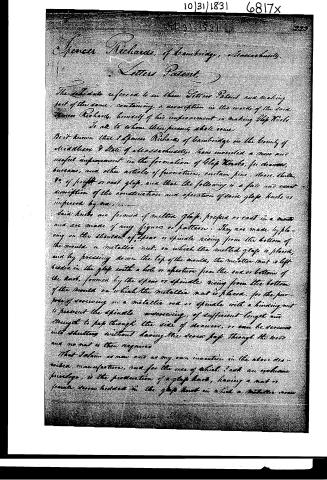
Page 2.
Spencer Richards, of Cambridge, Massachusetts.
Letters Patent.
The schedule referred to in these Letters Patent and making part of the same, containing a description in the words of the said Spencer Richards, himself of his improvement in making Slip Knobs.
So as to whom these presents shall come.
Be it known that I Spencer Richards of Cambridge in the County of Middlesex & State of Massachusetts, have invented a new and useful improvement in the formation of Slip Knobs, for drawers, bureaus, and other articles of furniture, curtain pins, door, thills, &c. of pressed or cast glass, and that the following is a full and exact description of the construction and operation of said glass knobs as improved by me.
Said knobs are formed of melted glass, pressed or cast in a mold and are made of any figure or pattern. They are made by placing in the shoulder of a gear or spindle rising from the bottom of the mold a metallic nut, on which the melted glass is placed, and by pressing down the top of the mold, the metallic nut is left buried in the glass with a hole or aperture from the top or bottom of the knob, formed by the gear or spindle rising from the bottom of the mold on which the metallic nut is placed, for the purpose of screwing in a metallic rod or spindle with a binding nut to prevent the spindle unscrewing, of sufficient length and strength to pass through the side of drawers; or can be screwed into shutters without having the screw pass through the top and no nut is then required.
That I claim as new and as my own invention in the above described manufacture, and for the use of which I ask an exclusive privilege, is the production of a glass knob, having a nut or female screw buried in the glass knob in which a metallic screw
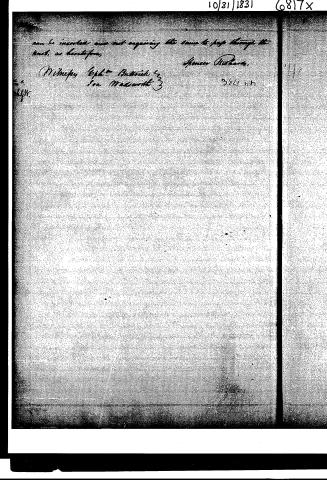
Page 3.
10/31/1831 6817x
can be inserted and not requiring the same to pass through the
hands as heretofore.
Spencer Andrews.
Wilkes, Esq. & Buttrick &
Jno. Matthews
3821 n.b.
11/2
A.W.
Published accounts: journal notice
Notice in the monthly list of patents
Journal of the Franklin Institute, new ser., vol. 9 (1832), p. 242 · View the page
39. For an improvement in Making Glass Knobs; Spencer Richards, Cambridge, Middlesex county, Massachusetts, October 31.
DATAMP: illustration
Illustrations from DATAMP


DATAMP (Directory of American Tool and Machinery Patents), via the Internet Archive · Archived DATAMP page
About this record
- Patentee
- the Journal of the Franklin Institute, Journal
- Date
- the Name and Date index of patents, DATAMP, USPTO records
- Invention
- DATAMP
- Listed in
- the Name and Date index of patents, DATAMP, USPTO records, Jim Shaw's X-patent list, the Journal of the Franklin Institute, Burke's List of Patents (1847)
- The patentee's full name comes from the Franklin Institute's journal.
- The residence comes from the Franklin Institute's journal.
- Burke's 1847 Patent Office list gives the same patent.