

Drawings and documents
National Archives restored drawings: drawing
Garner Wilkinson's Patent Drawing for an Axle Tree

National Archives, Restored Patent Drawings (Record Group 241) · Full-size scan at the National Archives · Catalog record
Show the text on the drawing Hide (182 words)
Words on the drawing as machine-read by the National Archives; not checked. Useful mainly for searching.
250 / 2. / GES & WAGONS. / [31] Axles / 12 / Aall / CLASSIFICATION / II ILA IEA T R LEGA ICE / 6857.7 / Patented 6th 6 the Dec 1831 / DIVISION. / Patent office / Ma de under direction of the / N. / amynouer of / F: / with the ach of 3 March 1837 / G. / HL Sunvorth / Commissioner of patents / Sectional parts. / REFERENCES. / A The three parts, the two Arms making it five. / 11 / THE / B B The Monfuble pieces. C. the receptes, in the upper part, and / G. / D those in the lower 2 part; to receive E. the Arm. F. its square, / or hut part. G. the outside screw. H.H. the double Box; / I. I. the single Box, for the Arm; with K.K. its screw and nut. / 390 / I To Plates, underneath, with their Braceb, Handard, nuts and screws, / to fasher the Aclitres together. M.M. Apertures, to admit oil. / L. / N.N.N.N. Oil wefsels, or tuber. O. plate, or Brace, to prevent / the forew (G) from unserewing; placed on the outside face of the inside / b. Burbon Delt. / of the hub.
USPTO scan
The patent as scanned by the USPTO
-
 Page 1
-
 Page 2
-
 Page 3
-
 Page 4


U.S. Patent and Trademark Office · Google Patents
Show the transcription Hide (938 words)
Machine transcription (LightOnOCR) of the pages as scanned by the USPTO, most of them the handwritten copies made when the records were restored after the 1836 fire. Not checked; it can misread handwriting, so compare it with the scan.
Page 1.
6857x
G. WILKINSON.
Axle-Tree.
Patented Dec. 6, 1831.

Page 2.
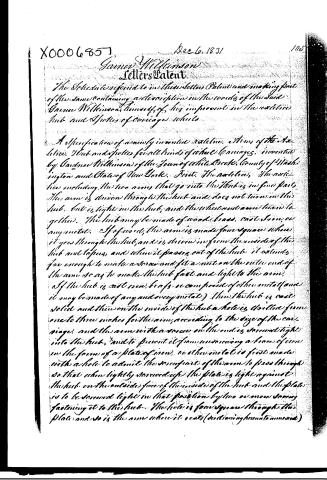
X0006857 Dec 6, 1831 105
Garnet Wilkinson
Letters Patent
The Articles referred to in this Letter Patent and making part of the same containing a description in the words of the said Garnet Wilkinson himself of his improvement in the axletree hub and spokes of carriage wheels.
A Specification of a newly invented axletree. Arms of the Axletree. Hub and spokes for all kinds of wheel carriages. invented by Garnet Wilkinson of the Town of White Plains, County of Washington and State of New York. First. The axletree, the axletree including the two arms that go into the Hub is in five parts. The arm is driven through the hub and does not turn in the hub, but is tight in the hub, and the wheel and arm turn together. The hub may be made of wood, brass, cast iron, or any metal. If of wood, the arm is made four square where it goes through the hub, and is driven in from the inside of the hub and tapers, and when it passes out of the hub it extends far enough to make a screw and fit a nut on the outer end of the arm so as to make the hub fast and tight to the arm. If the hub is cast iron, brass, or composed of other metal (and it may be made of any and every metal) then the hub is cast solid and then on the inside of the hub a hole is drilled from one to three inches for the arm, according to the size of the carriage, and the arm with a screw on the end is screwed tight into the hub, and to prevent it from unscrewing a brace of iron in the form of a plate of iron, or other metal is first made with a hole to admit the screw part of the arm to pass through so that when tightly screwed up the plate is tight against the hub on the outside face of the inside of the hub and the plate is to be screwed tight in that position by two or more screws fastening it to the hub. The hole is four square through the plate and so is the arm where it rests (continuing hereunto annexed)
Page 3.
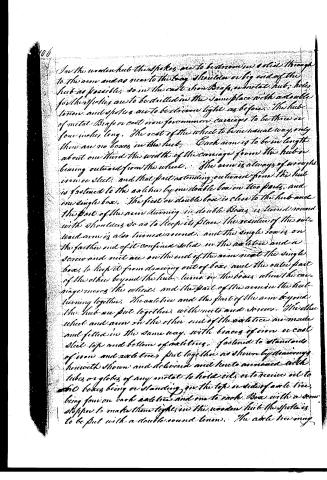
In the wooden hub the spokes are to be driven in solid through to the arm and as near to the box shoulder on big end of the hub as possible; so in the cast iron brass, or metal hub, holes for the spokes are to be drilled in the same place with a double tenon, and spokes are to be driven tight as before. The hub of metal, brass or cast iron for common carriages to be three or four inches long. The rest of the wheel to be in usual way, only there are no boxes in the hub. Each arm is to be in length about one third the width of the carriage from the hub bearing outward from the wheel. The arm is always of wrought iron or steel, and that part extending outward from the hub is fastened to the axle tree by one double box or two parts, and one single box. The first or double box is close to the hub and the part of the arm turning in double boxes is turned round with shoulders so as to keep its place. The remainder of the outward arm is also turned around, and the single box is on the farther end of it confined solid in the axle tree and a screw and nut are on the end of the arm near the single box, to keep it from drawing out of box, and the outer part of the other beyond the hub, turns in the boxes when the carriage moves the wheel, and the part of the arm in the hub turning together. The axle tree and the part of the arm beyond the hub are put together with nuts and screws. The other wheel and arm on the other end of the axle tree are made and fitted in the same way, with braces of iron or cast steel top and bottom of axle trees, fastened to standards of iron and axle trees put together as shown by drawing herewith shown and delivered and here to be named with tubes or globes of any metal to hold oils or to receive oil to six boxes being or standing on the top or sides of axle tree, being four on each axle tree and one to each box with a screw stopper to make them tight in the wooden hub the spoke is to be put with a double round tenon. The axle tree may
Page 4.
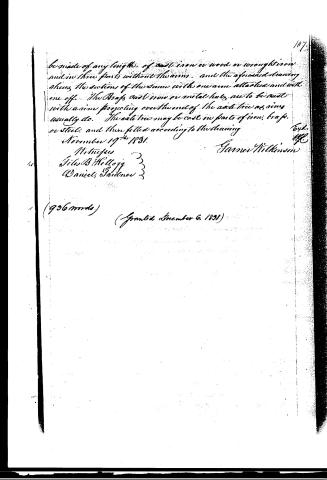
be made of any length, of cast iron or wood or wrought iron and in three parts without the arms, and the aforesaid drawing shows the section of the same with one arm attached and with one off. The brass cast iron or metal hats are to be cast with a rim projecting over the end of the axle tree as rims usually do. The axle tree may be cast in parts of iron, brass, or steel, and then fitted according to the drawing.
November 19th, 1831.
Witnesses
Silas B. Hellogg
Daniel Gardiner
Garnet Wilkinson
(936 mnds)
(Granted December 6, 1831)
Published accounts: journal notice
Notice in the monthly list of patents, with remarks
Journal of the Franklin Institute, new ser., vol. 9 (1832), p. 390 · View the page
2. For Axletrees, Hubs, and Spokes for Carriages; Garner Wilkinson, White Creek, Washington county, New York, December 6.
Remarks. The main object of this patent appears to be the fixing of the axle firmly in the nave or hub of the wheel, with a cylindrical gudgeon, or shaft, projecting out, which is to revolve in metal boxes fixed in that part of the axletree which is attached to the carriage. The apparatus, we are told, may be made of wood, or metal, and the mode of putting it together, in either case, is described; there, however, is no claim made, and as the principal feature is without novelty, we are unable, without further advice, to tell for what the patent is taken.
About this record
- Patentee
- the Journal of the Franklin Institute, Journal
- Date
- the Name and Date index of patents, USPTO records, Jim Shaw's X-patent list
- Invention
- the Name and Date index of patents
- Listed in
- the Name and Date index of patents, USPTO records, Jim Shaw's X-patent list, the Journal of the Franklin Institute, Burke's List of Patents (1847)
- The patentee's full name comes from the Franklin Institute's journal.
- Burke's 1847 Patent Office list gives the same patent.