

Drawings and documents
USPTO scan
The patent as scanned by the USPTO
-
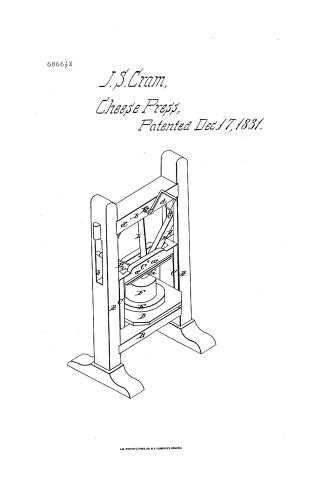 Page 1
-
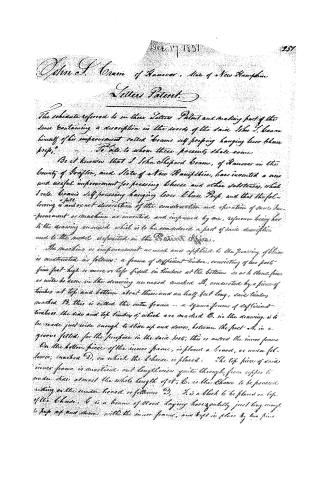 Page 2
-
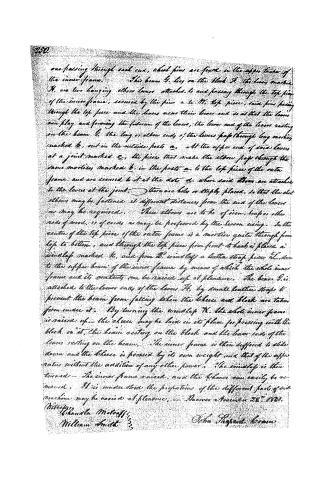 Page 3


U.S. Patent and Trademark Office · Google Patents
Show the transcription Hide (891 words)
Machine transcription (LightOnOCR) of the pages as scanned by the USPTO, most of them the handwritten copies made when the records were restored after the 1836 fire. Not checked; it can misread handwriting, so compare it with the scan.
Page 1.
6866 $\frac{1}{2}$ X
J. S. Cram,
Cheese Press,
Patented Dec. 17, 1831.

A.M. PHOTO-LITHO. CO. N.Y. (OSBORNE'S PROCESS)
Page 2.
Dec. 17, 1831
John S. Beam of Hanover, State of New Hampshire
Letters Patent.
The schedule referred to in these Letters Patent and making part of the same containing a description in the words of the said John S. Beam himself of his improvement called "Beam self-pressing hanging lines beam press." To file to whom these presents shall come.
Be it known that I John Shepard Beam, of Hanover in the County of Grafton, and State of New Hampshire, have invented a new and useful improvement for pressing cheese and other substances, which I call Beam self-pressing hanging lines beam press, and that the following is an exact description of the construction and operation of said improvement or machine as invented and improved by me, reference being had to the drawing annexed which is to be considered a part of said description and to the model deposited in the Patent Office.
The machine or improvement as used and applied to the pressing of cheese is constructed as follows: a frame of sufficient timber, consisting of two posts five feet high or more or less fixed in timbers at the bottom so as to stand firm as will be seen in the drawing annexed marked A, connected by a piece of timber at top and bottom about three and a half feet long, said timbers marked B, this is called the outer frame — a square frame of sufficient timber the side and top timbers of which are marked C, in the drawing, is to be made just wide enough to slide up and down, between the post A, in a groove fitted for the purpose in the said post, this is called the inner frame. On the bottom piece of the inner frame, is placed a board, or under platform, marked D, on which the cheese is placed. The top piece of said inner frame is mortised and tenoned quite through, from top to under side almost the whole length of it, E, is the cheese to be pressed, resting on the under board or platform D. It is a block to be placed on top of the cheese. It is a beam of wood having hoepgally just long enough to pass up and down, with the inner frame, and kept in place by two pins
Page 3.
one passing through each end, which pins are fixed in the upper timber of the inner frame. This beam G, lies on the block H. The levers marked H, are two hanging elbow levers attached to and passing through the top piece of the inner frame, secured by the pins a b M. Top piece, said pins passing through the top piece and the levers near their lower end so as that the levers can play and forming the fulcrum of the levers, the lower end of the levers resting on the beam G. The long or elbow ends of the levers pass through long mortises marked b, cut in the outside posts a. At the upper end of said levers at a joint marked c, the piece that makes the elbow pass through the same mortises marked b, in the posts a, to the top piece of the outer frame, and are secured to it at the dots d, where said levers are attached to the levers at the joint. There are holes or staples placed, so that the slot elbows may be fastened at different distances from the end of the levers as may be required. These elbows are to be of iron, brass or other rods of wood, or of cords as may be preferred by the person using. In the centre of the top piece of the outer frame is a mortise quite through from top to bottom, and through the top piece from front to back is placed a windlass marked K, and from K windlass a leather strap passes L, down to the upper beam of the inner frame by means of which the whole inner frame and its contents can be raised up at pleasure. The beam G is attached to the lower ends of the levers H, by small leather straps to prevent the beam from falling when the cheese and block are taken from under it. By turning the windlass K, the whole inner frame is raised up—the cheese may be laid in its place for pressing with the block on it, the beam resting on the block and the lower ends of the levers resting on the beam. The inner frame is then suffered to slide down and the cheese is pressed by its own weight and that of the apparatus without the addition of any other power. The windlass is then turned—the inner frame raised, and the cheese can easily be removed. It is under these the proportions of the different parts of said machine may be varied at pleasure. — Patented November 28th, 1831.
Witnesses:
Ephraim Metcalf
William Smith
John Shepard, Beam
Published accounts: journal notice
Notice in the monthly list of patents, with remarks
Journal of the Franklin Institute, new ser., vol. 9 (1832), p. 394 · View the page
14. For a Cheese Press; John Crane, Hanover, Grafton county, New Hampshire, December 17.
Remarks. This is called the self-pressing-hanging lever cheese press. It is called self-pressing because the power applied is only the weight of the cheese and that of the apparatus within which it is placed. The construction is ingenious, and the press may undoubtedly be made to operate well. There is a frame similar to that of the ordinary standing press, and a second frame is made which fits between the cheeks of the former, is about half its height, and will readily slide up and down within it. When this inner frame is raised, the two levers which operate in pressing the cheese, approach towards a horizontal position, and when the frame is lowered they are so constructed that they approach to a vertical position, and their shorter ends bear upon a board, or follower, placed above the cheese. An accurate description of it cannot be given without a drawing. There is no claim made, and as the whole arrangement is considered new, and we believe correctly so, it was not necessary to make any.
About this record
- Patentee
- Jim Shaw's X-patent list
- Date
- the Name and Date index of patents, USPTO records
- Invention
- the Name and Date index of patents
- Listed in
- the Name and Date index of patents, USPTO records, Jim Shaw's X-patent list, the Journal of the Franklin Institute, Burke's List of Patents (1847)
- The sources give different dates; the date shown is the one most of them agree on.
- The Franklin Institute's journal confirms the date shown.
- Burke's 1847 Patent Office list gives the same patent.
- Burke's 1847 Patent Office list gives a slightly different date; the date shown follows the standard lists.
- Residence from Burke's 1847 Patent Office list; the standard lists give none.