

Drawings and documents
National Archives restored drawings: drawing
O. Willis' Patent Drawing for a Railway Car Gold Riddle

National Archives, Restored Patent Drawings (Record Group 241) · Full-size scan at the National Archives · Catalog record
Show the text on the drawing Hide (77 words)
Words on the drawing as machine-read by the National Archives; not checked. Useful mainly for searching.
90. ORI / [3] / Washers, / Vol. /2. page 539 / /2- / CLASSIFICATION / 6871- X / DIVISION. / O.WILLIS / Railway Car Gold Riddle / Patented) Dec 21 "/83/2 / a. Frame / b. Inclined plane / C. Carand Riddle / d. Hopper / C Repple / f Refuse or washed grovel / Patent Office April 19th 1842 / Strickland Det / Made under the direction of the the commprious of Paterts / in conformaty with ach of 3 March 1837 / Manya Sumorth / of Paten
USPTO scan
The patent as scanned by the USPTO
-
 Page 1
-
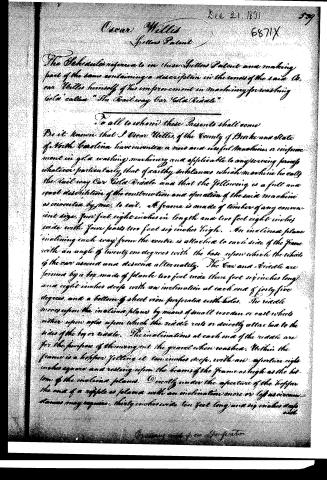 Page 2
-
 Page 3


U.S. Patent and Trademark Office · Google Patents
Show the transcription Hide (542 words)
Machine transcription (LightOnOCR) of the pages as scanned by the USPTO, most of them the handwritten copies made when the records were restored after the 1836 fire. Not checked; it can misread handwriting, so compare it with the scan.
Page 1.
6871X
O. WILLIS.
Ore Washer.
Patented Dec. 21, 1831.
THE NORRIS PETERS CO., PHOTO-LITHO., WASHINGTON, D. C.
Page 2.
Oscar Willis
Letters Patent
The Schedules referred to in these Letters Patent and making part of the same containing a description in the words of the said Oscar Willis himself of his improvement in machinery for washing 'tela' called "The Railway Car Tela Riddle."
To all to whom these Presents shall come
Be it known that I Oscar Willis, of the County of Burke and State of North Carolina have invented a new and useful Machine or improvement in tela washing machinery and applicable to any serving purpose whatever particularly that of earthy substances which machine I call the Railway Car Tela Riddle and that the following is a full and exact description of the construction and operation of the said machine as invented by me to wit. A frame is made of timber of any convenient size, four feet eight inches in length and two feet eight inches wide with four posts two feet six inches high. An inclined plane inclining each way from the centre is attached to each side of the frame with an angle of twenty one degrees with the base upon which the whole of the car ascends and descends alternately. The Car and Riddle are formed by a box made of plank two feet wide three feet six inches long and eight inches deep with an inclination at each end of forty five degrees and a bottom of sheet iron perforated with holes. The riddle moves upon the inclined planes by means of small wooden or cast wheels either upon axle upon which the riddle rests or directly attached to the sides of the box or riddle. The inclinations at each end of the riddle are for the purpose of throwing out the gravel when washed. Within the frame is a hopper getting it ten inches deep, with an aperture eight inches square and resting upon the beams of the frame as high as the bottom of the inclined planes. Directly under the aperture of the hopper the end of a riffle is placed with an inclination more or less as circumstances may require, thirty inches wide ten feet long and six inches deep with
Page 3.
with the riffles three inches deep and six inches apart. The machine is used in the following manner. When the grit or gravel is thrown from a table or platform into the riddle a man places at the end of the frame gives motion to the riddle by pushing it forwards compelling the wheels next to him to ascend the inclined planes and those farther from him to descend upon the other side and vice versa, whereby a peculiar motion is given to the gravel and is thus specially washed by being thrown on in the usual manner. My claim in this invention is entire with the exception of the riffle.
Oscar Willis
Expt. Witnesses
W.H. B. H. Coather
James H. Sale
[2494 000]
Published accounts: journal notice
Notice in the monthly list of patents, with remarks
Journal of the Franklin Institute, new ser., vol. 9 (1832), p. 394 · View the page
15. For Machinery for Washing Gold, called the Rail-wayCar Gold Riddle; Oscar Willis, Burke county, North Carolina, December 21.
Remarks. A riddle is to be prepared consisting of four pieces of timber which form the sides, and a bottom of sheet iron, which is to be perforated with numerous small holes. This riddle runs upon small wheels, the ways upon which they run forming a double inclined plane. When the auriferous gravel, or earthy matter, is thrown into this riddle, it is to be moved backward and forward by hand, one end of the riddle rising, and the other being depressed as it moves in each direction, in consequence of the inclination of the ways. Water is to be supplied which washes the gold, and other matters, through the holes on to a recipient below, whence it is conducted to a sloping trough, or ripple, with slats across it, which detain the gold, whilst the lighter parts wash over. The whole is claimed with the exception of the ripple. The patentee says that experience has proved the great value of this machine; there is nothing in its appearance, however, which would mark a superiority over several others previously in use.
About this record
- Patentee
- the Journal of the Franklin Institute, Journal
- Date
- the Name and Date index of patents, USPTO records, Jim Shaw's X-patent list
- Invention
- the Name and Date index of patents
- Listed in
- the Name and Date index of patents, USPTO records, Jim Shaw's X-patent list, the Journal of the Franklin Institute, Burke's List of Patents (1847)
- The patentee's full name comes from the Franklin Institute's journal.
- Burke's 1847 Patent Office list gives the same patent.