

Drawings and documents
National Archives restored drawings: drawing
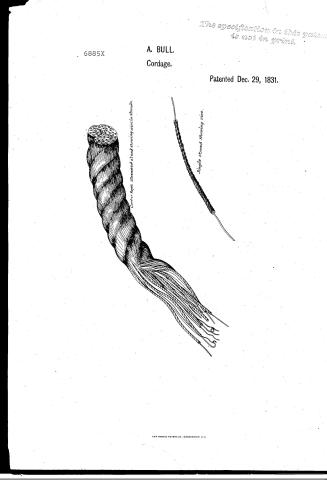
A. Bull's Patent Drawing for Cordage

National Archives, Restored Patent Drawings (Record Group 241) · Full-size scan at the National Archives · Catalog record
Show the text on the drawing Hide (74 words)
Words on the drawing as machine-read by the National Archives; not checked. Useful mainly for searching.
dage. - Ten / Vol. / 28. CORDAGE / Cords & Ropes / CLASSIFICATION / 6885-X / DIVISION. / A.BULL / Patented 29th 29th Dec 1831- / Cordage / cordor Rope Stranded at end showing wire in Strands / tola / Single Strand showing wire / Patent office aug 31 1841 / Made under the direction of the commupious / of Patents in conformety with act of 30 March 1834 / Strickland Del / Mennyh wmoth / Commisioner or Pa
USPTO scan
The patent as scanned by the USPTO
-
 Page 1
-
 Page 2


U.S. Patent and Trademark Office · Google Patents
Show the transcription Hide (243 words)
Machine transcription (LightOnOCR) of the pages as scanned by the USPTO, most of them the handwritten copies made when the records were restored after the 1836 fire. Not checked; it can misread handwriting, so compare it with the scan.
Page 1.
6885X
A. BULL.
Cordage.
Patented Dec. 29, 1831.

THE NORRIS PETERS CO., WASHINGTON, D.C.
Page 2.
Dec. 29, 1831
Aaron Bull, of Caroline State of New York.
Letter Patent.
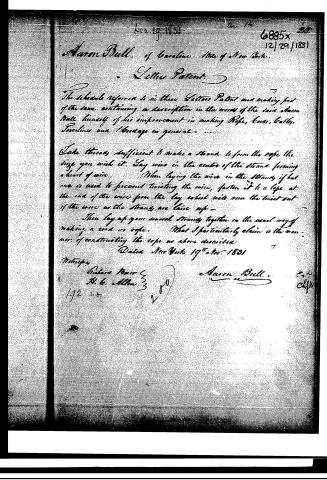
The schedule referred to in these Letters Patent and making part of the same containing a description in the words of the said Aaron Bull himself of his improvement in making Rope, Cords, Cables, Towlines and Cordage in general.
Take threads sufficient to make a Strand to form the rope the size you wish it. Lay wire in the center of the strands forming a heart of wire. When laying the wire in the strands, if but one is used to prevent twisting the wire, fasten it to a loop at the end of the wire from the lay which will run the twist out of the wire as the strands are laid up.
Then lay up your several strands together in the usual way of making a cord or rope. What I particularly claim is the manner of constructing the rope as above described.
Dated New York 19th Dec. 1831
Witnesses:
Richard Brown
H. L. Allen
Aaron Bull
6885x 25
12/29/1831
Published accounts: journal notice
Notice in the monthly list of patents, with remarks
Journal of the Franklin Institute, new ser., vol. 9 (1832), p. 401 · View the page
32. For an improvement in Making Ropes, Cords, Cables, Tow Lines, and Cordage in general; Aaron Bull, Caroline, Tompkins county, New York, December 29.
Remarks. The patentee of this improved rope has gone upon the correct principle that some of the metals are stronger than hemp, but we apprehend that in this instance he has failed in the attempt to apply the principle, or fact, to a useful purpose. He, however, is so brief in the description of his invention, that we can give the whole to our readers and still occupy but little space. Threads sufficient to form a strand are to be taken, and in forming it wire is to be laid in the centre of it so as to form the heart. After the several strands are thus prepared, they are to be laid together in the usual way. We are not told what kind of wire should be employed, and are at a loss to say what will answer the purpose. Iron will rust, gold will be too dear, and most of the metals having but little tenacity, must be counted out. Even copper, the most promising of the family, will break by repeated bendings, and will not yield like the more elastic parts of the strand. We are really apprehensive that if any advantage be derived from this patent it will be confined to the wire drawer, and that the consequent increase of his business will be of but short duration.
About this record
- Patentee
- the Journal of the Franklin Institute, Journal
- Date
- the Name and Date index of patents, USPTO records, Jim Shaw's X-patent list
- Invention
- the Name and Date index of patents
- Listed in
- the Name and Date index of patents, USPTO records, Jim Shaw's X-patent list, the Journal of the Franklin Institute, Burke's List of Patents (1847)
- The patentee's full name comes from the Franklin Institute's journal.
- The residence comes from the Franklin Institute's journal.
- Burke's 1847 Patent Office list gives the same patent.