

Drawings and documents
National Archives restored drawings: drawing
David Stem's Patent Drawing for an Improvement in Mill Stones

National Archives, Restored Patent Drawings (Record Group 241) · Full-size scan at the National Archives · Catalog record
Show the text on the drawing Hide (106 words)
Words on the drawing as machine-read by the National Archives; not checked. Useful mainly for searching.
83. MILLS. / Grinding Mills. / Cylinder and Concave. / o 0 / $2. your / CLASSIFICATION / David Hum / 6887-+ / DIVISION. / Improvement in Mill Itone. / Vol. ir. pg. 465. / Patented Ian 5. 1832. / 1241 / C. / Side-view, / Preferences. a zunner. B bedstone. C spindle ddddde. / furrows. ee timbers to hold the bedstone. f lever X Screw. / g flywheel h.wallower . i mortive with a rattle staff. K rulley / l strap.m.shoe n. spring. / Patent office Deary. / made under the direction of the Commiforoner of Patents / in conformity with act.of 30 march / Face of the bedstone. / ch. L.Steinhmann Jel: / Sommiforer of Patents
USPTO scan
The patent as scanned by the USPTO
-
 Page 1
-
 Page 2
-
 Page 3


U.S. Patent and Trademark Office · Google Patents
Show the transcription Hide (643 words)
Machine transcription (LightOnOCR) of the pages as scanned by the USPTO, most of them the handwritten copies made when the records were restored after the 1836 fire. Not checked; it can misread handwriting, so compare it with the scan.
Page 1.
No Printed Specification Available
6887X
D. STEM.
Dressing Millstones.
Patented Jan. 5, 1832.

THE MORRIS PETERS CO., PHOTO-LITHO., WASHINGTON, D.C.
Page 2.
6887X Jan. 5, 1832 465
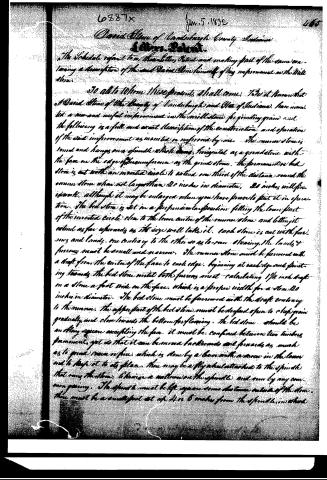
David Elton of Washington County, Indiana
Letters Patent.
The Schedule refers to our Letters Patent and making part of the same containing a description of the said David Elton himself of his improvement in the Mill Stone.
To all to whom these presents shall come: We it known that David Elton of the County of Washington and State of Indiana, have invented a new and useful improvement in the millstone for grinding grain and the following is a full and exact description of the construction and operation of the said improvement as invented or improved by me. The runner stone is round and hangs on a spindle which turns horizontal as a grindstone with the face on the edge of the runner stone as the grindstone. The permanent bed stone is cut with an inverted circle to extend one third of the distance round the runner stone when not larger than 20 inches in diameter. 20 inches will suffice, although it may be enlarged when you have power to put it in operation. The bed stone is set in a perpendicular position filling the lower part of the inverted circle close to the lower centre of the runner stone and letting it extend as far upwards as its size will take it. Each stone is cut with furrows and lands one contrary to the other so as to run slurring. The lands & furrows must be small and narrow. The runner stone must be furrowed with a draft from the centre of the face to each edge, beginning at each edge and pointing towards the bed stone until both furrows meet—calculating 1 1/4 inch draft on a stone a foot wide on the face, which is a proper width for a stone 20 inches in diameter. The bed stone must be furrowed with the draft contrary to the runner. The upper part of the bed stone must be deepened open to keep grain gradually and close towards the bottom for flavoring. The bed stone should be an alloy of iron excepting the face. It must be confined between two timbers permanent, yet so that it can be moved backwards and forwards as much as to grind corn in fine, which is done by a beam with a screw in the lower end to keep it to its place. There may be a fly wheel attached to the spindle that runs the stone, likewise a mullion on the spindle and run by any common gearing. The spindle must be left open some distance outside of the stone. There must be a small foot set at 4 or 5 inches from the spindle, in which
Page 3.
Jan 5, 1832
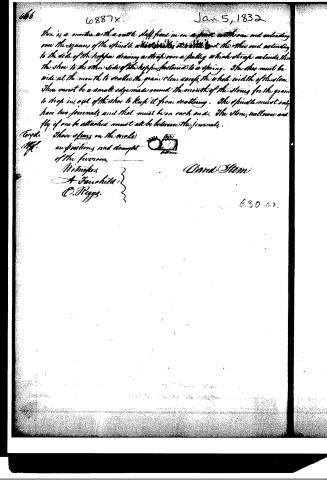
There is a mortar with a small staff fixed in on a point with one end extending over the square of the spindle which rotates it, and the other end extending to the side of the hopper drawing a strap over a pulley which strap extends from the shoe to the other side of the hopper, fastened to a spring. The shoe must be wide at the mouth to scatter the grain clean across the whole width of the stone. There must be a small edge made round the mouth of the stone for the grain to drop in, out of the shoe to keep it from scattering. The spindle must only have two journals and that must be on each end. The stone, wallower, and fly if one be attached, must all be between the journals.
[Diagram]
David Stann
630.00.
Published accounts: journal notice
Notice in the monthly list of patents, with remarks
Journal of the Franklin Institute, new ser., vol. 10 (1832), p. 29 · View the page
2. For an improvement in the Mill Stone for grinding grain; David Stem, Mechanicsville, Vanderburgh county, Indiana, January 5.
Remarks. This grist mill is to act upon the well known principle of many paint mills. The runner is to be a cylinder, revolving horizontally, and the bed stone a hollow segment in which it fits, the stones being furrowed in a suitable manner. The bed stone is to be borne up against the cylinder laterally, and the feeding regulated by their greater or less distance apart. There is no claim made, nor is there much room for one.
About this record
- Patentee
- DATAMP
- Date
- the Name and Date index of patents, DATAMP, USPTO records
- Invention
- DATAMP
- Listed in
- the Name and Date index of patents, DATAMP, USPTO records, Jim Shaw's X-patent list, the Journal of the Franklin Institute