

Drawings and documents
National Archives restored drawings: drawing
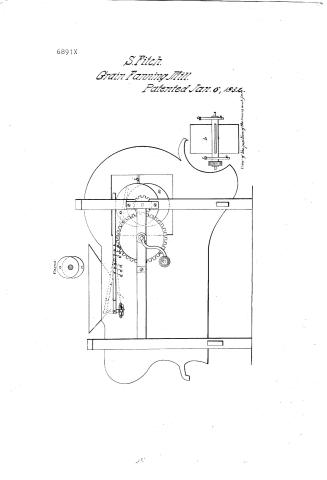
Samuel Fitch's Patent Drawing for a Fanning Mill

National Archives, Restored Patent Drawings (Record Group 241) · Full-size scan at the National Archives · Catalog record
Show the text on the drawing Hide (99 words)
Words on the drawing as machine-read by the National Archives; not checked. Useful mainly for searching.
130. THRASHING. / Grain Separators. / B. Shaking Screens. / owers. / $2 / Lamuel Fitch / CLASSIFICATION / 6891- X / Fanning Mill / Vol.th pg 353. / DIVISION. / Patented Ian. 6 1832. / view of the position of the cams and fan. / Cams. / Preferences. / a a flat circular / pieces of metal, cams. / b the fan / CC the levers. / dddd holes in the levers. / ee strap. / fthe shoe. / g.g / Patent affic Dear 7.1841 H / made under the direction of the Commipion / of Patents inconformity with acrof 1857 st. mareh / h. L. Slintemann s. / M with / Commiformer of Patents.
USPTO scan
The patent as scanned by the USPTO
-
 Page 1
-
 Page 2
-
 Page 3
-
 Page 4


U.S. Patent and Trademark Office · Google Patents
Show the transcription Hide (916 words)
Machine transcription (LightOnOCR) of the pages as scanned by the USPTO, most of them the handwritten copies made when the records were restored after the 1836 fire. Not checked; it can misread handwriting, so compare it with the scan.
Page 1.
6891X
S. Fitch.
Grain Fanning Mill.
Patented Jan. 6, 1834.
View of the position of the cam and fan.

Page 2.
May 26, 1852
Thomas French, Athens, O.U.
Sutton Patent.
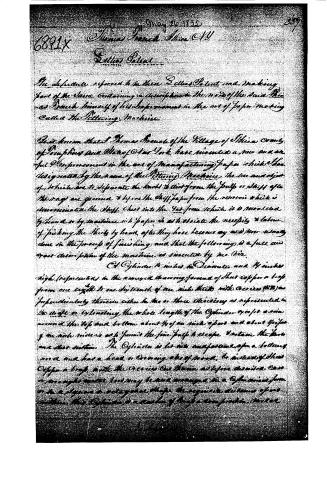
The defendant referred to in these Suttons Patent and making part of the same containing a description in the words of the said Thomas French himself of his improvement in the art of paper making called the Pitting Machine.
Be it known that Thomas French of the Village of Athens County of Oneida and State of New York, have invented a new and useful Improvement in the art of manufacturing paper which has designated by the name of the Pitting Machine, the use and object of which are to separate the bonds & dust from the pulp or stuff after the same are ground & by one the stuff paper from the residue which is denominated the stuff chest into the vat from which is produced by hand or by machine with paper, so as to obviate the necessity & labor of picking the fibers by hand after they have become dry and now usually done in the process of finishing, and that the following is a full and exact description of the machine as invented by me (her).
A Cylinder 10 inches in Diameter and 14 inches high (represented in the annexed drawing) formed of that copper or brass from one eighth to one sixteenth of an inch thick with grooves (as in) as particularly therein either in two or three divisions as represented in the same or extending the whole length of the Cylinder except a ring around the top and bottom about ½ of an inch apart and about ½ of an inch wide so to form the fine pulp to escape & retain the fine and dust within. The Cylinder is let into and fastened upon a hollow iron rod and has a head or covering also of brass, to instead of the Copper or brass, with the grooves as therein as before described, cast or wrought metal and may be used arranged in a cylindrical form or in a square or octagonal shape, the required distance of parts within this Cylinder is a matter of large consideration.
J. L. Sutton
Page 3.
6891X
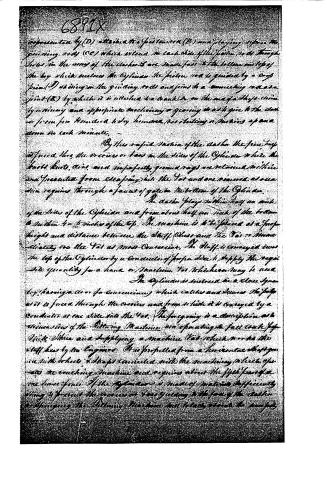
represented by (D) attached to a piston rod (B) and playing upon the guiding rods (C) which extend in each side of the piston rods through holes in the ends of the dashers and are made fast to the bottom and top of the box which encloses the Cylinder. The piston rod is guided by a cross piece (F) sliding on the guiding rods and joins to a connecting rod at a joint (K) by which it is attached to a crank A on the end of a shaft driven by ordinary and appropriate machinery or gearing so as to give to the dasher from few hundred to by hundred per minute, according to the speed of the dasher in each minute.
By this rapid motion of the dasher the fine body is forced into the crevices or holes in the sides of the Cylinder where the knots, knots, dirt, and imperfectly ground rags are retained within and prevented from escaping into the Vat and one removed at once when required through a faucet of gate in the bottom of the Cylinder.
The dasher plays within half an inch of the sides of the Cylinder and from about half an inch of the bottom to within 4 or 5 inches of the top. The machine is to be placed at a proper height and distance between the shaft chest and the Vat or more directly over the Vat as most convenient. The shaft is conveyed over the top of the Cylinder by a conductor of proper size to supply the required quantity for a hand or machine Vat which can may be used.
The Cylinder is enclosed with close space by having a cover for convenience which catches and secures the pulp as it is forced through the crevices and from which it is conveyed by a conductor at one side into the Vat. The foregoing is a description of the dimensions of the Filtering Machine. In operating the fast work for Mille Stine and supplying a machine Vat which works the shaft best by the Engine. It is propelled from a horizontal shaft gear with wheel & shafts connected with the machinery which operates the crushing machine and requires about the fifth part of a one horse power. If the Cylinder is made of material sufficiently strong to protect the crevices at your getting to the face of the dasher and giving the Filtering Machine and being about to supply
Page 4.
6841X
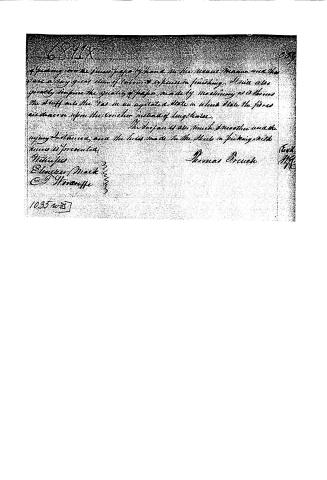
of feeding on the green paper by hand. The issue means and the
have a very great deal of labor & expense in finishing. It will also
greatly improve the quality of paper made by machinery as it throws
the stuff into the vat in an agitated state in which state the fibres
are drawn upon the surface instead of lumping.
The surface is also much smoother and the
wiring is retained, and the lines made in the sheet in picking with
hairs is prevented.
Thomas Druce
Witnesses
Elmer Mack 2
C. J. Wroth 3
1035 w 25
384
119
Published accounts: journal notice
Notice in the monthly list of patents, with remarks
Journal of the Franklin Institute, new ser., vol. 10 (1832), p. 29 · View the page
3. For an improvement in the Fanning Mill; Samuel Fitch, Otsego county, New York, January 6.
Remarks. The improvement here offered consists in putting an eccentric wheel upon each end of the shaft of the revolving fan, which wheels act upon levers, giving motion to the shoe, "which motion is necessary to the cleaning of grain." No more.
About this record
- Patentee
- DATAMP
- Date
- the Name and Date index of patents, DATAMP, USPTO records
- Invention
- DATAMP
- Listed in
- the Name and Date index of patents, DATAMP, USPTO records, Jim Shaw's X-patent list, the Journal of the Franklin Institute, Burke's List of Patents (1847)
- Burke's 1847 Patent Office list gives the same patent.