

Drawings and documents
National Archives restored drawings: drawing
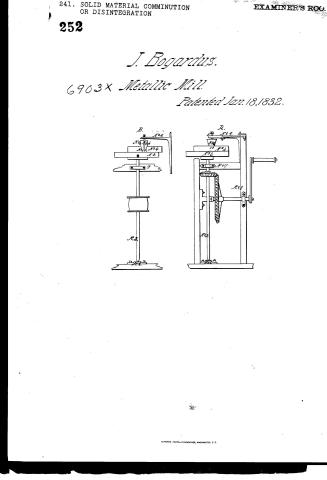
James Bogardus' Patent Drawing for a Universal Mill

National Archives, Restored Patent Drawings (Record Group 241) · Full-size scan at the National Archives · Catalog record
Show the text on the drawing Hide (39 words)
Words on the drawing as machine-read by the National Archives; not checked. Useful mainly for searching.
83. MILLS. / Grinding Mills. / ruprised movement / to / Compound Movement. / CLASSIFICATION / James Bogardus / 6903.x 3.X / Patented 18th Jan. 1832 / Universal Mills / DIVISION. / V3 / my / 11111 / they / curtua
USPTO scan
The patent as scanned by the USPTO
-
 Page 1
-
 Page 2
-
 Page 3
-
 Page 4


U.S. Patent and Trademark Office · Google Patents
Show the transcription Hide (768 words)
Machine transcription (LightOnOCR) of the pages as scanned by the USPTO, most of them the handwritten copies made when the records were restored after the 1836 fire. Not checked; it can misread handwriting, so compare it with the scan.
Page 1.
241. SOLID MATERIAL COMMUNITION
OR DISINTEGRATION
252
J. Bogardus.
6903X Metallic Mill.
Patented Jan. 18, 1832.

Page 2.
6903x Jan 18, 1832
James Bogardus
Letters Patent (Patent Jan. 18, 1832)
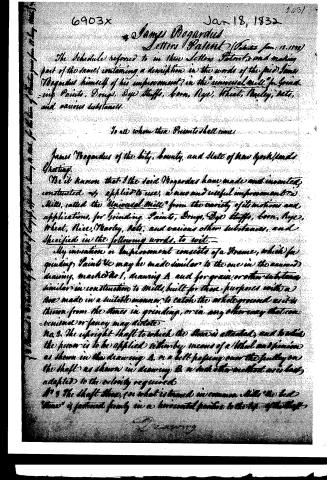
The Schedule referred to in these Letters Patent, and making part of the same, containing a description in the words of the said James Bogardus himself of his improvement in the universal mill for grinding Paints, Drugs, Dye Stuffs, Corn, Rye, Wheat, Barley, Oats, and various substances.
To all whom these Presents shall come
James Bogardus of the City, County, and State of New York, sends Greeting.
Be it known that I the said Bogardus have made and invented, constructed & applied to use, a new and useful improvement in Mills, called the "Universal Mill" from the variety of its motions and applications, for grinding Paints, Drugs, Dye Stuffs, Corn, Rye, Wheat, Rice, Barley, Oats, and various other substances, and specified in the following words, to wit:—
My invention or improvement consists of a Stone, which for grinding Paints &c may be made similar to the one in the annexed drawing, marked No 1, drawing A and for grain or other substances similar in construction to mills built for those purposes with a Stone made in a suitable manner to catch the whole ground as it is thrown from the Stones in grinding, or in any other way that convenience or fancy may dictate.
No 2. The upright Shaft to which the Stone is attached, and to which the power is to be applied either by means of a Wheel and pinion as shown in the drawing A, or a belt passing over the pulley on the Shaft as shown in drawing B or such other method as is best adapted to the velocity required.
No 3. The Shaft Stone, (or what is termed in common Mills the bed Stone) is fastened firmly in a horizontal position to the top of the Shaft.
J. Bogardus
Page 3.
6903x Jan 18, 1832
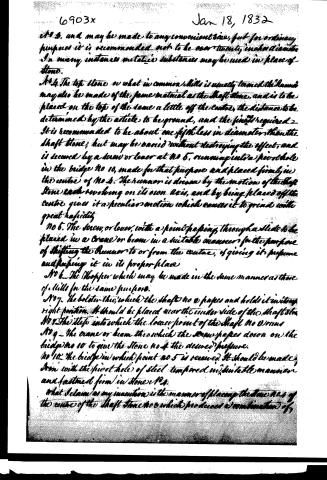
No 3. and may be made to any convenient size, but for ordinary purposes it is recommended not to be over twenty inches in diameter. In many instances metallic substances may be used in place of stone.
No 4. The top stone or what in common mills is usually termed the Runner may also be made of the same material as the shaft stone, and is to be placed on the top of the same a little off the centre, the distance to be determined by the article to be ground, and the finest required. It is recommended to be about one fifth less in diameter than the shaft stone, but may be varied without destroying the effect, and is secured by a screw or lever at No 5, running into a pivot hole in the bridge No 10, made for that purpose and placed firmly in the centre of No 4. The runner is driven by the motion of the shaft stone each revolving on its own axis, and by being placed off the centre gives it a peculiar motion which causes it to grind with great rapidity.
No 5. The screw, or lever, with a point passing through a slide to be placed in a crane or beam in a suitable manner for the purpose of shifting the Runner to or from the centre, of giving it pressure and keeping it in its proper place.
No 6. The thresher which may be made in the same manner as those of mills for the same purpose.
No 7. The bolster thim, which the shaft No 3 passes and holds it in its right position. It should be placed near the underside of the shaft stone.
No 8. The step into which the lower point of the shaft No 3 runs.
No 9. The crane or beam through which the screw passes down on the bridge No 10 to give the stone No 4 the desired pressure.
No 10. The bridge in which point No 5 is received. It should be made of iron with the pivot hole of steel tempered in suitable manner and fastened firm in stone No 4.
What I claim as my invention is the manner of placing the stone No 4 off the centre of the shaft stone No 3 which produces a combination of
Page 4.
6903x
Jan 18, 1832
of motions that I believe to be hitherto unknown and cannot be easily described.
New York December 7th 1831
James Bogardus
Witnesses
Johns McLean
N. Griffing
Exds. N.Y.C.
710 wds
Published accounts: journal notice
Notice in the monthly list of patents, with remarks
Journal of the Franklin Institute, new ser., vol. 10 (1832), p. 34 · View the page
17. For a Universal Mill, for grinding paints, drugs, dye stuffs, corn, rye, wheat, barley, oats, and various other substances; James Bogardus, city of New York, January 18.
Remarks. In this mill, both the stones are made to revolve, but the upper one receives its motion from that of the lower, in a way to be presently described. The lower stone is fixed firmly upon a vertical shaft which is made to revolve by the application of any suitable power, and with any required speed. The upper stone is made smaller than the lower, say one-fifth less in diameter, and it is placed so as not to be concentric with it; it may, for example, be so situated that the peripheries of the two stones will coincide on one side, whilst on the opposite side one-fifth of the diameter of the lower stone will be exposed. The upper stone is kept in its place and its pressure regulated by means of a screw passing through a beam above it, the point of which bears upon a bridge piece in the middle of the eye. It will be at once evident that the revolution of the lower stone will give a slower and peculiar revolution to the upper. A hopper is to rise above the eye of the upper stone, and other requisite appendages are employed. The claim is to "the manner of placing the upper stone off the centre of the shaft of the lower stone." Metal, it is mentioned, may, in some cases, be employed instead of the stones for grinding.
About this record
- Patentee
- DATAMP
- Date
- the Name and Date index of patents, DATAMP, USPTO records
- Invention
- DATAMP
- Listed in
- the Name and Date index of patents, DATAMP, USPTO records, Jim Shaw's X-patent list, the Journal of the Franklin Institute, Burke's List of Patents (1847)
- Burke's 1847 Patent Office list gives the same patent.