

Drawings and documents
USPTO scan
The patent as scanned by the USPTO
-
 Page 1
-
 Page 2
-
 Page 3
-
 Page 4
-
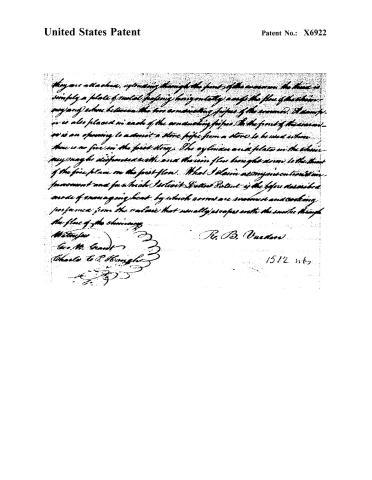 Page 5


U.S. Patent and Trademark Office · Google Patents
Show the transcription Hide (1,528 words)
Machine transcription (LightOnOCR) of the pages as scanned by the USPTO, most of them the handwritten copies made when the records were restored after the 1836 fire. Not checked; it can misread handwriting, so compare it with the scan.
Page 2.
United States Patent
Patent No.: X6922
Robert B. Gardner.
Letters Patent
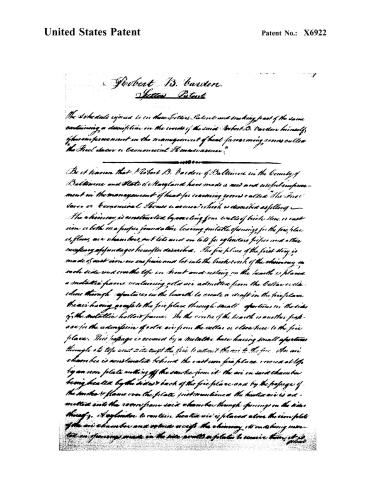
The schedule referred to in these Letters Patent and making part of the same containing a description in the words of the said Robert B. Gardner himself, of his improvement in the management of heat for warming rooms called "The Fuel saver or Economical House warmer."
Be it known that Robert B. Gardner of Baltimore in the County of Baltimore and State of Maryland have made a new and useful improvement in the management of heat for warming rooms called "The Fuel saver or Economical House warmer" which is described as follows —
The chimney is constructed by erecting four walls of brick, stone or cast iron or both on a proper foundation leaving suitable openings for the fire, flue or flues, air chambers, outlets and inlets for ventilators, pipes and other necessary appendages hereafter described. The fire place of the first story is made of cast iron or one piece and let into the brick work of the chimney on each side and over the top in front and resting on the hearth is placed a metallic frame containing extra air admission from the cellar or elsewhere through apertures in the hearth to create a draft in the fireplace the air having access to the fire place through small apertures in the sides of the metallic hollow frame. In the centre of the hearth is another passage for the admission of extra air from the cellar or elsewhere to the fire place. This passage is covered by a metallic base having small apertures through its top and side to let the fire to admit the air to the fire. The air chamber is constructed behind the cast iron fire place covered at top by an iron plate cutting off the smoke from it. The air in said chamber being heated by the sides and back of the fire place and by the passage of the smoke and flame over the plate just mentioned the heated air is admitted into the room from said chamber through openings on the side thereof. A cylinder to contain heated air is placed above the iron plate of the air chamber and opens except the chimney, its end being mounted in openings made in the side walls or plates to receive them, etc.
Page 3.
United States Patent
Patent No.: X6922
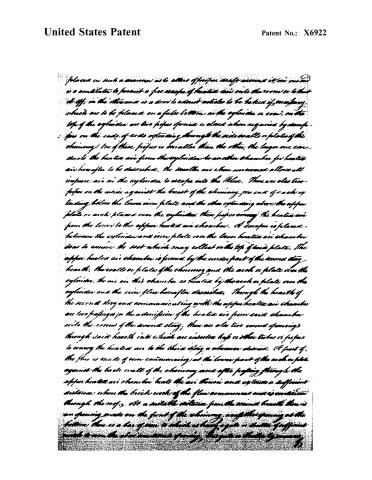
placed in such a manner as to allow of proper drafts around it, in one end is a ventilator to permit a free escape of heated air into the room or to shut it off, in the other end is a door to admit articles to be baked if necessary, which are to be placed on a false bottom in the cylinder or oven. On the top of the cylinder are two pipes joined or closed when required by stopcocks on the ends of rods extending through the side walls or plates of the chimney. One of these pipes is smaller than the other, the larger one conducts the heated air from the cylinder to another chamber for heated air hereafter to be described, the smaller one when unopened allows all impure air in the cylinder to escape into the flue. There are also two pipes on the inside against the breast of the chimney, one end of each extending below the lower iron plate and the other extending above the upper plate or arch placed over the cylinder. These pipes convey the heated air from the lower to the upper heated air chamber. A scraper is placed between the cylinder and iron plate over the lower heated air chamber so as to remove the soot which may collect on the top of said plate. The upper heated air chamber is formed by the under part of the second story heath, the walls or plates of the chimney and the arch or plate over the cylinder. The air in this chamber is heated by the arch or plate over the cylinder and the iron flue hereafter described. Through the heath of the second story and communicating with the upper heated air chamber are two passages for the admission of the heated air from said chamber into the rooms of the second story, there are also two round openings through said heath into which are inserted long or other tubes or pipes to convey the heated air to the third story or wherever desired. A part of the flue is made of iron commencing at the lower part of the arch or plate against the back wall of the chimney and after passing through the upper heated air chamber heats the air therein and extends a sufficient distance where the brick work of the flue commences and is continued through the roof, at a suitable distance from the second heath there is an opening made on the front of the chimney, except the opening at the bottom there is a bar of iron to which is hinged a gate or shutter of sufficient width to cover the above mentioned opening, this gate is thatched by means
Page 4.
United States Patent
Patent No.: X6922
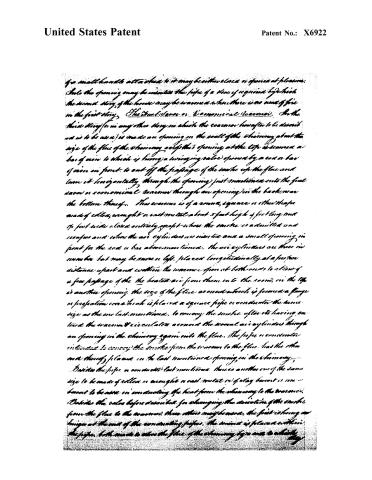
for small handle attached to it may be either closed or opened at pleasure. Into the opening may be inserted the pipe of a stove or regina by which the second story of the house may be warmed when there is no need of fire in the first story. The Stove (or or Economical Warmer). In the third story (or in any other story in which the warmer hereafter to be described is to be used) is made an opening in the wall of the chimney about the size of the flue of the chimney and to this opening at the top is secured a box of iron to which is hinged a swinging valve opened by a rod or bar of iron in front to cut off the passage of the smoke up the flue and turn it horizontally through the opening just mentioned into the first room or economical warmer through an opening in the back, near the bottom thereof. This warmer is of a round, square or other shape made of iron, wrought or cast metal about 5 feet high & feet long, and its feet wide closed entirely except where the smoke is admitted and escapes and where the air cylinders are inserted and a small opening in front for the rod or bar above mentioned. The air cylinders are three in number but may be more or less, placed longitudinally at a proper distance apart and within the warmer open at both ends to allow of a free passage of the heated air from them into the room, in the top is another opening, the size of the flue around which is formed a flange or projection over which is placed a square pipe or conductor the same size as the one last mentioned, to convey the smoke after its having entered the warmer & circulated around the several air cylinders through an opening in the chimney again into the flue. The pipe or conductor intended to convey the smoke from the warmer to the flue has the other end thereof placed in the last mentioned opening in the chimney. Besides the pipe or conductor last mentioned there is another one of the same size to be made of iron or wrought or cast metal or of clay burnt or unburnt to be used in conducting the heat from the chimney to the warmer. Besides the valve before described for changing the direction of the smoke from the flue to the warmer, there others may be used, the first is hung on hinges at the end of the conducting pipes. The second is placed within the pipe, both meant to enter the flue of the chimney by means to which
Page 5.
United States Patent
Patent No.: X6922
they are all a sheet, extending through the front of the chimney, the sheet is simply a plate of metal passing horizontally across the flow of the chimney, may any where between the two ascending pipes of the chimney. It is also placed in each of the ascending pipes. At the front of the chimney is an opening to admit a stone pipe from a stove to be used where there is no fire in the first story. The cylinders and plates in the chimney may be disposed with and the main flow brought down to the front of the fireplace on the first floor. What I claim as my invention is the above described arrangement and for which I obtain Patent is the above described mode of managing heat by which rooms are warmed and cooling preserved from the coldest that usually escapes with the smoke through the flow of the chimney.
Witnesses
Geo. W. Grant
Charles E. P. Strong
R. B. Vucelov
1512 n.b.
Published accounts: journal notice
Notice in the monthly list of patents, with remarks
Journal of the Franklin Institute, new ser., vol. 10 (1832), p. 83 · View the page
3. For an improvement in the mode of managing heat for warming rooms, called the Fuel Saver and Economical House Warmer; Robert B. Varden, city of Baltimore, February 6.
Remarks. There are so many things in the plan here described which have been heretofore applied, and some of them patented, that we cannot tell precisely what is intended to be claimed as new, the patentee having presented the whole, and then informed us that what he claims "is the before described mode of managing heat, by which rooms are warmed, and cooking performed from the caloric that usually escapes with the smoke through the flue of the chimney." The fire place is to be of cast iron, made in one piece, and set into the brick work so as to leave a hollow space behind the back and jambs. Into this hollow space air is to be admitted from the cellar, or from out of doors, whence, being heated by the fire, it is to pass through proper openings into the room. Above the fire place a hollow cylinder of iron is to cross the flue: cold air is to be admitted into this also, and in like manner, when warmed, is to escape into the room. Brass or other tubes are likewise to conduct heated air from chambers under the hearth, and into a room above. The apparatus denominated the economical warmer operates in the manner of the drum attached to stove pipes, and is to be fixed in an upper apartment, against the flue of the chimney. When it is used, a damper is made to close the flue, and cause the smoke and heated air to pass into, and through the warmer, which may be made of sheet metal, in any form, having cross tubes opening into the room to expose a larger surface to the heating process. A damper in the flue, or in the pipe above it, which returns into the chimney, serves to regulate the draft. Besides the opening from the cellar admitting air behind the jambs, &c. there is another through the middle of the hearth, to supply a draft to the fire. Several appendages which we have not noticed are mentioned and figured; but the general plan has been described, and we leave it to those who have given attention to the different apparatus which have been devised for economising heat, to discover what there is of novelty in the principle, or in the arrangement of the foregoing invention.
About this record
- Patentee
- DATAMP
- Date
- the Name and Date index of patents, DATAMP, USPTO records
- Invention
- DATAMP
- Listed in
- the Name and Date index of patents, DATAMP, USPTO records, Jim Shaw's X-patent list, the Journal of the Franklin Institute, Burke's List of Patents (1847)
- Burke's 1847 Patent Office list gives the same patent.